New Editor on the block…

By Jana Vamosi How’s it going, eh? Yeah, that’s right. A Canadian has infiltrated the ranks as a new Senior Editor. I will be joining the esteemed Rob Freckleton and Bob O’Hara in directing manuscripts and developing the journal. My first challenge will be to master some of these modern communication tools, namely this “social media” fad I keep hearing so much about. A flash … Continue reading New Editor on the block…

Issue 5.6

Issue 5.6 is now available online, containing articles on Spatio-temporal methods, lightscapes, stable isotopes, foodwebs, tree-based methods, modelling biomass change and occupancy models. This issue includes the applications paper Fitting occupancy models with E-SURGE: hidden Markov modelling of presence–absence data, and 2 open access articles on improving species distribution models: the value of data on abundance and mapping artificial lightscapes for ecological studies. About the … Continue reading Issue 5.6

Issue 5.5

Issue 5.5 is now online! This months issue includes articles on species distribution models, detection and diversity, and movement and modelling. We have 2 open access papers on calculating second derivatives of population growth rates for ecology and evolution by Esther Shyu and Hal Caswell, and understanding co-occurrence by modelling species simultaneously with a Joint Species Distribution Model (JSDM) by Laura Pollock et al. Mick … Continue reading Issue 5.5

Notre Dame study reveals that particle size matters for environmental DNA monitoring

Common carp
Common carp

University of Notre Dame scientists have now published the first detailed investigation of just how small (or big) environmental DNA, or eDNA, particles really are, and their results provide important guidance for all eDNA monitoring programs.

Like investigators combing a crime scene for DNA traces from suspects or victims, ecologists now apply similar genetic tests to search the environment for important species. These traces of animal or plant DNA in water, soil and air are called environmental DNA. Aquatic eDNA monitoring is emerging as a powerful way to detect harmful species like invasive Asian carp and Burmese pythons or beneficial species like Chinook salmon and Idaho giant salamander. Because this tool is new, little is known about these tiny DNA-containing bits and how to best capture them from water.

Using common carp, one of the 30 worst invasive species worldwide, the researchers found eDNA in particles ranging from smaller than a mitochondrion to larger than a grain of table salt. Most of the eDNA was in particles between 1 and 10 micrometers, about the same diameter as a single strand of spider silk. Continue reading “Notre Dame study reveals that particle size matters for environmental DNA monitoring”

UV-radiation data to help ecological research

Here’s a press release on a recent Methods paper, glUV: a global UV-B radiation data set for macroecological studies, taken from Helmholz – Centre for Environmental Research – UFZ:

Researchers at the Helmholtz Centre for Environmental Research (UFZ) have processed existing data on global UV-B radiation in such a way that scientists can use them to find answers to many ecological questions. According to the paper published in Methods in Ecology and Evolution, an online journal of the British Ecological Society, this data set allows drawing new conclusions about the global distribution of animal and plant species.

fig 2
Average intensity of global UV-B radiation – mean UV-B of highest month. (Tomáš Václavík/UFZ)
fig 1
Average intensity of global UV-B radiation – mean UV-B of lowest month. (Tomáš Václavík/UFZ)

Many research projects study the effects of temperature and precipitation on the global distribution of plant and animal species. However, an important component of climate research, the UV-B radiation, is often neglected. The landscape ecologists from UFZ in collaboration with their colleagues from the Universities in Olomouc (Czechia), Halle and Lüneburg have processed UV-B data from the U.S. NASA space agency in such a way that they can be used to study the influence of UV-B radiation on organisms.

The basic input data were provided by a NASA satellite that regularly, since 2004, orbits the Earth at an altitude of 705 kilometres and takes daily measurements of the UV-B radiation. “For us, however, not daily but the long-term radiation values are crucial, as these are relevant for organisms”, says the UFZ researcher Michael Beckmann, the lead author of the study. The researchers therefore derived six variables from the UV-B radiation data. These include annual average, seasonality, as well as months and quarters with the highest or lowest radiation intensity.

In order to process the enormous NASA data set, the UFZ researchers developed a Continue reading “UV-radiation data to help ecological research”

Issue 5.4

Issue 5.4 is now online! Included are 2 freely available application articles: PopGenReport: simplifying basic population genetic analyses in R, by Aaron T. Adamack and Bernd Gruber, and RangeShifter: a platform for modelling spatial eco-evolutionary dynamics and species’ responses to environmental changes by Greta Bocedi et al. There is also an open access article: Measuring telomere length and telomere dynamics in evolutionary biology and ecology, … Continue reading Issue 5.4

2013 Robert May Prize Winner

The Robert May Prize is awarded annually for the best paper published in Methods by a young author at the start of their research career. We’re delighted to announce that the 2013 winner is Will Pearse, for his Application article “phyloGenerator: an automated phylogeny generation tool for ecologists”. Although ecologists frequently want to make use of phylogenies, they often lack the skills to create detailed … Continue reading 2013 Robert May Prize Winner

Issue 5.3

Issue 5.3 is now online, including research on stable isotopes, distribution modelling, agriculture, habitat monitoring and surveys. There is a freely available Application article, Geographic assignment with stable isotopes in IsoMAP, by Gabe Bowen et al., and an open access article, Predicting local and non-local effects of resources on animal space use using a mechanistic step selection model, by Jonathan Potts et al. About the cover: Vegetation … Continue reading Issue 5.3

Enhanced articles (HTML)

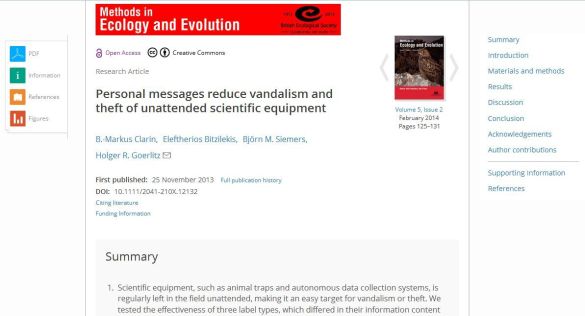
Wiley have just launched the Anywhere Article, which is an enhanced version of the HTML article. It allows readers to view an article on any device – whether at a desktop, or on the move with a tablet or smart phone, and it includes a host of useful new features.

Anywhere article example

Here are a few of the features that an Anywhere Article offers:
o Superfluous information is kept tucked away under a hyperlink, which you can click on for further information if you choose e.g. an author’s contact information and links to any of their previous publications stored on Wiley Online Library.
o There’s a panel on the left-hand side of the screen where you can view the article information, the reference list, download a PDF, and open the interactive figure viewer.
o There’s a menu on the right-hand side of the screen that lets you skip between sections.
o If you click on a reference within the article, the full details will pop-up in the left-hand panel, along with links to the abstract online, and details of it’s previous citations.
o You can open figures in the figure viewer, which allows you to zoom in, download as a Continue reading “Enhanced articles (HTML)”

What method has transformed your field the most, during your career?

In the 4th and final installment of Barb Anderson’s INTECOL 2013 podcasts, she asks a number of delegates: What method has transformed your field the most, during your career?

The answers in this podcast are given by the following people:

  1. Steve Hubbell, University of California, Los Angeles, USA (00.21)
  2. Georgina Mace, University College London, UK (00.44)
  3. Carsten Dormann, University of Freiburg, Germany (01.07)
  4. Continue reading “What method has transformed your field the most, during your career?”