Last week many of us were at the Ecology Across Borders meeting in Ghent, catching up with friends, making new friends, and listening to talks about the latest ecological science. Many of us, of course, were also following social media. On the statistics social media scene a lot of attention was being paid to a post on Medium by Kristian Lum: Statistics, we have a … Continue reading Ecology, do we have a problem?
Scientific software is an increasingly important part of scientific research, and ecologists have been at the forefront of developing open source tools for ecological research. Much of this software is distributed via R packages – there are over 200 R packages for ecology and evolution on CRAN alone. Methods regularly publishes Application articles introducing R packages (and other software) that enable ecological research, and we’re … Continue reading Solving YOUR Ecology Challenges with R: Ecology Hackathon in Ghent
Eleni is a Lecturer in Statistics and a member of the Statistical Ecology @ Kent (SE@K) group at the University of Kent. She develops statistical models motivated by ecological applications to study populations of birds, insects and, more recently, humans.
There were three invited speakers: Professor Richard Chandler, from University College London, Professor Jonty Rougier, from the University of Bristol and Dr Kate Searle, from the Centre for Ecology and Hydrology, who presented via Skype.
All three talks included interesting motivating data, clever modelling and great insight.
Taming the Pachyderm
Professor Richard Chandler presented joint work with Marianna Demetriou on “The interpretation of climate model ensembles”. Projecting future global temperatures is clearly a timely topic and Richard’s talk highlighted the challenges of doing this reliably. And they’re certainly not minor challenges, in his own words, this is a problem he has spent 10 years thinking about! Continue reading “RSS Meeting on Model Averaging: Elephants, Oscars and Spiky Data”
Earlier this month Leila Walker attended a panel discussion imparting ‘Practical Tips for Reproducible Research’, as part of the Annual Meeting of the Macroecology Special Interest Group(for an overview of the meeting as a whole check out this Storify). The session and subsequent drinks reception was sponsored by Methods in Ecology and Evolution. Here, Leila reports back on the advice offered by the panel members.
For anyone interested in viewing further resources from the session, please see here. Also, you may like to consider attending the best practice for code archiving workshop at the 2016 BES Annual Meeting. Do you have any tips for making your research reproducible? Comment on this post or email us and let us know!
This year’s Annual Meeting of the Macroecology SIG was the biggest yet, with around 75 attendees and even representation across the PhD, post-doc and faculty spectrum. The panel discussion aimed to consider what reproducibility means to different people, identify the reproducibility issues people struggle with, and ultimately provide practical tips and tools for how to achieve reproducible research. Each of the participants delivered a short piece offering their perspective on reproducibility, with plenty of opportunity for discussion during the session itself and in the poster and wine reception that followed.
Attendees enjoy a wine reception (sponsored by MEE) whilst viewing posters and reflecting on the Reproducible Research panel discussion. Photo credit: Leila Walker
Post provided by EMILIE AIMÉ, Managing Editor, Methods in Ecology and Evolution This year’s annual ESA meeting is fast approaching. It’s in Fort Lauderdale, Florida and I’ll be heading across the pond, along with Catherine Hill, our Head of Publications, and Hazel Norman, our Executive Director, to chat to delegates about Methods in Ecology and Evolution, as well as our other journals and the British … Continue reading Meet the Team at ESA 2016
If you are attending Evolution, as well as attending the fabulous talks mentioned by Hélène below, do stop by booth 125 to see our BES colleague Simon Hoggart. Simon is the Assistant Editor of Journal of Animal Ecology and would be happy to answer your questions about any of our journals or any of the other work we do here at the BES.
RPANDA: a time machine for evolutionary biologists
Imagine “Doc”, Marty’s friend in Back to the Future, trying to travel back millions of years in an attempt to understand the history of life. Instead of building a time machine from a DeLorean sports car powered by plutonium, he could dig fossils, or more likely, he would use molecular phylogenies.
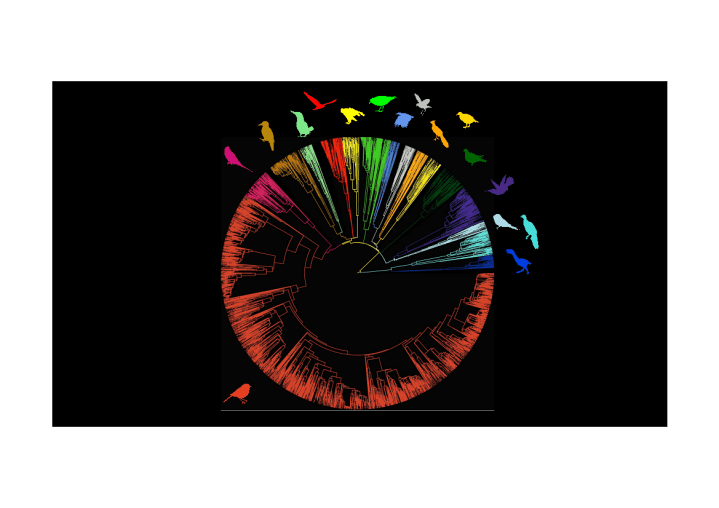
Molecular phylogenies are family trees of species that can be built from data collected today: the genes (molecules) of present-day species (Fig 1). They are often thought of as trees, in reference to Darwin’s tree of life. The leaves represent the present: species that can be found on Earth today. The branches represent the past: ancestral species, which from time to time split, giving rise to two independent species. The structure of the tree tells us which species descend from which ancestors, and when their divergence happened.
Fig 1: The phylogenetic tree of all birds (adapted from Jetz et al. 2012). Each bird order is represented by a single bird silloutter and a specific colour (the most abundant order of Passeriformes, for example is represented in dark orange). Each terminal leaf represents a present-day bird species, while internal branches represent the evolutionary relationships among these species.
iMarCo is a new initiative aimed at creating an international network for promoting collaborative projects among European scientists interested in the study of marine connectivity. The network covers a broad spectrum of marine science disciplines including physical oceanography, microchemistry, genetics and evolutionary ecology, behaviour, tagging, fisheries and aquaculture.
Register for FREE for the first ever BES Publishing webinar based on our forthcoming Demography Beyond the Population Special Feature.
This hour long webinar will begin at 1pm (GMT) on Tuesday 1 March. It highlights some of the excellent articles soon to be published in the British Ecological Society journals Special Feature entitled “Demography Beyond the Population”. The Special Feature is a collaborative effort including articles in all six BES journals. This is the first time such a large ecological collaboration has been attempted worldwide. Using a cross-journal approach has allowed us to highlight the strongly interdisciplinary nature of the field of demography to its fullest potential as well as to lay down the foundations for future directions at the interface of ecology, evolution, conservation biology and human welfare. The webinar has several international speakers and will discuss the articles in the Special Feature and the implications for demography research going forward. Continue reading “Demography Beyond the Population Webinar: Register for Free Now”
One of my main areas of study is Periphyton developed in microcosms. For those of you who don’t know, Periphyton is a green biofilm that you may notice in some (not very clean) swimming pools and is composed mainly of algae, bacteria, fungi, meiofauna and detritus. I started studying Periphyton because my Masters thesis involved developing a model in freshwater systems and after that I wanted to look into their spatial distribution.
I wanted to find an opportunity to connect my study system with two of my passions: space travel (I used to watch Star Trek and also I thoroughly enjoyed Space: The Final Frontier for Ecological Theory by Peter Kareiva) and tropical rainforests (which I developed a fondness for while watching Tarzan). I thought I could use Periphyton as a model system to test ecological theory, with a complexity similar to tropical forest as suggested by Lowe [1].
The study of the spatial structure of Periphyton was not as easy as space travel in Star Trek (for one thing they have a warp drive and I don’t!). I wanted to compare spatial models and data, but the methods that were available weren’t very well-suited to what I wanted to do, so I was not sure of how to begin. In the end, I decided to launch my first microcosms experiment and in the first photos I took of Periphyton’s spatial structure I saw they were like clouds, algae clouds. Continue reading “From Star Trek to Species Ranks in Space… and Beyond”
This post is an outcome of the ‘Maximising the Exposure of Your Research’ Workshop at the BES 2015 Annual Meeting in Edinburgh (UK). If you’re interested in joining us for our 2016 Annual Meeting in Liverpool (UK), you can find some more information and pre-register HERE.
In recent years there has been a significant increase in the number of academic articles published. At the same time, readers are changing how they find content, tending towards a point of entry at article level as opposed to journal level. These two factors mean that it is increasingly necessary for authors to make their articles easy for relevant readers to find. Search Engine Optimisation (SEO) is one of the best ways to do this.





 Methods Blog