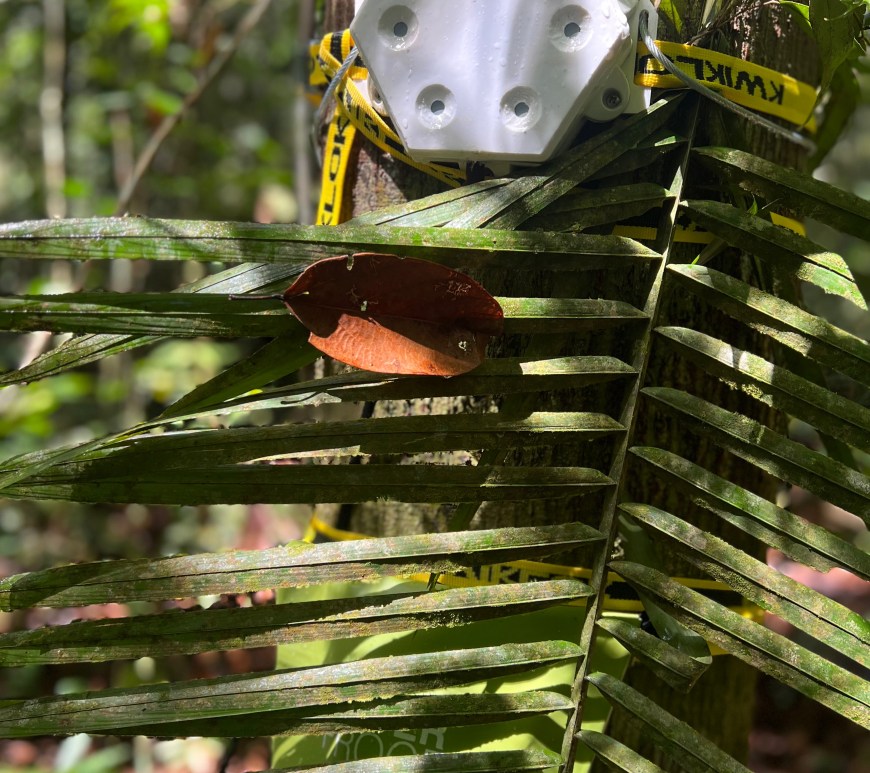
2024 Robert May Prize Shortlist: Methods Ecology and Evolution’s Award for Early Career Researchers

The Robert May Prize is awarded by the British Ecological Society each year for the best paper in Methods in Ecology and Evolution written by an early career author. With entries spanning the 15th Volume of the journal, our Senior Editors carefully shortlisted the following 10 papers: Natasha Klappstein: Step selection functions with non-linear and random effects Omar Saif: Fieldwork in conservation organisations–A review of methodological challenges, opportunities and … Continue reading 2024 Robert May Prize Shortlist: Methods Ecology and Evolution’s Award for Early Career Researchers

Robert May Prize 2023: Winner announced for early career researcher award

We’re excited to announce Willem Bonnaffé as the winner of the 2023 Robert May Prize, celebrating the best article in the journal by an author at the start of their career. Winner: Willem Bonnaffé Research: Fast fitting of neural ordinary differential equations by Bayesian neural gradient matching to infer ecological interactions from time-series data About the Research In previous work, Willem Bonnaffé and Tim Coulson … Continue reading Robert May Prize 2023: Winner announced for early career researcher award

Detangling NODEs

I’m Willem Bonnaffé,  a postdoctoral researcher at the University of Oxford. In my research, I integrate biological data, mathematical modelling, and machine learning. I spend most of my time modelling natural systems with neural ordinary differential equations – NODEs or Neural ODEs for short. In this blog post, I am hoping to shed light on what these models are and how I came to use … Continue reading Detangling NODEs

Does my species senesce?

Post provided by Lotte de Vries Animals and plants exhibit a wide range of patterns of longevity, growth, and reproduction but the general drivers of this enormous variation in life history are poorly understood. Comparative demography uses large demographic databases to attempt to identify patterns in life-history strategies across the tree of life (e.g. this PNAS paper, and this one). In this paper, we show … Continue reading Does my species senesce?

Increasing Complexity in Species Distribution Modelling

Megan Laxton and colleagues originally set out to translate an existing example of a species distribution model into a new software framework. However, what originated as a simple modelling example developed into a discussion on structural complexity in species distribution models. Complexity in Species Distribution Models The original idea for our paper was to provide a worked example demonstrating the usage of the R package … Continue reading Increasing Complexity in Species Distribution Modelling

The Data Double Standard: how this article came to be

Post provided by Alison Binley As a new Master’s student at Carleton University, I was excited to learn the ins and outs of using community science data (also known commonly as citizen science, participatory research, and crowd-sourced data) to conduct conservation research. I was working on estimating population trends using eBird, a popular, opportunistic community science platform that collects data on birds, and fascinated by … Continue reading The Data Double Standard: how this article came to be

Early career research: Increasing access, reproducibility and transparency in phylogenetic analyses with Cristian Román-Palacios

I was born in the Colombian Andes (Armenia, Quindío) back in the 90s. I received my bachelor’s degree in Biology from Universidad del Valle, in Cali, Colombia, in 2015. I moved to the US in 2016 to pursue a Ph.D. in Ecology and Evolutionary Biology at the University of Arizona – a degree that I completed in Fall of 2020. Although my research interests seem … Continue reading Early career research: Increasing access, reproducibility and transparency in phylogenetic analyses with Cristian Román-Palacios

2023 Robert May Prize Shortlist: Methods Ecology and Evolution’s Award for Early Career Researchers

The Robert May Prize is awarded by the British Ecological Society each year for the best paper in Methods in Ecology and Evolution written by an early career author. With entries spanning the 14th Volume of the journal, our Senior Editors carefully shortlisted the following 9 papers: Megan Laxton; Balancing structural complexity with ecological insight in Spatio-temporal species distribution models Charlotte de Vries; Discretising Keyfitz’ entropy for … Continue reading 2023 Robert May Prize Shortlist: Methods Ecology and Evolution’s Award for Early Career Researchers

Robert May Prize 2022: Winner announced for early career researcher award 

We’re excited to announce Tanya Strydom as the winner of the 2022 Robert May Prize , celebrating the best article in the journal by an author at the start of their career.  Winner: Tanya Strydom Research: Food web reconstruction through phylogenetic transfer of low-rank network representation About the Research Despite their importance in many ecological processes, collecting data and information on ecological interactions is an … Continue reading Robert May Prize 2022: Winner announced for early career researcher award 

Wind-robust sound event detection and denoising for bioacoustics

Post provided by Julius Juodakis Common solutions to wind noise don’t work with bioacoustics Bioacoustics has great potential to help us understand animal communities. We already have strikingly futuristic hardware for capturing natural sounds, such as the autonomous Audiomoth or the 5-gram μMoth recorders, and projects making use of it, such as the live-observation WhaleMap, SAFE Project in Borneo, or the Australian Acoustic Observatory, the … Continue reading Wind-robust sound event detection and denoising for bioacoustics