Technological advancements in the past 20 years or so have spurred rapid growth in the study of migratory connectivity (the linkage of individuals and populations between seasons of the annual cycle). A new article in Methods in Ecology and Evolution provides methods to help make quantitative comparisons of migratory connectivity across studies, data types, and taxa to better understand the causes and consequences of the seasonal distributions … Continue reading How Can We Quantify the Strength of Migratory Connectivity?
Today, we are pleased to be the latest new member of the Methods in Ecology and Evolution Associate Editor Board. David Soto joins us from the University of Leuven in Belgium and you can find out a little more about him below. David Soto “I am an isotope ecologist with interests in developing new stable isotope methods and techniques for tracing spatio-temporal changes in food webs, and understanding … Continue reading New Associate Editor: David Soto
In a new Methods in Ecology and Evolution video, Javier Puy outlines a new method of experimental plant DNA demethylation for ecological epigenetic experiments. While the traditionally-used approach causes underdeveloped root systems and high mortality of treated plants, this new one overcomes the unwanted effects while maintaining the demethylation efficiency. The authors demonstrate its application for ecological epigenetic experiments: testing transgenerational effects of plant–plant competition. … Continue reading Improved and Harmless Demethylation Method for Ecological Epigenetic Experiments
Scientific software is an increasingly important part of scientific research, and ecologists have been at the forefront of developing open source tools for ecological research. Much of this software is distributed via R packages – there are over 200 R packages for ecology and evolution on CRAN alone. Methods regularly publishes Application articles introducing R packages (and other software) that enable ecological research, and we’re … Continue reading Solving YOUR Ecology Challenges with R: Ecology Hackathon in Ghent
Motion vision is an important source of information for many animals. It facilitates an animal’s movement through an environment, as well as being essential for locating prey and detecting predators. However, information on the conditions for motion vision in natural environments is limited. To address this, Bian et al. have developed an innovative approach that combines novel field techniques with tools from 3D animation to … Continue reading Animal Behaviour through a Virtual Lens
Today we are welcoming two more Associate Editors to the Methods in Ecology and Evolution who were invited to work with the journal following our open call earlier this year. Jessica Royles joins from the University of Cambridge, UK and Simon Blomberg is coming to us from the University of Queensland, Australia. You can find out more about both of them below. Simon Blomberg “I am a statistician who started out … Continue reading Two More New Associate Editors
The seasonal long-distance migration of all kinds of animals – from whales to dragonflies to amphibians to birds – is as astonishing a feat as it is mysterious and this is an especially exciting time to study migratory animals. In the past 20 years, rapidly advancing technologies – from tracking devices, to stable isotopes in tissues, to genomics and analytical techniques for the analysis of ring re-encounter databases – mean that it’s now possible to follow many animals throughout the year and solve many of the mysteries of migration.
What is Migratory Connectivity?
One of the many important things we’re now able to measure is migratory connectivity, the connections of migratory individuals and populations between seasons. There are really two components of migratory connectivity:
Linking the geography of where individuals and populations occur between seasons.
The extent, or strength, of co-occurrence of individuals and populations between seasons.
This extra large issue contains seven Applications articles and three Open Access articles. These five papers are freely available to everyone, no subscription required.
–LSCorridors: LandScape Corridors considers stochastic variation, species perception and landscape influence on organisms in the design of ecological corridors. It lets you simulate corridors for species with different requirements and considers that species perceive the surrounding landscape in different ways.
–HistMapR: HistMapR contains a number of functions that can be used to semi-automatically digitize historical land use according to a map’s colours. Digitization is fast, and agreement with manually digitized maps of around 80–90% meets common targets for image classification. This manuscript has a companion video and was recommended by Associate Editor Sarah Goslee.
–vortexR: An R package to automate the analysis and visualisation of outputs from the population viability modelling software Vortex. vortexR facilitates collating Vortex output files, data visualisation and basic analyses (e.g. pairwise comparisons of scenarios), as well as providing more advanced statistics.
More than anything else, the phenotype of an organism determines how it interacts with the environment. It’s subject to natural selection, and may help to unravel the underlying evolutionary processes. So shape traits are key elements in many ecological and biological studies.
Commonly, basic parameters like distances, areas, angles, or derived ratios are used to describe and compare the shapes of organisms. These parameters usually work well in organisms with a regular body plan. The shape of irregular organisms – such as many plants, fungi, sponges or corals – is mainly determined by environmental factors and often lacks the distinct landmarks needed for traditional morphometric methods. The application of these methods is problematic and shapes are more often categorised than actually measured.
As scientists though, we favour independent statistical analyses, and there’s an urgent need for reliable shape characterisation based on numerical approaches. So, scientists often determine complexity parameters such as surface/volume ratios, rugosity, or the level of branching. However, these parameters all share the same drawback: they are delineated to a univariate number, taking information from one or few spatial scales and because of this essential information is lost. Continue reading “The Power of Infinity: Using 3D Fractal Geometry to Study Irregular Organisms”
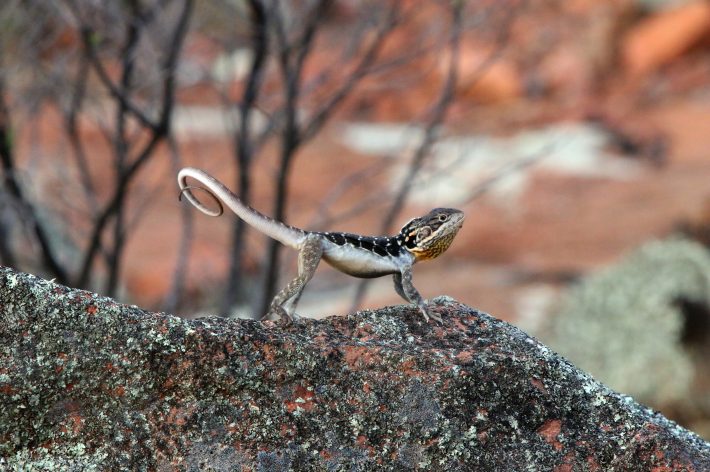
Many animals rely on movement to find prey and avoid predators. Movement is also an essential component of the territorial displays of lizards, comprising tail, limb, head and whole-body movements.
For the first time, digital animation has been used as a research tool to examine how the effectiveness of a lizard’s territorial display varies across ecological environments and conditions. The new research was published today in the journal Methods in Ecology and Evolution.