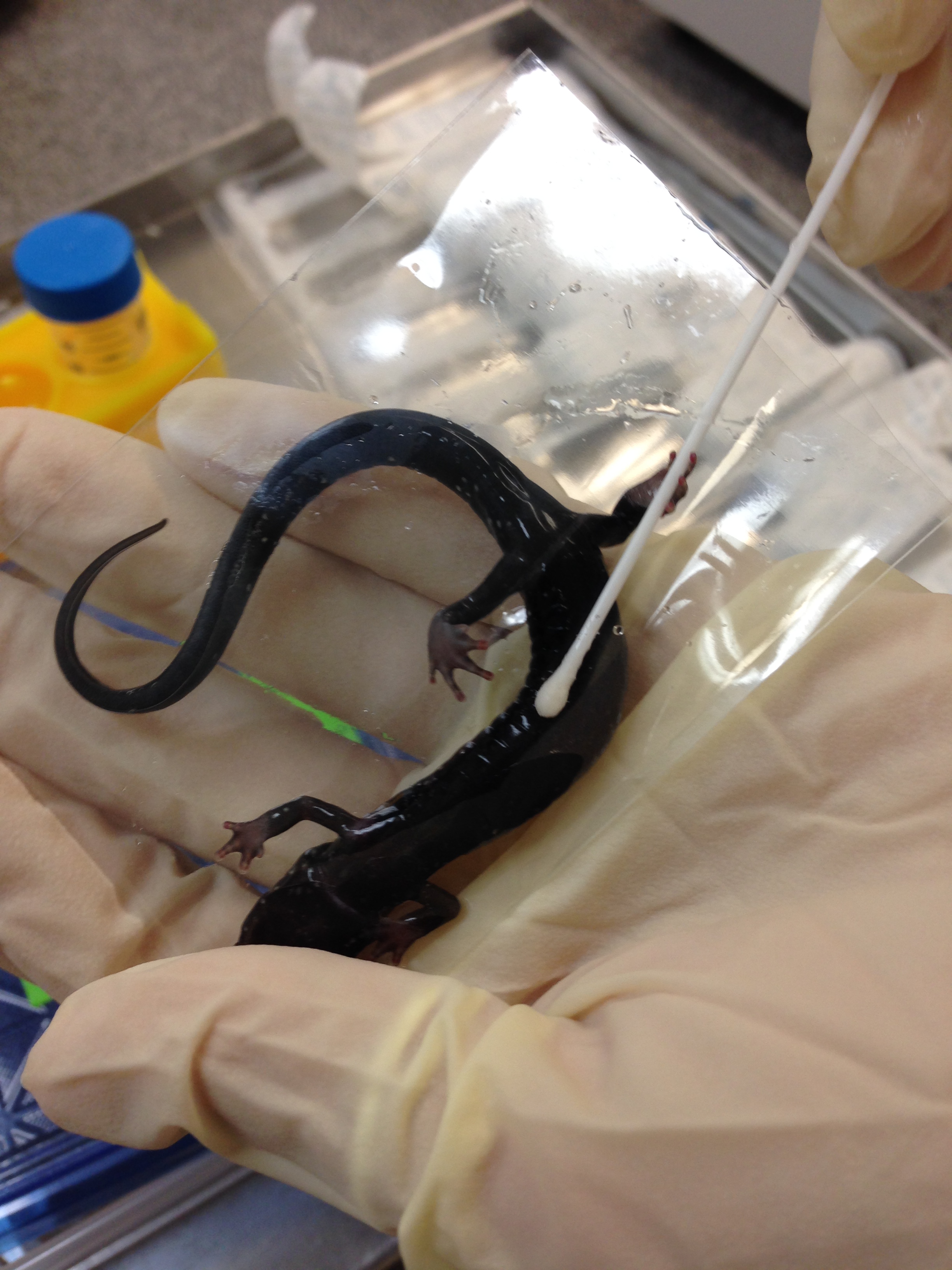
Many researchers, breeders and hobbyists need to know sex of their animals. Sometimes it’s easy – in sexually dimorphic species you only have to look. In other species or juveniles it’s often not so straightforward though. And it’s often impossible – but sometimes essential – in embryos or in tissue samples. Determining sex from DNA is the most practical option, or sometimes even the only possibility, in these cases.
Molecular sexing is routinely used in mammals and birds, but until now it has only been available for a handful of reptile species. Many people didn’t believe that this situation would improve considerably any time soon. But why? Continue reading “Reptile DNA Sexing: Easier Than You Ever Thought”
Heard but not seen, populations of forest elephants (Loxodonta cyclotis) are rapidly declining due to ivory poaching. As one of the largest land mammals in the world, this species is surprisingly difficult to observe in the dense forests of Central Africa, but their low frequency rumbles can be recorded. With the autonomous recording afforded by passive acoustic monitoring (PAM) though, we have a window onto forest elephant ecology and behaviour that’s providing data critical to their conservation and survival.
The diverse ways that PAM can contribute to conservation outcomes is growing and while still underappreciated, the availability of relatively inexpensive recorders, increased power efficiency, and powerful techniques to automate the detection of signals have led to an explosion in use. In 2007 there were only about 20 published papers using PAM techniques, but since then over 400 papers have appeared in peer-reviewed journals.
Spectrogram of two forest elephant rumbles. Horizontal line shows the limit of human hearing.
Essentially, PAM is the automatic recording of sounds in a given environment, often for long periods. The trick, and often greatest challenge, is to find the signals of interest (bird calls, elephant rumbles, gunshots) within the recordings. With these signals we can quantify abundance, occupancy and spatial or temporal patterns of activity. Particularly in landscapes or ecosystems where visual observation is difficult (e.g. oceans, rainforests, nocturnal environments) PAM may be uniquely capable of delivering informative and unbiased data. Because PAM is a relatively new method but of considerable interest across the disciplines of ecology, behaviour and conservation, there is huge interest in refining the sampling and statistical methods needed to deal with the peculiarities of acoustic data. Continue reading “Listen Up! Using Passive Acoustic Monitoring to Help Forest Elephant Conservation”
This issue contains two Applications articles and two Open Access articles. These four papers are freely available to everyone, no subscription required.
–Paco: An R package that assesses the phylogenetic congruence, or evolutionary dependence, of two groups of interacting species using both ecological interaction networks and their phylogenetic history.
–Open MEE: Open Meta-analyst for Ecology and Evolution (Open MEE) addresses the need for advanced, easy-to-use software for meta-analysis and meta-regression.It offers a suite of advanced meta-analysis and meta-regression methods for synthesizing continuous and categorical data, including meta-regression with multiple covariates and their interactions, phylogenetic analyses, and simple missing data imputation.
When trying to understand how wildlife, for example a bird species, may react to climate change scientists generally study how species numbers vary in relation to climatic or weather variables (e.g. Renwick et al. 2012, Johnston et al. 2013). The way this tends to be done is by gathering information (data!) about bird numbers as well as the weather variables (for example temperature) in several locations (i.e. in space) and fitting a regression model to these data to detect and illustrate how bird numbers go up or down with temperature.
Data on bird numbers and temperatures in several locations lets researchers see the relationship between the two.
This relationship is then used to forecast how bird numbers may change along with potential temperature changes in the future (i.e. in time), for example due to climate change.
Relationships between bird numbers and temperature in a given location are often used to forecast changes in bird numbers with expected changes in temperatures over time.
Detecting the movements and interactions of elusive, nocturnal wildlife is a perpetual challenge for wildlife biologists. But, with security tracking technology, more commonly used to protect museum artwork, new Oxford University research has revealed fresh insights into the social behaviour of badgers, with implications for disease transmission.
Previous studies have assumed that badgers are territorial and, at times, anti-social, living in tight-knit and exclusive family groups in dens termed ‘setts’. This led to the perception that badgers actively defend territorial borders and consequently rarely travel beyond their social-group boundaries.
This picture of the badger social system is so widely accepted that some badger culling and vaccination programmes rely on it – considering badger society as being divided up into discrete units, with badgers rarely venturing beyond their exclusive social-groups. But, the findings, newly published in Methods in Ecology and Evolution, have revealed that badgers travel more frequently beyond these notional boundaries than first thought, and appear to at least tolerate their neighbours. Continue reading “Oxford Research Sheds Light on the Secret Life of Badgers”
Occupancy surveys are widely used in ecology to study wildlife and plant habitat use. To account for imperfect detection probability many researchers use occupancy models. But occupancy probability estimates for rare species tend to be biased because we’re unlikely to observe the animals at all and as a result, the data aren’t very informative. In their new article – ‘Occupancy surveys with conditional replicates: An … Continue reading Conditional Occupancy Design Explained
Rather than conduct an aquatic roll call with nets to know which fish reside in a particular body of water, scientists can now use DNA fragments suspended in water to catalog invasive or native species.
“We’ve sharpened the environmental DNA (eDNA) tool, so that if a river or a lake has threatened, endangered or invasive species, we can ascertain genetic detail of the species there,” said senior author David Lodge, the Francis J. DiSalvo Director of the Atkinson Center for a Sustainable Future at Cornell, and professor of ecology and evolutionary biology. “Using eDNA, scientists can better design management options for eradicating invasive species, or saving and restoring endangered species.” Continue reading “Refined DNA Tool Tracks Native and Invasive Fish”
New method faster, more efficient and less damaging to the environment
A team of researchers from the University of Wollongong (UOW) and the University of Tasmania has developed a new method for assessing the health of fragile Antarctic vegetation using drones, which they say could be used to improve the efficiency of ecological monitoring in other environments as well.
The researchers have written about their method in an article published in Methods in Ecology and Evolution, a scientific journal of the British Ecological Society.
This issue contains three Applications articles (one of which is Open Access) and one additional Open Access article. These four papers are freely available to everyone, no subscription required.
– BioEnergeticFoodWebs: An implementation of Yodzis & Innes bio-energetic model, in the high-performance computing language Julia. This package can be used to conduct numerical experiments in a reproducible and standard way.
–Controlled plant crosses: Chambers which allow you to control pollen movement and paternity of offspring using unpollinated isolated plants and microsatellite markers for parents and their putative offspring. This system has per plant costs and efficacy superior to pollen bags used in past studies of wind-pollinated plants.
–The Global Pollen Project: The study of fossil and modern pollen assemblages provides essential information about vegetation dynamics in space and time. In this Open Access Applications article, Martin and Harvey present a new online tool – the Global Pollen Project – which aims to enable people to share and identify pollen grains. Through this, it will create an open, free and accessible reference library for pollen identification. The database currently holds information for over 1500 species, from Europe, the Americas and Asia. As the collection grows, we envision easier pollen identification, and greater use of the database for novel research on pollen morphology and other characteristics, especially when linked to other palaeoecological databases, such as Neotoma.
A long standing research topic in evolutionary biology is the genetic basis of adaptation. In other words, how does a novel trait appear (or spread) in response to an environmental change? Despite the rapid advances in sequencing over the last two decades, we have only been able to fully characterize a few adaptations.
As stated by Richard Dawkins in Climbing Mount Improbable, while natural selection is a very simple process, modeling natural selection and determining its causes, effects and consequences is an extremely difficult task. Also, most of our efforts so far have been focused on just one type of genetic variation: single nucleotide polymorphisms (SNPs). Other types of variations such as transposable element (TE) insertions have received much less attention. Paradoxically, some great examples of the role of TEs in adaptation have been right under our noses the whole time, in basic biology textbooks. Continue reading “Getting Serious About Transposable Elements”