Over the next few weeks we will be welcoming three new Associate Editors to Methods in Ecology and Evolution. Susan Johnston (University of Edinburgh, UK) became a member of the Associate Editor Board on Monday 5 October. She will be joined on 19 October by Natalie Cooper (Natural History Museum, London, UK) and finally by Luísa Carvalheiro (University of Brasília, Brazil) on 2 November. You can find out … Continue reading New Associate Editors
This month’s issue contains one Applications article and two Open Access articles, all of which are freely available.
– POPART: An integrated software package that provides a comprehensive implementation of haplotype network methods, phylogeographic visualisation tools and standard statistical tests, together with publication-ready figure production. The package also provides a platform for the implementation and distribution of new network-based methods.
Michalis Vardakis et al. provide this month’s first Open Access article. In ‘Discrete choice modelling of natal dispersal: ‘Choosing’ where to breed from a finite set of available areas‘ the authors show how the dispersal discrete choice model can be used for analysing natal dispersal data in patchy environments given that the natal and the breeding area of the disperser are observed. This model can be used for any species or system that uses some form of discrete breeding location or a certain degree of discretization can be applied.
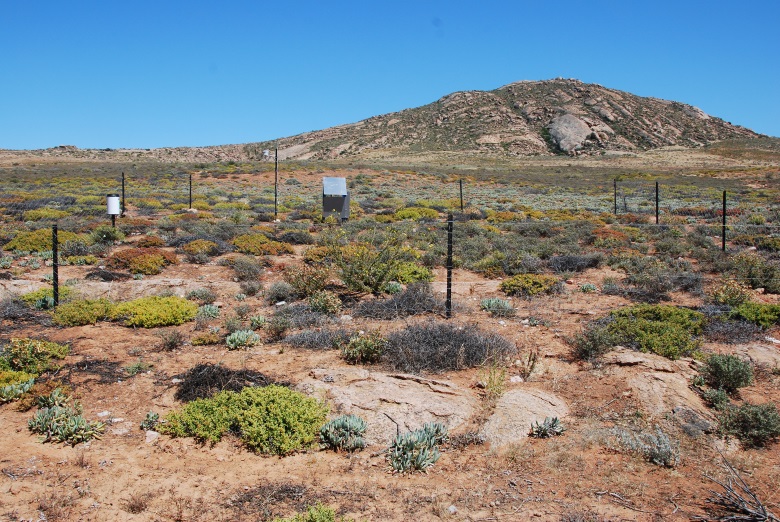
Innovative measuring device enables the water content of biological soil crusts to be measured for the first time.
Biological soil crusts comprising lichens, algae and mosses play an important role in the earth’s ecosystems. They fix carbon dioxide and nitrogen while giving off significant amounts of the greenhouse gas nitrous oxide. Information on soil moisture is of vital importance to investigate their fixation and release processes and to understand them in detail. Previously, no sensor existed that could measure the water content in the top millimeters of the soil with sufficient accuracy. This gap has now been closed by a new development of Bettina Weber and her colleagues at the Max Planck Institute for Chemistry in Mainz, as can be read online in the ‘Early View’ section of the Methods in Ecology and EvolutionWiley Online Library. They have managed to construct an appropriate soil moisture sensor, which delivers reliable data, as well as being cost-effective and flexible to use.
Biological soil crusts consist of a community of cyanobacteria, lichens, algae and bryophytes, together with fungi, bacteria, and archaea, which grow in the upper three to five millimeters of the soil, forming a hardened layer. They exist in dry regions throughout the world and occupy approximately 20 million square meters, which is almost as large as the surface of South America. All the organisms in biological soil crusts are poikilohydric, which means that they are only active when the soil is sufficiently moist, but survive in an inactive state under dry conditions. Continue reading “Mainz scientists develop new soil moisture sensor”
Today is 10th National Wildlife Day. As we have done for a few awareness days this year (Bats, Biodiversity and Bees so far) we are marking the day by highlighting some of our favourite Methodsin Ecology and Evolution articles on the subject. Obviously ‘wildlife’ is a pretty big topic, so we have narrowed our focus (slightly) to monitoring wildlife (with one or two additional papers that we didn’t want to leave out).
This list is certainly not exhaustive and there are many more wonderful articles on these topics in the journal. You can see more of them on the Wiley Online Library.
If you would like to learn more about National Wildlife Day, you may wish to visit the organisation’s website, follow them on Twitter and Facebook or check out today’s hashtag: #NationalWildlifeDay.
Without further ado though, please enjoy our selection of Methods articles for National Wildlife Day:
Integrating Demographic Data
Our National Wildlife Day celebration begins with an article from our EURING Special Feature. Robert Robinson et al. present an approach which allows important demographic parameters to be identified, even if they are not measured directly, in ‘Integrating demographic data: towards a framework for monitoring wildlife populations at large spatial scales‘. Using their approach they were able to retrieve known demographic signals both within and across species and identify the demographic causes of population decline in Song Thrush and Lawping.
The 100th anniversary of the Ecological Society of America was celebrated in Baltimore, Maryland at their Annual Conference in August. This year a record 10,000 ecologists attended the six day event. ESA conferences now boast a staggering number of scientific presentations, ranging from numerous plenary talks, organized oral sessions and regular oral presentation sessions to lightening talks, posters, workshops and mixers. It was both exhilarating and overwhelming, but featured a truly impressive amount of science.
As the sheer magnitude of the event made attending even a fraction of the talks impossible, it feels odd to highlight any particular presentations. Two talks, however – both on the final morning of the conference – did strike me as worth mentioning; not because they featured groundbreaking science, or novel insights, but because they reflect potentially powerful new platforms from which groundbreaking science might develop. Continue reading “A Big Database and Big Models Pave the Way for Big Questions in Ecology”
You’ve spent months, or even years, working on a project. You’ve finalised your manuscript and you’re ready to submit. But which journal should you send your paper to?
@ Colin (click image to see original)
In recent years, this question has only gotten harder. As more and more journals enter the market, the decision of where to send your paper is becoming increasingly confusing. With predatory journals muddying the waters and an increasing pressure to publish, deciding where to submit can be a daunting task for even seasoned academics.
The following post was written by Tim Poisot. To see the original version, please visit his blog.
Tim is an Associate Editor who works on Applications submissions for Methods in Ecology and Evolution. His research interests include spatial and temporal dynamics of species interactions at the community level, the relevance of variability in community structure on emerging ecosystem properties, and the evolutionary dynamics of multi-species assemblages.
I am back from the centennial meeting of the Ecological Society of America. I met a lot of great people, saw a lot of great talks, and had lovely discussions. One thing that has been in the back of my mind for a while though, is the question of how much methodology should go into an oral presentation?
Methods are important — over the last two years I have found that this has been the part of papers I criticize the most during peer review. Any result is only as robust as its least robust element and there are, in ecology, enough sources of variability that we do not want methods to add any more. As a consequence, appreciating a result and its robustness require that we be able to understand and evaluate the methods by which this result has been obtained.
There are a few elements to evaluating a method. Does it rely on a sound and tested theory? Is it properly applied? Is the method correctly implemented? All of these questions (and some more) should be asked — and answered in the affirmative — before we decide to accept a result. If not, we are putting ourselves in the position to blindly accept what we are being told. Continue reading “How Much Methodology Should go into Conference Talks?”
Black bears in Yosemite National Park that don’t seek out human foods subsist primarily on plants and nuts, according to a study conducted by biologists at UC San Diego who also found that ants and other sources of animal protein, such as mule deer, make up only a small fraction of the bears’ annual diet.
As you may know, tomorrow (Saturday 22 August) is National Honey Bee Day in the USA. To mark the day we will be highlighting some of the best papers that have been published on bees and pollinators in Methods in Ecology and Evolution.
You can find out more about National Honey Bee Day (and about bees in general) HERE.
Without further ado though, here are a few of the best Methods papers related to Honey Bees:
Honey Bee Risk Assessment
Our Honey Bee highlights begin with Hendriksma et al.’s article ‘Honey bee risk assessment: new approaches for in vitro larvae rearing and data analyses‘. Robust laboratory methods for assessing adverse effects on honey bee brood are required for research into the issues contributing to global bee losses. To facilitate this, the authors of this article recommend in vitro rearing of larvae and suggest some appropriate statistical tools for the related data analyses. Together these methods can help to improve the quality of environmental risk assessment studies on honey bees and secure honey bee pollination. As this article was published over two years ago, it can be accessed for free by anyone.



 Methods Blog