Issue 6.2 is now online! The February issue of Methods is now online! This month we have two applications articles. Both are free to access, no subscription required. – NLMpy: A PYTHON software package for the creation of neutral landscape models (there are also two videos associated to this paper on our Youtube channel) – BAT – an R package for the measurement and estimation of … Continue reading Issue 6.2
Demographic methods and population modeling have been popular tools amongst ecologists for a long time. Recent advances, some of which have been written about in the pages of Methods, have allowed these approaches to be applied to a wide range of questions, helping to integrate population-level processes more broadly into ecological research.
2014 was a wonderful year for Methods in Ecology and Evolution. We had a record number of submissions and we published some fantastic articles (if we do say so ourselves). None of this would have been possible though without the work of the people who generously provide reviews for the journal. Whether you reviewed one paper or twenty, we really appreciate your time and effort. … Continue reading Thank you to our 2014 Reviewers
Issue 6.1 is now online! Our first issue of 2015 is now online! This month we include one freely available Applications article: – A biochemical approach for identifying plastics exposure in live wildlife We also have two wonderful Open Access papers, ‘Evaluation and management implications of uncertainty in a multispecies size-structured model of population and community responses to fishing‘ by Robert B. Thorpe, Will J. … Continue reading Issue 6.1
In this video Thomas Etherington shows how to use the NLMpy Python package to create neutral landscape models. The video demonstrates how the paper’s Supporting Information documentation, Python scripts, and GIS data can be used to create a the example neutral landscape models that are shown in the paper. Recognising that some ecologists may not be very familiar with Python, the authors have also created … Continue reading NLMpy: a python software package for the creation of neutral landscape models
Issue 5.11 is now online! This month we include 2 freely available application articles: – ENMeval: An R package for conducting spatially independent evaluations and estimating optimal model complexity for Maxent ecological niche models – enaR: An r package for Ecosystem Network Analysis We also have 4 interesting open access papers, ‘The accuracy of Fastloc-GPS locations and implications for animal tracking‘ by Antoine Dujon et … Continue reading Issue 5.11
By Charles M. Francis, Richard J. Barker, Evan G. Cooch This joint Special Feature (published in MEE and the open access journal Ecology and Evolution) brings together a series of papers presented at the EURING 2013 technical conference that, collectively, cover many of the latest developments in the analysis of data from marked individuals to estimate demographic parameters, such as survival, recruitment, nest success, density, population size … Continue reading Modelling Demographic Processes in Marked Populations: Proceedings of the EURING 2013 analytical meeting
Lidar point cloud from a scanned Eucalyptus tree (left) with colours correlating to point density (blue to red moving from high to low density). On the right is the reconstructed tree volume from which mass can be estimated.
A terrestrial laser scanning technique that allows the structure of vegetation to be 3D-mapped to the millimetre is more accurate in determining the biomass of trees and carbon stocks in forests than current methods, according to new research involving UCL.
The research paper, an international collaboration led by Wageningen University, is published today in Methods in Ecology and Evolution and demonstrates the technique in Australian forests.
The study authors believe it could be an important development in the monitoring of carbon stocks for worldwide climate policy-making. Both above-ground biomass and carbon stocks are important details for UN-REDD, the United Nations initiative on Reducing Emissions from Deforestation and forest Degradation that is striving to keep the destruction of forests in check and thereby preserve the uptake of carbon by trees.
Paper co-author Dr Mat Disney (UCL Geography) said: “This new paper shows how effectively we can now turn highly-accurate laser measurements, comprising millions of 3D laser points, into estimates of tree mass. Weighing trees is really hard – time Continue reading “Laser scanning accurately ‘weighs’ trees”
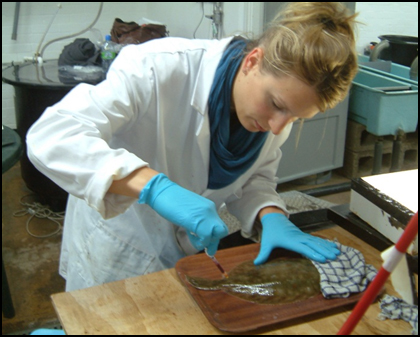
BY CHRISTOPHER DOYLE This article has been taken from ABC Environment. Scientists have developed a new technique to assess how much plastic a seabird has eaten. It involves a quick massage and a cotton swab. A TEAM OF AUSTRALIAN scientists has developed a new method for assessing how much plastic debris a seabird has eaten while foraging on the open ocean, leading to a better … Continue reading Seabirds’ plastic diet shows up in their feather oil
We’d like to welcome 4 new Associate Editors to the team! Patrick Jansen from Wageningen University, Nicolas Lecomte from Université de Moncton, John Reynolds from Simon Fraser University and Matt Schofield from the University of Otago. Read their profiles below to find out about their research interests: “I am an ecologist specializing in consumer-resource interactions, particularly those between predators and their prey and between herbivores … Continue reading New Associate Editors