Post provided by Michael Smith Tracking bee movement is anything but an easy task. Electronic tags are often too cumbersome and extensive electronic systems such as radars are costly to deploy. There is a need for a low-cost, low-impact tool, with high spatial resolution for tracking bees, to investigate how far they forage. In this blog post, Michael Smith discusses the development of retroreflective tags … Continue reading Insect tracking using retroreflective tags
Females are attracted to the hollow material in trap nests.
When thinking of bees and wasps, most people have social insects living in colonies in mind. But most species are actually solitary. In these species, every female builds her own nest and does not care for the offspring once nest construction is completed. Most of those species nest in the ground. Several thousand species of bees and wasps use pre-existing above-ground cavities though (such as hollow twigs and stems, cracks under bark, or empty galleries of wood-boring insects).
To keep you in suspense, I’ll resolve the importance of studying cavity-nesting species later in this blog post. First, I’ll introduce you to one of the more elegant research methods in ecology: trap nests. To study and collect these cavity-nesting species, you can take advantage of their nesting preferences. By exposing artificial cavities and offering access to an otherwise restricted nesting resource, you can attract females searching for suitable nesting sites.
Building these trap nests is simple, but the design can vary greatly. Many designs and materials can be used to build the artificial nesting sites, such as drilling holes in wooden blocks or packing hollow plant material (e.g. reeds) in plastic tubes. Once females find the trap nest and finish their nest construction, the developing offspring are literally ‘trapped’ in their nests. They can then be collected, their trophic interactions (e.g. food and natural enemies) observed, and the specimens can be reared for identification. Continue reading “All You (Possibly) Ever Wanted to Know about ‘Trap Nests’”
Rachel Carson (1940) Fish & Wildlife Service employee photo.
I can’t think of a more inspirational and influential ecologist than Rachel Carson. Nearly fifty years ago she released a book called Silent Spring, which argued that pesticides such as DDT were cascading up through food chains causing the death or sterilisation of birds and other animals. The publication of her book provoked public debate, likely in part because it was serialised in The New Yorker, and led to a paradigm shift in US and (arguably) global pest control policy.
With the full support of the scientific community to verify her facts and arguments, she was able to defeat the chemical industry’s backlash and galvanise public opinion in her favour. The 2005 Stockholm Convention, in which DDT was banned from agricultural use, would likely have never happened if it were not for her work.
“In a post-truth world where trust in the scientific process is being eroded almost daily, Rachel Carson is a perfect example of how we can speak out and be heard while still being scientists.”
This month’s issue contains one Applications article and two Open Access articles, all of which are freely available.
– POPART: An integrated software package that provides a comprehensive implementation of haplotype network methods, phylogeographic visualisation tools and standard statistical tests, together with publication-ready figure production. The package also provides a platform for the implementation and distribution of new network-based methods.
Michalis Vardakis et al. provide this month’s first Open Access article. In ‘Discrete choice modelling of natal dispersal: ‘Choosing’ where to breed from a finite set of available areas‘ the authors show how the dispersal discrete choice model can be used for analysing natal dispersal data in patchy environments given that the natal and the breeding area of the disperser are observed. This model can be used for any species or system that uses some form of discrete breeding location or a certain degree of discretization can be applied.
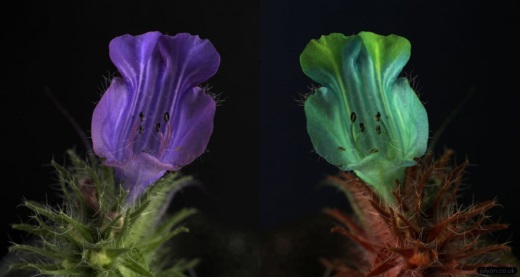
New camera technology that reveals the world through the eyes of animals has been developed by University of Exeter researchers. The details are published today in the journal Methods in Ecology and Evolution.
Echium angustifolium in Tenerife (Borage family). To us the flowers are a fairly uniform purple, but bees can see two UV absorbent patches at the top of the flower.
The software, which converts digital photos to animal vision, can be used to analyse colours and patterns and is particularly useful for the study of animal and plant signalling, camouflage and animal predation, but could also prove useful for anyone wanting to measure colours accurately and objectively.
It may sound counter-intuitive, but crushing up bees into a ‘DNA soup’ could help conservationists understand and even reverse their decline – according to University of East Anglia scientists.
Research published today in the journal Methods in Ecology and Evolution shows that collecting wild bees, extracting their DNA, and directly reading the DNA of the resultant ‘soup’ could finally make large-scale bee monitoring programmes feasible.
This would allow conservationists to detect where and when bee species are being lost, and importantly, whether conservation interventions are working.
The UK’s National Pollinator Strategy outlines plans for a large-scale bee monitoring programme. Traditional monitoring involves pinning individual bees and identifying them under a microscope. But the number of bees needed to track populations reliably over the whole country makes traditional methods infeasible.



 Methods Blog