The potential and practice of arboreal camera trapping

Post provided by Jennifer Moore

Each year Methods in Ecology and Evolution awards the Robert May Prize to the best paper published in the journal by an author at the start of their career. Ten Early Career Researchers made the shortlist for this year’s prize, including Jennifer Moore who is a post-doctoral associate at the University of Florida in the USA. In this interview, Jennifer shares insights on her paper ‘The potential and practice of arboreal camera trapping’.

Continue reading “The potential and practice of arboreal camera trapping”

Non-invasive playback experiments allow for rigorous studies of wildlife interactions

Post provided by Meredith Palmer, Chris “Akiba” Wang, Jacinta Plucinski & Robert M. Pringle

The BoomBox ABR deployed with a Bushnell TrophyCam camera trap in Gorongosa National Park, Mozambique

Camera traps are a valuable tool in ecological research, especially for capturing large quantities of information on the behaviour of an array of wildlife within an ecological community. Camera traps are seldom used to experimentally testing key animal behaviour hypotheses, despite the potential offered by the non-invasive technology. In this blog post, Dr. Meredith Palmer and co-authors discuss the application of the ‘BoomBox’ camera trap module that allows researchers to conduct a unique suite of manipulative experiments on free-living species in complex environments, as published in their Methods in Ecology and Evolution article ‘BoomBox: An Automated Behavioral Response (ABR) Camera Trap Module for Wildlife Playback Experiments’.

Continue reading “Non-invasive playback experiments allow for rigorous studies of wildlife interactions”

Searching for snow leopards

Post provided by Ian Durbach and Koustubh Sharma

Snow leopard captured via camera trap in Mongolia. Picture credit: Snow Leopard Conservation Foundation/Snow Leopard Trust/Panthera (OR SLCF/SLT/PF).

Snow leopards are notoriously elusive creatures and monitoring their population status within the remote, inhospitable habitats they call home, can be challenging.  In this post, co-authors Ian Durbach and Koustubh Sharma discuss the applications of their Methods in Ecology and Evolution article, ‘Fast, flexible alternatives to regular grid designs for spatial capture–recapture’, for monitoring snow leopard populations.

Continue reading “Searching for snow leopards”

Earth Day 2020: Monitoring Biodiversity for Climate Action

Post provided by Chloe Robinson

The demands of a growing human population are putting increasing pressure on the Earth’s natural systems and services. Dubbed the ‘Anthropocene’, we are currently living in a period where human actions are directly altering many earth processes, including atmospheric, geologic, hydrologic and biospheric processes. Climatic change and the resulting consequences, including rising temperatures, changing precipitation (i.e. rainfall, snow etc) and increase in frequency of storm events, represent the biggest challenge to our future and the life-support ecosystems that make our world habitable.

Artist’s interpretation of global climate change. Photo credit: Pete Linforth/Pixabay.

In 1970, Earth Day was launched as a modern environmental movement and a unified response to an environment in crisis. Earth Day has provided a platform for action, resulting in the creation of the Environmental Protection Agency (EPA), The Clean Air, Clean Water and Endangered Species Acts in the US and more globally. This year, 22 April marks the 50th anniversary of Earth Day, and the number one environmental crisis theme which needs immediate attention is ‘Climate Action’. Many of our ecosystems on earth are degrading at an alarming pace and we are currently experiencing a species loss at a rate of tens or hundreds of times faster than in the past. 

Continue reading “Earth Day 2020: Monitoring Biodiversity for Climate Action”

ViXeN: View eXtract aNnotate Multimedia Data

Post provided by KadaMbari Devarajan

At a time when data is everywhere, and data science is being talked about as the future in different fields, a method that produces huge amounts of multimedia data is camera-trapping. We need ways to manage these kinds of media data efficiently. ViXeN is an attempt to do just that.

Camera traps have been a game-changer for ecological studies, especially those involving mammals in the wild. This has resulted in an increasing amount of camera trap datasets. However, the tools to manage camera trap data tend to be very specific and customised for images. They typically come with stringent data organisation requirements. There’s a growing amount of multimedia datasets and a lack of tools that can manage several types of media data.

In ‘ViXeN: An open‐source package for managing multimedia data’ we try to fix this visible gap. Camera trap management is a very specific a use-case. We thought that the field was missing general-purpose tools, capable of handling a variety of media data and formats, that were also free and open source. ViXeN was born from this idea. It stands for View eXtract aNnotate (media data). The name is also an ode to the canids I was studying at the time which included two species of foxes.


Example camera trap video Continue reading “ViXeN: View eXtract aNnotate Multimedia Data”

Citizen Science Projects Have a Surprising New Partner – The Computer

Below is a press release about the Methods in Ecology and Evolution article ‘Identifying animal species in camera trap images using deep learning and citizen science‘ taken from the University of Minnesota-Twin Cities.

The computer’s accuracy rates for identifying specific species, like this warthog, are between 88.7 percent and 92.7 percent. Image credit: ©Panthera
The computer’s accuracy rates for identifying specific species, like this warthog, are between 88.7 percent and 92.7 percent. ©Panthera

For more than a decade, citizen science projects have helped researchers use the power of thousands of volunteers who help sort through datasets that are too large for a small research team. Previously, this data generally couldn’t be processed by computers because the work required skills that only humans could accomplish.

Now, computer machine learning techniques that teach the computer specific image recognition skills can be used in crowdsourcing projects to deal with massively increasing amounts of data—making computers a surprising new partner in citizen science projects.

Continue reading “Citizen Science Projects Have a Surprising New Partner – The Computer”

Estimating the Size of Animal Populations from Camera Trap Surveys

Below is a press release about the Methods paper ‘Distance sampling with camera traps‘ taken from the Max Planck Society.

A Maxwell's duiker photographed using a camera trap. Marie-Lyne Després-Einspenner
A Maxwell’s duiker photographed using a camera trap. ©Marie-Lyne Després-Einspenner

Camera traps are a useful means for researchers to observe the behaviour of animal populations in the wild or to assess biodiversity levels of remote locations like the tropical rain forest. Researchers from the University of St Andrews, the Max Planck Institute for Evolutionary Anthropology (MPI-EVA) and the German Centre for Integrative Biodiversity Research (iDiv) recently extended distance sampling analytical methods to accommodate data from camera traps. This new development allows abundances of multiple species to be estimated from camera trapping data collected over relatively short time intervals – information critical to effective wildlife management and conservation.

Remote motion-sensitive photography, or camera trapping, is revolutionising surveys of wild animal populations. Camera traps are an efficient means of detecting rare species, conducting species inventories and biodiversity assessments, estimating site occupancy, and observing behaviour. If individual animals can be identified from the images obtained, camera trapping data can also be used to estimate animal density and population size – information critical to effective wildlife management and conservation. Continue reading “Estimating the Size of Animal Populations from Camera Trap Surveys”

Just snap it! Using Digital Cameras to Discover What Birds Eat

Post provided by Davide Gaglio and Richard Sherley

Digital photography has revolutionised the way we view ourselves, each other and our environment. The use of automated cameras (including camera traps) in particular has provided remarkable opportunities for biological research. Although mostly used for recreational purposes, the development of user-friendly, versatile auto-focus digital single lens reflex (DSLR) cameras allows researchers to collect large numbers of high quality images at relatively little cost.

These cameras can help to answer questions such as ‘What does that species feed its young?’ or ‘How big is this population?’, and can provide researchers with glimpses of rare events or previously unknown behaviours. We used these powerful research tools to develop a non-invasive method to assess the diets of birds that bring visible prey (e.g. prey carried in the bill or feet) back to their chicks. Continue reading “Just snap it! Using Digital Cameras to Discover What Birds Eat”

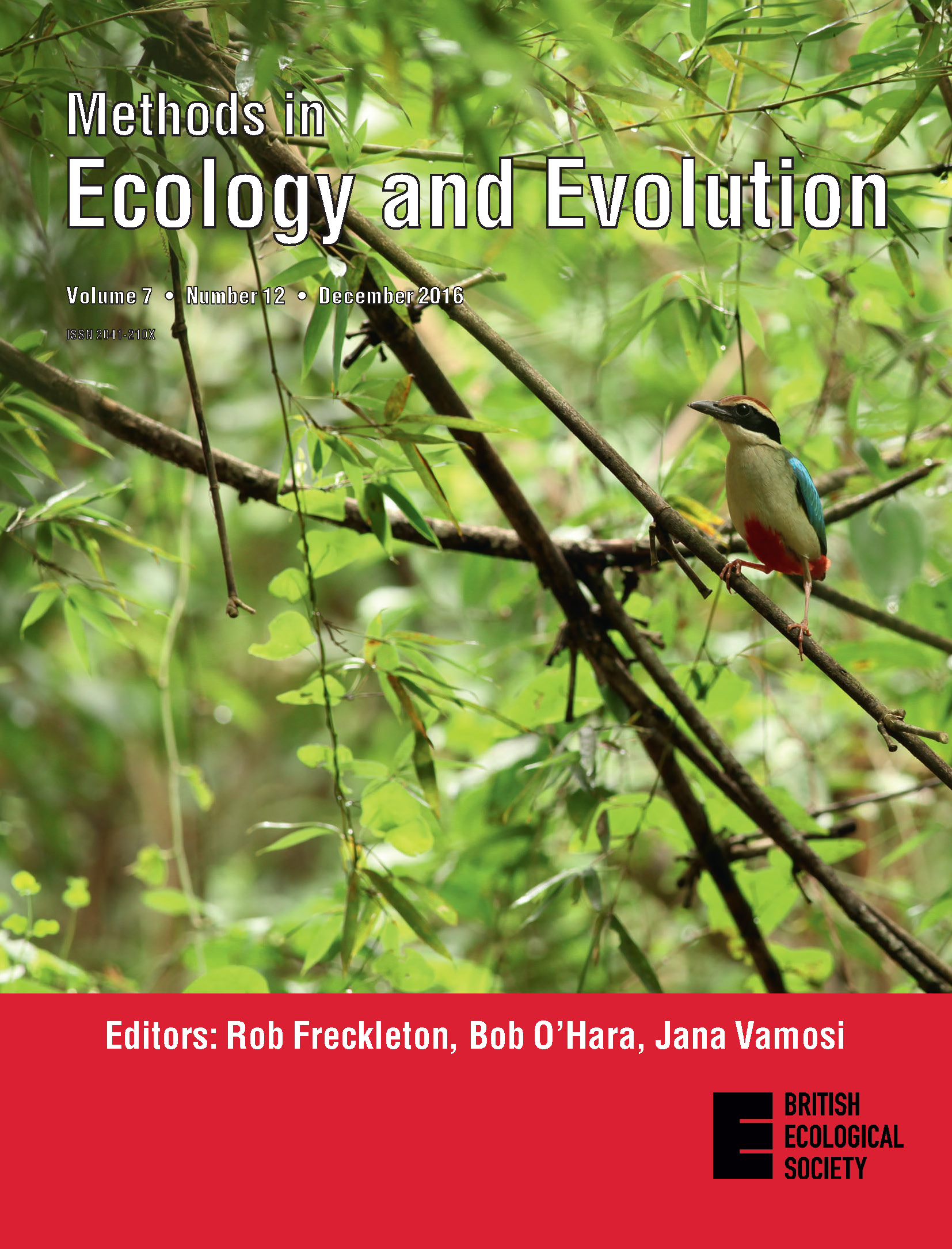
Issue 7.12

Issue 7.12 is now online!

The final 2016 issue of Methods is now online!

This month’s issue contains four Applications articles and two Open Access articles, all of which are freely available.

– iNEXT: The R package iNEXT (iNterpolation/EXTrapolation) provides simple functions to compute and plot the seamless rarefaction and extrapolation sampling curves for the three most widely used members of the Hill number family (species richness, Shannon diversity and Simpson diversity).

– camtrapR: A new toolbox for flexible and efficient management of data generated in camera trap-based wildlife studies. The package implements a complete workflow for processing camera trapping data.

– rotl: An R package to search and download data from the Open Tree of Life directly in R. It uses common data structures allowing researchers to take advantage of the rich set of tools and methods that are available in R to manipulate, analyse and visualize phylogenies.

– Fluctuating-temperature chamber: A design for economical, programmable fluctuating-temperature chambers based on a relatively small commercially manufactured constant temperature chamber modified with a customized, user-friendly microcontroller.

Continue reading “Issue 7.12”

Issue 7.10

Issue 7.10 is now online!

The October issue of Methods is now online!

This month’s issue contains three Applications articles and two Open Access articles, all of which are freely available.

– CODYN: New analytical tools applied to long-term data demonstrate that ecological communities are highly dynamic over time. The R package, library(“codyn”), helps ecologists implement these tools and gain insi–ghts into ecological community dynamics.

– Geometric Morphometrics: A tool for the R statistical environment that optimises the smoothing procedure for 3D surfaces used in Geometric Morphometrics.

– TRAPPER: Open source, multi-user software that facilitates analysis of videos and images, provides spatial filtering and web-mapping, allows flexible implementation of specific data collection protocols, and supports data re-use and (re)discovery.

Continue reading “Issue 7.10”