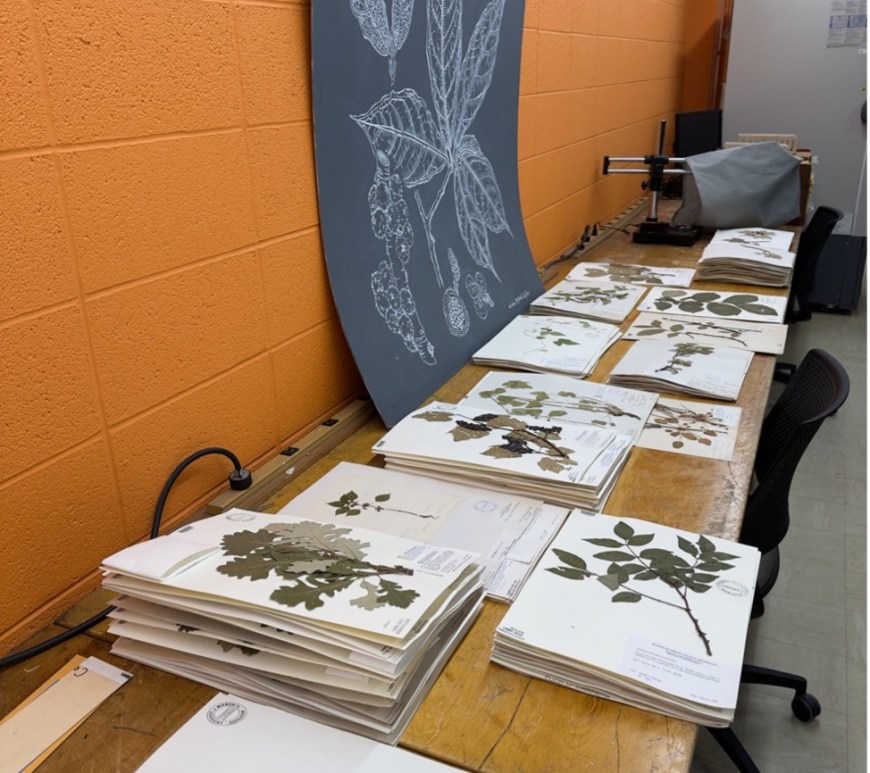
Reflecting on the past: developing hyperspectral reflectance spectroscopy for herbarium specimens

Post provided by Aaron Lee Complicated instruments and simple solutions It was an abnormally warm and balmy December in Minnesota, and Dr. Jeannine Cavender-Bares and I were in the lab. The lights were off, blinds were closed, and we had fashioned a makeshift stand to hold a large tungsten halogen lightbulb, angled perfectly to shine into the long fiber optic cable of a spectrometer connected … Continue reading Reflecting on the past: developing hyperspectral reflectance spectroscopy for herbarium specimens

Why Accurate Stable Isotope Discrimination Factors are so Important: A cautionary tale (involving kea)

Post provided by AMANDA GREER

Stable isotopes as a tool for ecologists

Our research into the foraging ecology of this cheeky parrot (kea: Nestor notabilis) prompted us to develop a simple method to establish discrimination factors © Andruis Pašukonis
Our research into the foraging ecology of this cheeky parrot (kea: Nestor notabilis) prompted us to develop a simple method to establish discrimination factors © Andruis Pašukonis

Isotopes are atoms that have the same number of protons and electrons but differ in their number of neutrons; they are lighter and heavier forms of the same element. Unlike radioactive isotopes, stable isotopes do not decay over time.

The ratio of heavy to light stable carbon (δ13C) and nitrogen (δ15N) isotopes in an animal’s tissues depend on its diet, although offset by a certain amount. This integration of δ13C and δ15N from an animal’s diet into its tissues allows ecologists to use stable isotope analysis to investigate a species’ present and historical diets, food-web structures, niche shifts,  migration patterns and more.   Continue reading “Why Accurate Stable Isotope Discrimination Factors are so Important: A cautionary tale (involving kea)”