
Post provided by Aaron Lee
Complicated instruments and simple solutions
It was an abnormally warm and balmy December in Minnesota, and Dr. Jeannine Cavender-Bares and I were in the lab. The lights were off, blinds were closed, and we had fashioned a makeshift stand to hold a large tungsten halogen lightbulb, angled perfectly to shine into the long fiber optic cable of a spectrometer connected to a leaf clip. We had just received a focusing lens to reduce a target’s measurement area, and were testing to see if it worked. We peered into the window of the leaf clip, and lo and behold, the spot size was smaller! Excitedly, we hurried to trace the shape of the spot in pencil. I was hoping to craft a stamp-like setup that would enable spectral measurements from small, dead, pressed leaves mounted on herbarium specimens.
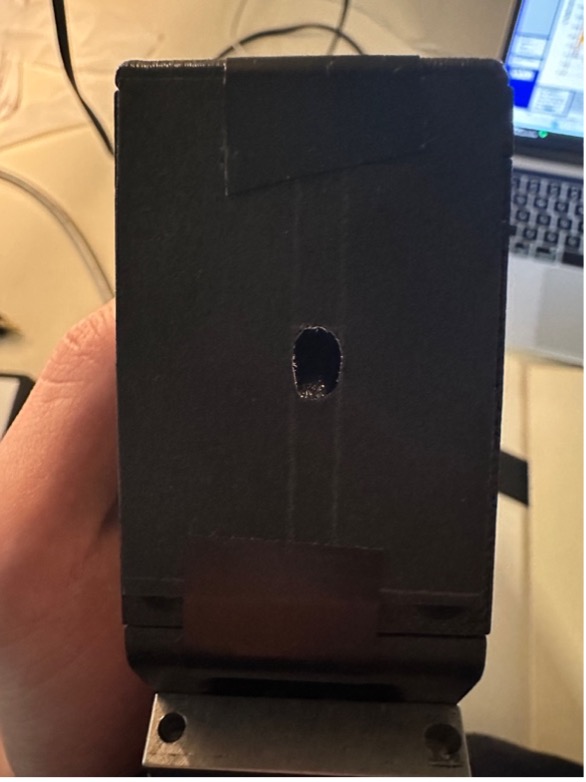

We were testing a simple solution for a complicated instrument to adapt “hyperspectral reflectance spectroscopy” for herbarium specimens. Breaking this term starting from the back-end: “spectroscopy” is a technique that measures light, “reflectance” refers to light that bounces off of a material, and “hyperspectral” refers to the many hundreds of wavelengths that we retrieve reflected light from. Across many species, leaves share similar components that absorb a specific amount of light at the same wavelengths, producing a similar shape in a reflectance spectrum. When we measure the light reflected off a leaf, we can capture these shapes and infer quantitative functional traits that tell a deeper story of plant function.
Herbarium collections: dynamic research infrastructure for discovery
While we were still making decisions about the direction of my dissertation, Dr. Ya Yang, Dr. Brett Fredericksen, and I were involved in the ASCEND (Advancing Spectral biology in Changing ENvironments to understand Diversity) NSF Biology Integration Institute (https://spectralbiology.org). Through regular ASCEND programming and discussions, I was first exposed to the power of hyperspectral data. Today, hyperspectral data is most commonly used in applied contexts, from remote sensing at the landscape and biosphere scales, to high-throughput phenotyping in agricultural work. I am interested in the evolution and ecology of plant function at broad scales of time and space, and I was curious about the utility of hyperspectral data in the herbarium.
Herbaria are an amazing resource for the ecology and evolution communities. They centralize centuries of plant collections from all over the globe. A network of herbaria allow, in many cases, loans of material across countries and continents. As an herbarium scientist, you can travel across time and space without leaving your desk! However, as archives of biodiversity, herbaria are closely guarded by their protectors—the collections managers and curators. While many want to see the collections used, they are also conscientious of preserving the collections for long-term, indefinite use.
With this in mind, we approached Jeannine, lead PI in ASCEND, with a proposal to collaborate and develop models to estimate leaf traits from herbarium specimens, eventually leading to our aforementioned December “breakthrough”. We next turned to the collections manager at the University of Minnesota Herbarium, Dr. Tim Whitfeld, for guidance on how to best approach our study.

Together, we decided to target common species from the metropolitan area around our university. Our study required destructive sampling from specimens, and we reasoned that these species were often collected and would continue to be collected from the region. Furthermore, in developing this work as a pilot study, we decided to sample for traits requiring a minimal amount of tissue. Not all specimens are suitable for a spectral measurement, and our “breakthrough” of reducing the spot size allowed us to target tiny leaf fragments and specific regions of mounted leaves.
Right people, right place, right time
This project taught me the power of team-based science. As a graduate student with training in systematics and a limited perspective, I hoped that hyperspectral data from specimens could uncover the same insights about plant function as widely used trait ecology techniques. However, there was a gap in the literature validating hyperspectral data for herbarium specimens. I was repeatedly reassured that our study was working through repeated interactions with ASCEND (including Juan Ramirez-Lerma and Drs. Antonio Guzmán, Dawson White, and Dudu Meireles). We also involved undergraduate collaborators Lauren Vander Esch and Jin Oong in the data collection and analysis, and they began to make observations about the species and offered suggestions on our workflows. Collaborating with stakeholders from multiple scientific communities allowed us to consider pragmatic and ethical approaches to retrieving traits from hyperspectral measurements of herbarium specimens.
Since initiating this project, Dr. Cavender-Bares’ group at the Harvard University Herbaria has led the organization of the International Herbarium Spectroscopy Working Group (https://iherbspec.github.io/). To meet rapidly changing funding landscapes, human-driven environmental change, and huge gaps in our understanding of the status and maintenance of plant biodiversity, large and small herbaria across the world are engaging in the spectral digitization of specimens as an emerging component of the extended specimen concept. We developed a standardized protocol to enable data merging across institutions, facilitating collaborative efforts to use hyperspectral data from herbarium specimens to describe the patterns and processes underlying plant biodiversity.
I am particularly excited to continue working on herbarium-derived reflectance spectra as a trait itself. And as hyperspectral reflectance spectroscopy is rapidly adopted across herbaria, I am excited to see what we can learn by simply shining a light on a dead, pressed leaf.
Read our study here


A fascinating look at how hyperspectral reflectance spectroscopy can expand the analytical possibilities of herbarium specimens. The ability to extract additional information from preserved samples highlights how advances in spectroscopy can support research without relying solely on conventional visual assessment. Careful calibration, standardized sample handling, and appropriate reference materials also seem essential for generating reliable and comparable spectral data. An interesting example of how established collections can contribute to modern analytical research.