An Ecologist and a Programmer Walk Into a Bar…

Post provided by Daniel Vedder, Markus Ankenbrand, and Juliano Sarmento Cabral

Five years ago, a new institute opened its doors at the University of Würzburg: the Center for Computational and Theoretical Biology (CCTB). The idea was simple. Take six computational research groups, covering topics from image analysis to genomics and ecological modelling, put them in a building together, and see what happens.

Despite our disparate areas of expertise, this “experiment” has worked really well. It soon turned out that one of our greatest strengths as an institute lay in the cumulative computer know-how we have, or have acquired together. In our experience, many biologists are still somewhat wary of computational techniques, and struggle with them even when they use them. Part of the reason for this unease, we believe, is that few biologists are thoroughly trained in computer science.

Continue reading “An Ecologist and a Programmer Walk Into a Bar…”
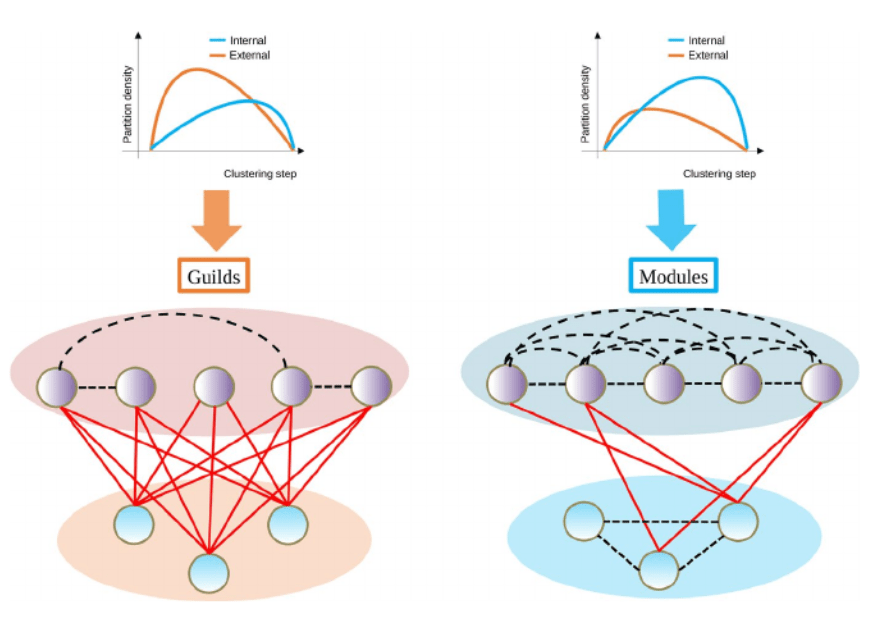
The quest for a sharp definition of function in biological networks

Robert May Prize Shortlisted Article

Post provided by Alberto Pascual-García

Each year Methods in Ecology and Evolution awards the Robert May Prize to the best paper in the journal by an author at the start of their career. Alberto Pascual has been shortlisted for his article ‘functionInk: An efficient method to detect functional groups in multidimensional networks reveals the hidden structure of ecological communities’. In this post, Alberto discusses the application of the functionInk (functional linkage) package for distinguishing modules and guilds from large multidimensional networks.

Continue reading “The quest for a sharp definition of function in biological networks”

Joint Species Distribution Models to Study Species and their Interactions

David Warton (University of New South Wales) interviews Otso Ovaskainen (University of Helsinki) about his two recent articles in Methods in Ecology and Evolution. David and Otso talk about studying communities of species and their interactions via joint species distribution models, the advances made by Otso’s papers and future developments in this field.

Continue reading “Joint Species Distribution Models to Study Species and their Interactions”