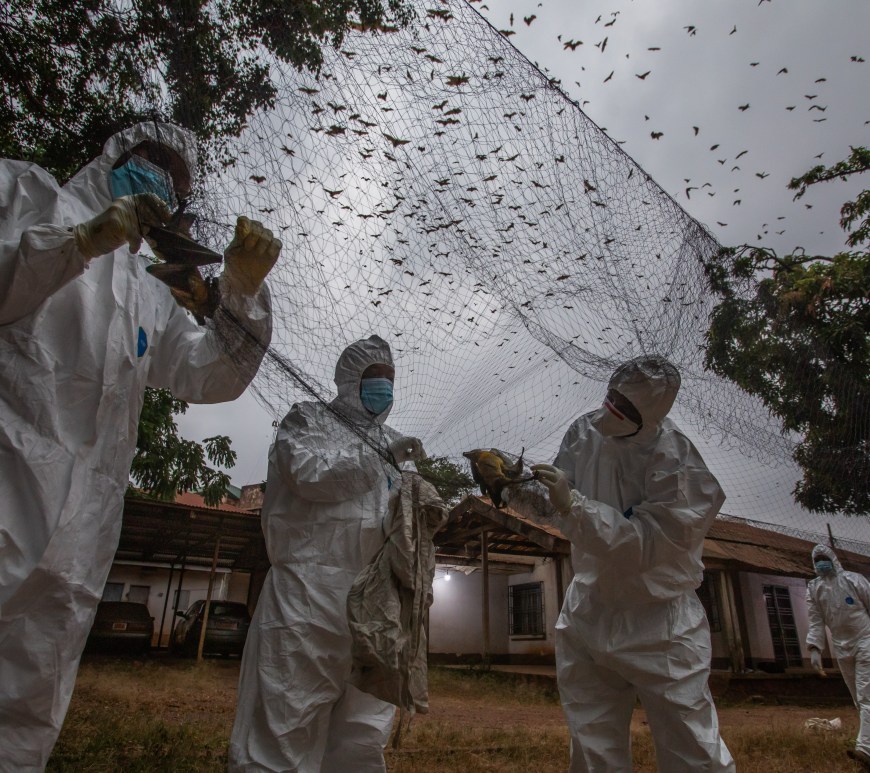
Post provided by Andrea Tonelli Over the past five decades, more than half of emerging infectious diseases in humans originated from animals, with zoonotic pathogens posing a growing threat to global health. Shifts in land use, climate change, direct use of wildlife and biodiversity loss all influence human exposure to pathogens of wild animals, shaping the likelihood of zoonotic spillover events. In the wake of … Continue reading Addressing observational biases in data-driven approaches of zoonotic hazard prediction
Post provided by Awoniyi Michael Adedayo Each year Methods in Ecology and Evolution awards the Robert May Prize to the best paper published in the journal by an author at the start of their career. Ten Early Career Researchers made the shortlist for this year’s prize, including Awoniyi Michael Adedayo, who recently defended his PhD from the Federal University of Bahia (UFBA) Brazil. In this … Continue reading Rhodamine B – a non-toxic biomarker for assessing the distance travelled by rats in urban slums
Black History Month is a UK-wide celebration that takes place every October, acknowledging and raising awareness of the contribution that Black African and Caribbean communities have made in Britain and across the globe.We are excited to promote and profile the work of Black ecologists and evolutionary biologists across the British Ecological Society blogs.
Dr. Halsey in the field measuring dune thistles.
My name is Dr. Samniqueka Halsey, and I am a computational ecologist. I use modelling and statistics to answer questions about the way the world works. In particular, I try to inform management actions about disease emergence and conservation with my models. I have worked on projects regarding Lyme disease, Chronic Wasting Disease and a dune thistle that is threatened by habitat fragmentation. I realized that I genuinely wanted to become an ecologist starting in my junior year of college when I took an ecology course. This class exposed me to the joys of fieldwork, going outside, and collecting data. Combined with a few more courses such as aquatic ecology where I could go out to streams and lakes to collect water samples and then go back to the lab to analyze, it was fascinating. I was even able to be a field technician in Arizona, where I helped to trap prairie dogs to collect blood and ectoparasites to test for the plague.
Dr. Dao (crouching on right) and team with Dr. Tovi Lehmann (with sandals), Dr. Yaro (with white cap), and Moussa Diallo (front).
The fact that mosquitoes are insects of massive importance is of little dispute. With malaria still killing almost half a million people annually and after recent outbreaks of Zika, dengue and West-Nile viruses the threat of mosquito-borne diseases is becoming common knowledge. The meme of ‘Mosquitoes are the No.1 killer of all time,’ is also growing more popular (I even heard it from my 8-year-old kid one day after he returned from school!). Yet, with all we think we know about the little bug(ger)s, it’s probably only the tip of the iceberg.
Much work was done over the past century to try to answer basic questions about mosquitoes like:
How big are their populations?
How long do they live?
Where do they go when we don’t see or feel them?
Different methods have been developed to provide insights and notions on the mosquitoes’ movements, survival, and populations estimates; but the limitations and conditions of these methods mean that our knowledge is still incomplete.
One of the gold-standard tools for answering questions like those above is Mark-Release-Recapture (MRR). It was developed almost a century ago and has been modified and remodified through the years, as different marking technologies became available. Continue reading “Life-Long Mosquito Marking: Are Stable Isotopes the Key?”
Pathogens and the infectious diseases that they cause can have devastating impacts on host individuals and populations. To better understand how pathogens are able to cause disease, we can investigate the genetic mechanisms underlying the infection process. Hosts may respond to infection by upregulating defence pathways. Pathogens, in turn, evade these host immune responses as they infect and cause disease. As this process unfolds and each organism responds to the other, gene expression changes in both the host and the pathogen. These gene expression changes can be captured by dual RNA‐seq, which simultaneously captures the gene expression profiles of a host and of a pathogen during infection. Continue reading “Using Dual RNA-seq to Investigate Host-Pathogen Systems When Genomic Resources are Limited”
Analysis of datasets collected on marked individuals has spurred the development of statistical methodology to account for imperfect detection. This has relevance beyond the dynamics of marked populations. A couple of great examples of this are determining site occupancy or disease infection state.
EURING Meetings
The regular series of EURING-sponsored meetings (which began in 1986) have been key to this development. They’ve brought together biological practitioners, applied modellers and theoretical statisticians to encourage an exchange of ideas, data and methods.
The discovery of Chronic Wasting Disease (CWD) in Norway in 2016 has led to extensive measures and testing of deer in Norway. Since 2018 there have been similar measures within the EU. But how many deer need to be tested before we can be (almost) certain that a population is not infected by CWD?
Statistical and quantitative methods within ecology have increased substantially in recent years. This rise can be attributed both to the growing need to address global environmental change issues, as well as the increase in data sources to address these challenges. Continue reading “Statistical Ecology Virtual Issue”
Current eDNA sampling technologies consist mainly of do‐it‐yourself solutions. The lack of purpose‐built sampling equipment is limiting the efficiency and standardization of eDNA studies. So, Thomas et al. (a team of molecular ecologists and engineers) designed ANDe™. In this video, the authors highlight the key features and benefits of ANDe™. This integrated system includes a backpack-portable pump that integrates sensor feedback, a pole extension with remote pump … Continue reading ANDe™: High‐Throughput eDNA Sampling in a Fully Integrated System
This double-size issue contains six Applications articles (one of which is Open Access) and two Open Access research articles. These eight papers are freely available to everyone, no subscription required.
–Temperature Manipulation: Welshofer et al. present a modified International Tundra Experiment (ITEX) chamber design for year-round outdoor use in warming taller-stature plant communities up to 1.5 m tall.This design is a valuable tool for examining the effects of in situ warming on understudied taller-stature plant communities
–Zoon: The disjointed nature of the current species distribution modelling (SDM) research environment hinders evaluation of new methods, synthesis of current knowledge and the dissemination of new methods to SDM users. The zoon R package aims to overcome these problems by providing a modular framework for constructing reproducible SDM workflows.
–BEIN R Package: The Botanical Information and Ecology Network (BIEN) database comprises an unprecedented wealth of cleaned and standardised botanical data. The bien r package allows users to access the multiple types of data in the BIEN database. This represents a significant achievement in biological data integration, cleaning and standardisation.


 Methods Blog