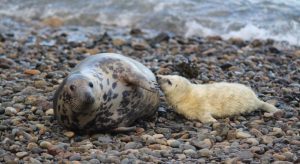
Wild grey seals. By Philip Newman, Natural Resources Wales
A brand new method has been developed by scientists at Plymouth Marine Laboratory (PML) and the University of Exeter, in collaboration with Abertay University and Greenpeace Research Laboratories, to investigate links between top predator diets and the amount of microplastic they consume through their prey. It offers potential insights into the exposure of animals in the ocean and on land to microplastics.
An estimated 9.6-25.4 million tonnes of plastic will enter the sea annually by 2025. Microplastics in particular have been found on the highest mountains and in the deepest seas. New techniques are needed to trace, investigate and analyse this growing concern. Continue reading “Finding the Links between Prey and Microplastics”
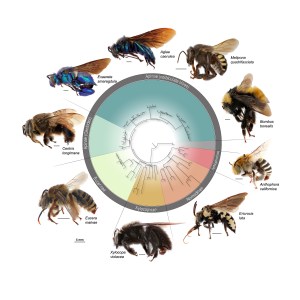
Sequencing ultraconserved DNA for phylogenetic research is a hot topic in evolution right now. As the name implies, Ultraconserved Elements (UCEs) are regions of the genome that are nearly identical among distantly related organisms. They can provide useful information for difficult phylogenetic questions. The list of advantages is long – among others, UCEs are:
phylogenetically informative on different timescales.
A key reason for the method’s success is the developers’ commitment to full transparency, active tutoring, and willingness to help next-gen sequencing newbies like me to get started. Help is just a github-issue post away.
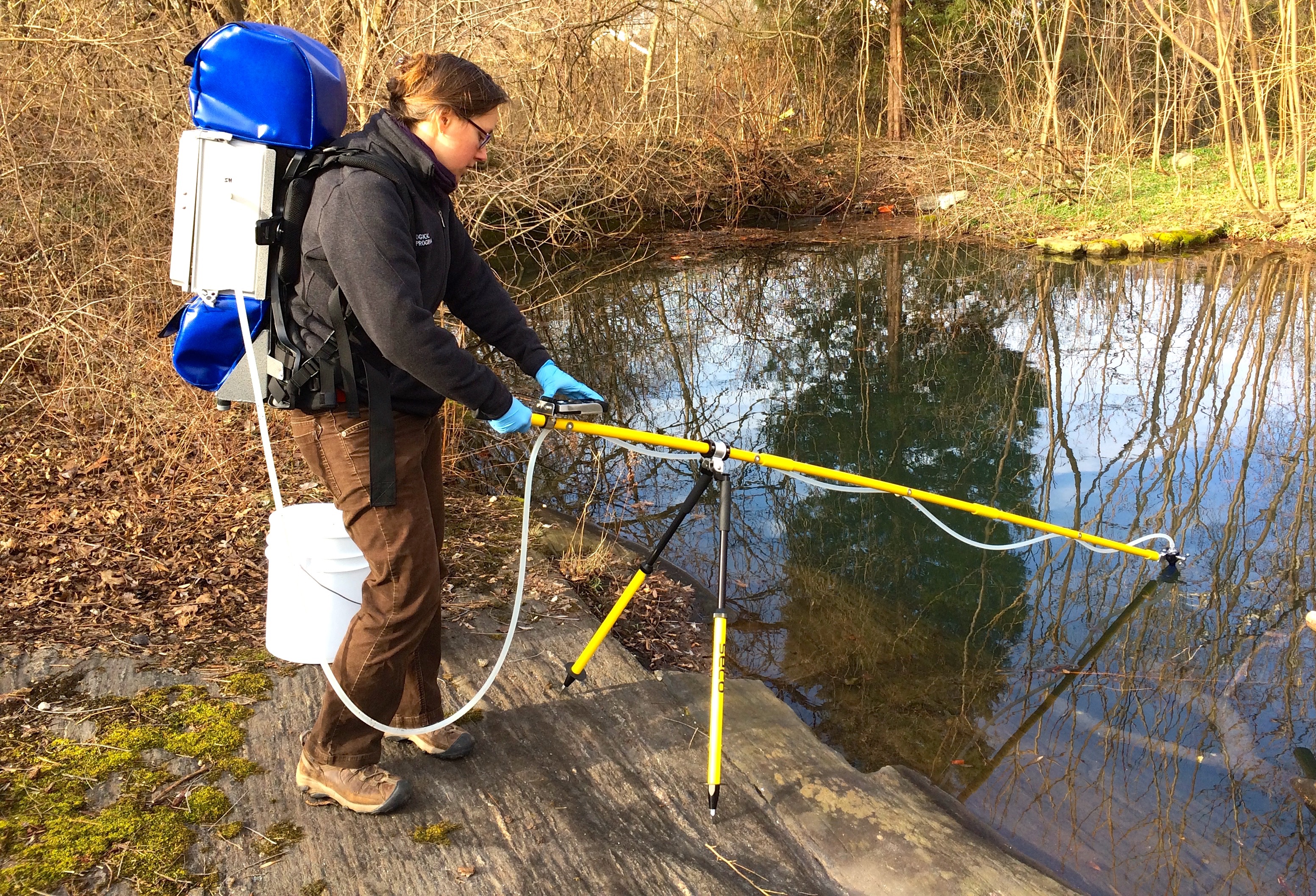
The ANDe system can help researchers tell whether endangered species are present.
In recent years, there have been a lot of studies on the use of environmental DNA (eDNA) for species detection and monitoring. This method takes advantage of the fact that organisms shed DNA into the environment in the form of urine, feces, or cells from tissue such as skin. As this DNA stays in the environment, we can use molecular techniques to search for traces of it. By doing this, we can determine if a species lives in a particular place.
The BES Microbial Ecology Special Interest Group is running a workshop today (Thursday 2 November) on Novel Tools for Microbial Ecology. To compliment this workshop, Xavier Harrison has edited a Virtual Issue of the best Methods in Ecology and Evolution articles on advances in methods of studying microbial evolution and ecology from the past few years.
Advances in Next-Generation Sequencing (NGS) technology now allow us to study associations between hosts and their microbial communities in unprecedented detail. However, studies investigating host-microbe interactions in the field of ecology and evolution are dominated by 16S and ITS amplicon sequencing. While amplicon sequencing is a useful tool for describing microbial community composition, it is limited in its ability to quantify the function(s) performed by members of those communities. Characterising function is vital to understanding how microbes and their hosts interact, and consequently whether those interactions are adaptive for, or detrimental to, the host. The articles in this Virtual Issue cover a broad suite of approaches that allow us to study host-microbe and microbe-microbe interactions in novel ways.
Rather than conduct an aquatic roll call with nets to know which fish reside in a particular body of water, scientists can now use DNA fragments suspended in water to catalog invasive or native species.
“We’ve sharpened the environmental DNA (eDNA) tool, so that if a river or a lake has threatened, endangered or invasive species, we can ascertain genetic detail of the species there,” said senior author David Lodge, the Francis J. DiSalvo Director of the Atkinson Center for a Sustainable Future at Cornell, and professor of ecology and evolutionary biology. “Using eDNA, scientists can better design management options for eradicating invasive species, or saving and restoring endangered species.” Continue reading “Refined DNA Tool Tracks Native and Invasive Fish”
Time flies… in the blink of an eye! And even more so in science. The molecular lab work we were used to two decades ago seems like ancient history to today’s PhD students. The speed of change in sequencing technology is so overwhelming that imagination usually fails to foresee how our daily work will be in 10 years’ time. But in the field of biodiversity assessment, we have very good clues. Next Generation Sequencing is quickly becoming our workhorse for ambitious projects of species and genetic inventories.
One by One Approach to Studying Biodiversity
For decades, most initiatives measured biodiversity in the same way: collect a sample of many individuals in the field, sort the specimens, identify them to a Linnaean species one at a time (if there was a good taxonomist in the group which, unfortunately, it is kind of lucky these days!), and count them. Or, if identification was based on molecular data, the specimen was subject to DNA extraction, to sequence one (or several) short DNA markers. This involved countless hours of work that could be saved if, instead of inventorying biodiversity specimen-by-specimen, we followed a sample-by-sample approach. To do this now, we just have to make a “biodiversity soup”.
Biodiversity assessment based on morphological identification and/or Sanger sequencing (“The one-by-one approach”)
“In some years, chum salmon are frequently the bycatch of pollock fishermen” in the Bering Sea, Garvin explained. “Genetically, chum salmon that originate in Western Alaska tend to look very similar. This makes it difficult for stakeholders because management and conservation efforts to address this bycatch can differ among these regions, but the ability to identify them with genetics is not possible.” Continue reading “Genetic Research May Help Trace Chum Salmon to Home Rivers”
DNA dietary analysis is a non-invasive tool used to identify the food consumed by vertebrates. The method relies on identifying prey DNA in the target animals’ scats. It’s especially useful for marine animals such as seals and seabirds as it is difficult to watch their feeding events.
In the video below, Julie McInnes describes scat collection protocols that she (along with Rachael Alderman, Bruce Deagle, Mary-Anne Lea, Ben Raymond and Simon Jarman) developed to optimise the detection of food DNA in vertebrate scat samples. The authors use the shy albatross to demonstrate their new methods.




 Methods Blog