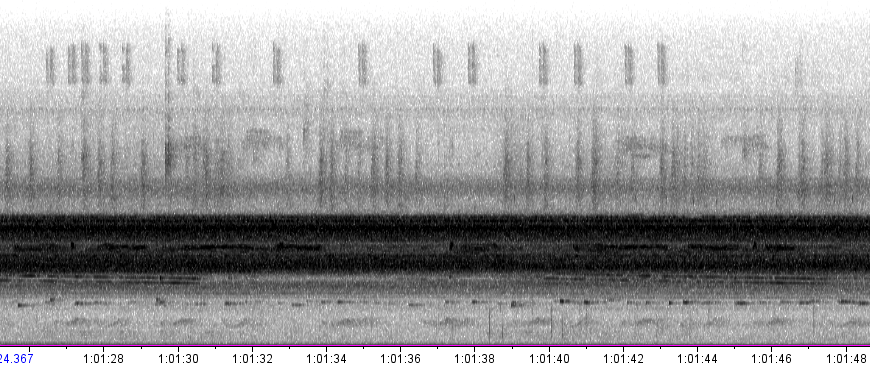
Gould’s toucanet Selenidera gouldii display involves dancing, but also lots of vocalisation. Credit: Oliver Metcalf.
Acoustic indices are increasingly being used when analysing soundscapes to gain information on biodiversity. However, inconsistent results and lack of consensus on best practices has hampered their application in conservation and land‐use management contexts. In this post, Oliver Metcalf talks about his Methods in Ecology and Evolution article ‘Acoustic indices perform better when applied at ecologically meaningful time and frequency scales’, where he highlights the need to calculate acoustic indices at ecologically appropriate time and frequency bins to reduce signal masking effects.
By now we’re all familiar with the global biodiversity crisis: increasing numbers of species extinct or at risk of extinction; widespread habitat loss and a seemingly endless set of political, logistical and financial obstacles hampering swift action for conservation. The international Convention on Biological Diversity (CBD) has set twenty global diversity targets, many of which require participating nations to conduct accurate and efficient monitoring to assess their progress and inform policy decisions. Governing bodies and organizations worldwide have agreed that immediate, efficient action is essential to preserving our planet’s increasingly threatened ecosystems.
But how? Diversity measurement techniques are a tricky business. Accurately recording diversity can be time-consuming, labor-intensive, expensive, invasive and highly susceptible to human error. Often these methods involve the employment of trained specialists to individually identify hundreds or even thousands of species, a process that can take many months to complete.
Marine habitats are particularly difficult to access because of the physical limitations of humans underwater, and are often flawed due to the influence of our presence on marine organisms. However, the oceans contain many of the world’s most diverse systems, and, despite the limitations of current methods, the need to monitor marine diversity is a top priority for the global conservation movement. Continue reading “Revealing Biodiversity on Rocky Reefs using Natural Soundscapes”


 Methods Blog