plantR: Managing species records from biological collections

Post provided by Renato Lima

Many biodiversity studies, covering a wide range of goals, need species records. These records are becoming readily available online, however there is minimal standardisation for these records at this stage, therefore requiring final users to spend a significant amount of time formatting records prior to using data. To overcome this, Renato Lima et al. have created plantR – an open-source package that provides a comprehensive toolbox to manage species records from biological collections. In this blog post, Renato discusses the workflow of the package and describes how this package can help researchers better assess data quality and avoid data leakage.

Continue reading “plantR: Managing species records from biological collections”

Why are some mammals black and white? 

Natasha Howell of Bristol University unearths the mystery of striking colouration in mammals and what skunks and bees have in common. This blog is part of our colourful countdown to the holiday season where we’re celebrating the diversity and beauty of the natural world. Click here to read the rest of the colour countdown series. The vast majority of mammal species are not known for their striking colouration. Compared to other … Continue reading Why are some mammals black and white? 

How do birds see the world? 

Almut Kelber, Professor at Lund University, takes us on a sweeping tour of the complex array of bird vision – from chickens to owls – to unravel how their ecology affects the way they see the world. This blog is part of our colourful countdown to the holiday season in which we’re celebrating the diversity and beauty of the natural world. Click here to read the rest of … Continue reading How do birds see the world? 

October Issue Out Now!

Our October Issue is out now! It’s a bumper issue, with 26 articles presenting the latest methods in ecology and evolution. We have methods for measuring temporal change in alpha diversity, aerial imaging of field plots, analysing 3D morphology images and more, plus four Applications and five Practical Tools articles for your reading. Find out more below! Featured Articles The potential and practice of arboreal … Continue reading October Issue Out Now!

A framework for unifying disturbance ecology

Post provided by: Brian Buma

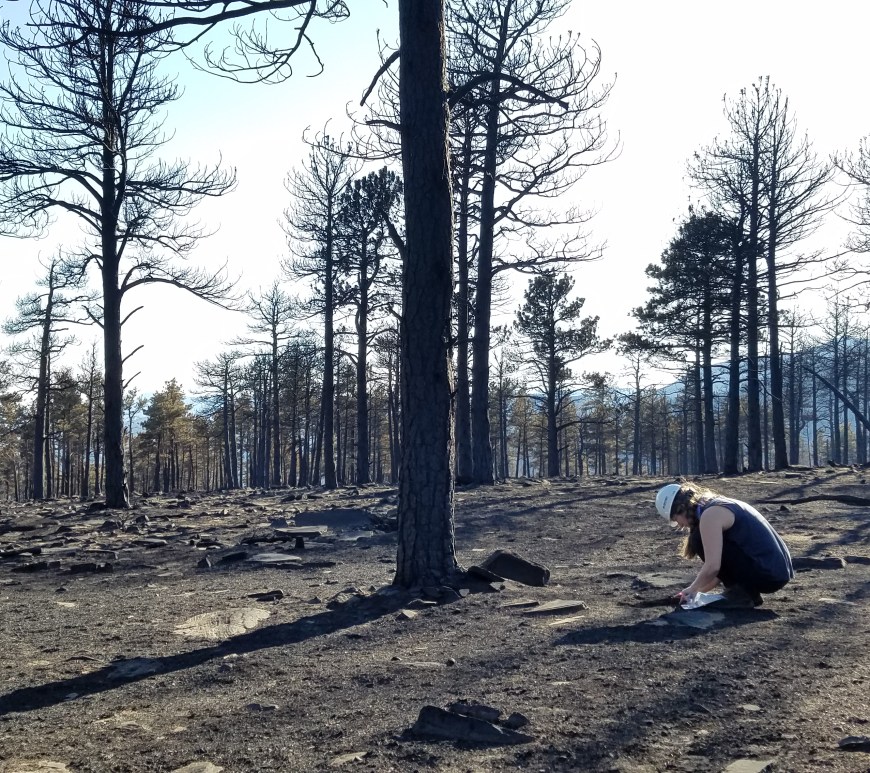
In this post, Brian Buma discusses a unifying framework for studying disturbance ecology, from largescale wildfires to bacterial colonies, as proposed in the new paper “Disturbance ecology and the problem of n = 1: A proposed framework for unifying disturbance ecology studies to address theory across multiple ecological systems” recently published in Methods in Ecology and Evolution.

Continue reading “A framework for unifying disturbance ecology”

The worldwide use of wildlife detection dogs – and how they became part of our life

Post provided by Annegret Grimm-Seyfarth

Border Collie Zammy is trained to search for Eurasian otter scat and pond, alpine and great crested newts. Photo: André Künzelmann.

For those not directly working with them, using wildlife detection dogs always sound like a new fancy idea that should be tested somehow. However, this method is neither new nor rare, and people working with wildlife detection dogs often call them their best method in finding their target species. In this post, Annegret Grimm-Seyfarth discusses her paper ‘Detection dogs in nature conservation: A database on their worldwide deployment with a review on breeds used and their performance compared to other methods’, which shows the broad and worldwide applications of wildlife detection dogs.

Continue reading “The worldwide use of wildlife detection dogs – and how they became part of our life”

10th Anniversary Volume 7: eDNA Editor’s Choice

To celebrate our 10th Anniversary, we are highlighting a key article from each of our volumes. For Volume 7 we selected The ecologist’s field guide to sequence‐based identification of biodiversity’ by Creer et al. (2016).

In this post, two of our Associate Editors with expertise in eDNA, Lynsey Harper and Chloe Robinson, select their favourite MEE papers in this field.

Continue reading “10th Anniversary Volume 7: eDNA Editor’s Choice”

2019 Robert May Early Career Researcher Prize Shortlist

Each year Methods in Ecology and Evolution awards the Robert May Prize to the best paper in the journal by an author at the start of their career. Today we present the shortlisted papers for 2019’s award, based on articles published in volume 10 of the journal. The winner will be chosen by the journal’s Senior Editors in a few weeks. Keep an eye on the blog … Continue reading 2019 Robert May Early Career Researcher Prize Shortlist

Methods behind the Madness: Ecology at the Poles

Post provided by Chloe Robinson, Crystal Sobel and Valerie Levesque-Beaudin

Aurora Borealis in the polar north. Photo: Noel Bauza, Pixabay

For those of us in the Northern Hemisphere, the coldest months of the year are upon us. A combination of post-holiday ‘blues’ and the cold, dark mornings make the daily trudge to work all that less inspiring. Recent snow storms in locations such as Newfoundland (Canada), have made it nearly impossible for many people to leave their homes, let alone commute to work. Now cast your mind to a little over 2,000 km north of Newfoundland and imagine the challenges faced with carrying out a job during the coldest, darkest months of the year.

As with every other biome on the planet, polar biomes contain a variety of different species, from bugs to baleen whales. To better understand the different species at our poles, scientists need to collect ecological data, but this is far from a walk in the park.

Iceberg in the Gerlache Strait, Antarctica. Photo: Liam Quinn, flikr.

With the year 2020 marking 200 years since the discovery of Antarctica and the Centenary of ‘vital’ Scott Polar Research Institute (Cambridge, UK), we wanted to highlight some of the polar research published in the journal, featuring challenges faced and current research being undertaken at the poles.

Continue reading “Methods behind the Madness: Ecology at the Poles”

Ten Years of Methods in Ecology and Evolution

Methods in Ecology and Evolution is turning 10 years old! Back in 2010, we launched the journal because of feedback from the community that there was a need for a journal that promoted the publication of new methods. Founding Editor Rob Freckleton and Graziella Iossa (now a member of the Editorial Board) summarised the aims and ambitions for the journal in the first issue. They … Continue reading Ten Years of Methods in Ecology and Evolution