Every species in the world has a unique geographic distribution. But many species have similar ranges. There are many things that can cause two (or more) species to have similar ranges – for example shared evolutionary histories, physical obstacles (mountains, oceans etc.) or ecological barriers limiting their dispersal. As a consequence, different regions of the globe are inhabited by different sets of living organisms.
In the mid-19th century ecologists recognised that the earth could be divided into different biogeographic regions. Alfred Russel Wallace (1823–1913) played a key role in defining and recognising biogeographic regions. He improved the existing maps of biogeographic regions and provided basic rules to identify them. His observation that some of these regions are home to similar species, despite being far away from each other and separated by significant barriers was the inspiration for Alfred Wegener’s theory of continental drift. In more recent years regionalisation has been used to understand the spatial drivers of biological evolution and to protect those regions characterised by particularly unique flora and fauna.
The biogeographic regions identified by Alfred Russel Wallace from The Geographical Distribution of Animals (1876)
This month’s issue contains two Applications articles and two Open Access articles, all of which are freely available.
– Plant-O-Matic: A free iOS application that combines the species distribution models with the location services built into a mobile device to provide users with a list of all plant species expected to occur in the 100 × 100 km geographic grid cell corresponding to the user’s location.
– RClone: An R package built upon genclone software which includes functions to handle clonal data sets, allowing:
Checking for data set reliability to discriminate multilocus genotypes (MLGs)
Ascertainment of MLG and semi-automatic determination of clonal lineages (MLL)
Genotypic richness and evenness indices calculation based on MLGs or MLLs
Describing several spatial components of clonality
This month’s issue contains two Applications articles and two Open Access articles, all of which are freely available.
– MO-Phylogenetics: A software tool to infer phylogenetic trees optimising two reconstruction criteria simultaneously and integrating a framework for multi-objective optimisation with two phylogenetic software packages.
– PHYLOMETRICS: An efficient algorithm to construct the null distributions (by generating phylogenies under a trait state-dependent speciation and extinction model) and a pipeline for estimating the false-positive rate and the statistical power of tests on phylogenetic metrics..
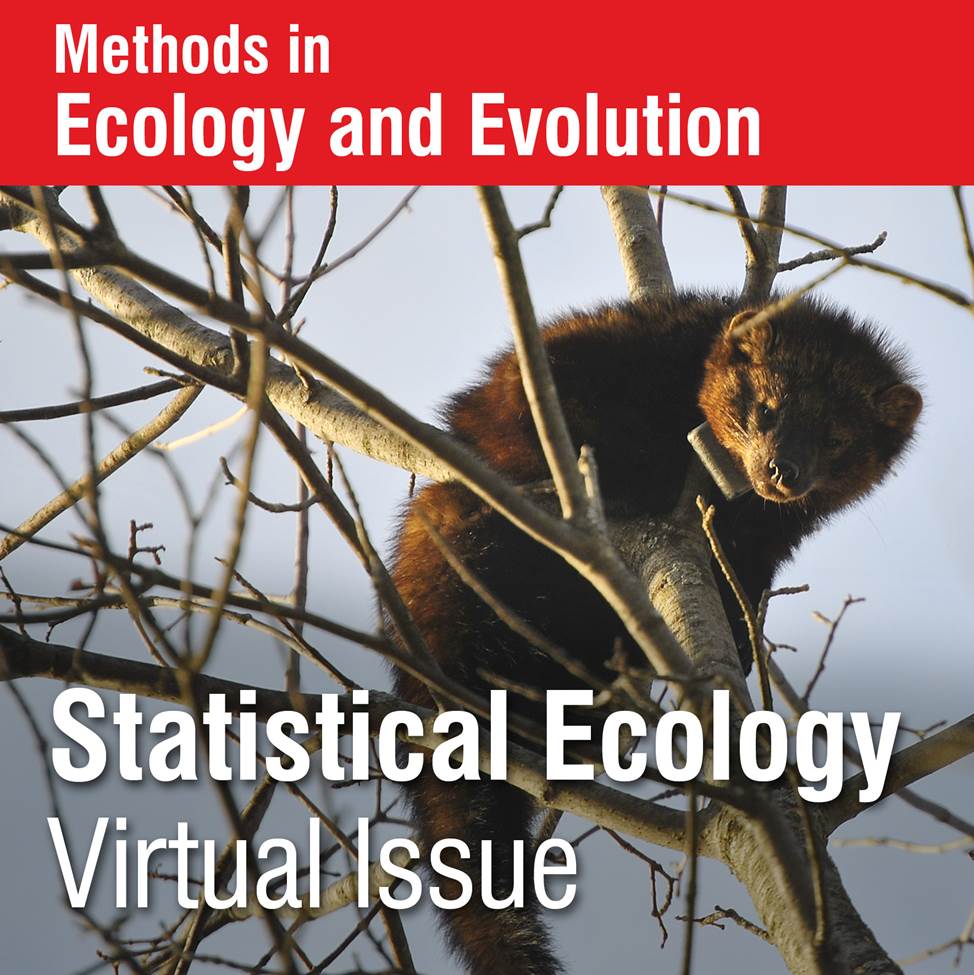
At the last ISEC, in Montpellier in 2014, an informal survey suggested that Methods in Ecology and Evolution was the most cited journal in talks. This reflects the importance of statistical methods in ecology and it is one reason for the success of the journal. For this year’s International Statistcal Ecology Conference in Seattle we have produced a virtual issue that presents some of our best recent papers which cross the divide between statistics and ecology. They range over most of the topics covered at ISEC, from statistical theory to abundance estimation and distance sampling.
We hope that Methods in Ecology and Evolution will be equally well represented in talks in Seattle, and also – just as in Montpellier – some of the work presented will find its way into the pages of the journal in the future.
Our 5th Anniversary Special Feature is a collection of six articles (plus an Editorial from Executive Editor Rob Freckleton) that highlights the breadth and depth of topics covered by the journal so far. It grew out of our 5th Anniversary Symposium – a joint event held in London, UK and Calgary, Canada and live-streamed around the world in April 2015 – and contains papers by Associate Editors, a former Robert May prize winner and regular contributors to the journal.
The six articles are based on talks given at last May’s Symposium. They focus on:
In his Editorial for the Special Feature, Rob Freckleton looks to the future. In his words: “we hope to continue to publish a wide range of papers on as diverse a range of topics as possible, exemplified by the diversity of the papers in this feature”.
Friday was Endangered Species Day – so this is a good time to reflect on what science and scientists can do to support conservation efforts and to reduce the rate of species extinctions. One obvious answer is that we need to study endangered species to understand their habitat requirements as well as their potential for acclimatization and adaptation to changing environmental conditions. This information is crucial to for the design of informed conservation planning. However, for most endangered species the relevant phenotypes are not known a priori, which leaves the well-intentioned scientist asking “which traits should I measure?”. Transcriptome analysis is often a good way to answer to this question.
Our understanding of how biological diversity works has been advanced by a long history of observing species and linking patterns to ecological processes. However, we generally don’t focus as much on those species that aren’t observed, or in other words ‘absent species’. But, can absent species provide valuable information?
To begin learning about dark diversity, there are two important terms that we need to define: ‘species pool’ and ‘focal community’. A ‘species pool’ is a set of species present in a particular region or landscape that can potentially inhabit a particular observed community because of suitable local ecological conditions.
A ‘focal community’ is the set of species that have been observed in a particular region or landscape (this is the ‘observed community’ and can also be referred to as alpha diversity). For a given focal community to become established, the species within it must have overcome dispersal pressures as well as environmental and biotic filters.
High frequency data, like those obtained from individual electronic tags, carries the potential of giving us detailed information on the behaviour of species at the individual level. Such data are particularly useful for marine species, as we can’t observe them directly for long periods of time.
Understanding how individuals use water columns – both at daily and seasonal scales – can help define conservation measures such as restricting fishing activity to reduce by-catch or defining protected areas to help recovering populations or protect spawning and nursery areas. High frequency data have become popular as they give insight to detailed individual foraging behaviour and therefore the specific energetic needs that are linked to reproduction and fitness. Continue reading “Bringing Ecologists and Statisticians Together for the Conservation of Endangered Species”




 Methods Blog