Winner! Jenna Kline: Studying collective animal behaviour with drones and computer vision

Throughout March, we are featuring articles shortlisted for the 2025 Robert May Prize. The Robert May Prize is awarded by the British Ecological Society each year for the best paper in Methods in Ecology and Evolution written by an early career author. Jenna Kline’s article ‘Studying collective animal behaviour with drones and computer vision‘ is the winner of the award. Read all shortlisted articles here. About the paper What is … Continue reading Winner! Jenna Kline: Studying collective animal behaviour with drones and computer vision

Pieter Sanczuk: Continuous quantification of forest microclimate temperatures in space and time using fibre-optic technology

Throughout March, we are featuring articles shortlisted for the 2025 Robert May Prize. The Robert May Prize is awarded by the British Ecological Society each year for the best paper in Methods in Ecology and Evolution written by an early career author. Pieter Sanczuk’s article ‘Continuous quantification of forest microclimate temperatures in space and time using fibre-optic technology‘ is one of those shortlisted for the award. About the paper What … Continue reading Pieter Sanczuk: Continuous quantification of forest microclimate temperatures in space and time using fibre-optic technology

Or Ben-Zvi: The Benthic Underwater Microscope imaging PAM (BUMP): A non-invasive tool for in situ assessment of microstructure and photosynthetic efficiency

Throughout March, we are featuring articles shortlisted for the 2025 Robert May Prize. The Robert May Prize is awarded by the British Ecological Society each year for the best paper in Methods in Ecology and Evolution written by an early career author. Or Ben-Zvi’s article ‘The Benthic Underwater Microscope imaging PAM (BUMP): A non-invasive tool for in situ assessment of microstructure and photosynthetic efficiency‘ is one of those shortlisted for the … Continue reading Or Ben-Zvi: The Benthic Underwater Microscope imaging PAM (BUMP): A non-invasive tool for in situ assessment of microstructure and photosynthetic efficiency

Reflections from IBAC 2025: bioacoustics, community, and scientific insights

Post provided by Diandra Duengen What is IBAC? In 2025, the biennial meeting of the International Bioacoustics Society (IBAC) took place in Kerteminde, Denmark, the country in which the society was originally founded. IBAC’s aim is “[…] to promote international participation throughout the entire field of bioacoustical activity.” Since IBAC was founded in 1969, 27 bioacoustic symposia and congresses in 13 different countries have been … Continue reading Reflections from IBAC 2025: bioacoustics, community, and scientific insights

As above, so below: a perspective into the application of land-forest monitoring methods for the assessment of marine animal forests

Post provided by Torcuato Pulido Mantas I am a postdoctoral researcher in Marine Biology and Ecology at the Department of Life and Environmental Sciences (DiSVA), Polytechnic University of Marche, where I work in the Zoology Lab (link: https://www.instagram.com/zoomardisva/). We focus on understanding how climate change affects benthic marine organisms, developing new methods for marine environmental monitoring, and promoting effective conservation strategies for vulnerable habitats and … Continue reading As above, so below: a perspective into the application of land-forest monitoring methods for the assessment of marine animal forests

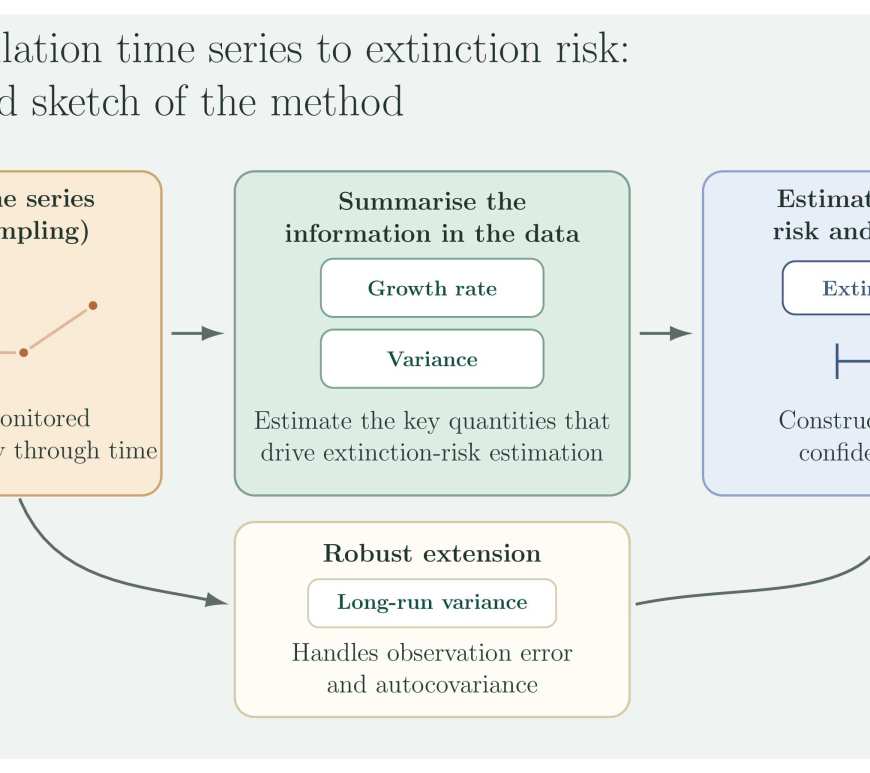
estar: An R package to measure ecological stability

Post provided by Ludmilla Figueiredo Nature is very dynamic: forests transform through the seasons and regrow after fire, insect plagues happen with little to no forewarning, and animals like the Fernandina giant tortoise and the leopard-spotted fish come back from the dead decades after apparent extinction. Some of these changes are part of the natural behaviour of these systems, but some are a response to … Continue reading estar: An R package to measure ecological stability

Managing plant viral epidemics – linking insect transmission and epidemic risk

Post provided by Ruairí Donnelly, Israël Tankam, and Alison Scott-Brown Here in the Epidemiology and Modelling Group at the University of Cambridge, our work is driven by the need to secure food supplies for future generations, particularly for those living in areas of the world already under increasing pressure from climate change and extreme weather conditions, making it harder for small-holders to produce and trade … Continue reading Managing plant viral epidemics – linking insect transmission and epidemic risk

A short guide for effective field data collection

Post provided by Faith Jones, Helen Spence-Jones, and Caroline Greiser Fieldwork is the foundation of ecological science. From observational and monitoring studies, to experiments done in complex real-world conditions, to ground-truthing models: we can’t hope to understand ecology if we don’t actually check what is happening in nature. The love of being outdoors has also attracted many of us to careers in ecology: fieldwork remains … Continue reading A short guide for effective field data collection

Teaching Models to Listen to Bats: The Story Behind BSG-BATS

Post provided by Katarina Meramo Bats are extraordinary animals. They fly, echolocate, and navigate in absolute darkness, and produce some of the most complex acoustic signals in the mammalian world. They pollinate, disperse seeds, control insect populations, and quietly hold ecosystems together. Yet, despite their importance, monitoring bats – particularly across large spatial and temporal scales – remains remarkably challenging. Over the past decade, bioacoustic … Continue reading Teaching Models to Listen to Bats: The Story Behind BSG-BATS

All I Want for Christmas is Data: Thoughts on Holidays in the Bush

In this series, we explore the unique experiences of field ecologists conducting research in remote field stations during the holiday season. Through personal stories and reflections, our contributors share what it’s like to conduct scientific work in remote, biodiverse environments, where the challenges of research intersect with the spirit of the holidays. From the solitude of secluded field stations to unexpected festive moments in the … Continue reading All I Want for Christmas is Data: Thoughts on Holidays in the Bush