Capturing the Contribution of Rare and Common Species to Turnover: A Multi-Site Version of Generalised Dissimilarity Modelling

Post provided by Guillaume Latombe and Melodie A. McGeoch

Understanding how biodiversity is distributed and its relationship with the environment is crucial for conservation assessment. It also helps us to predict impacts of environmental changes and design appropriate management plans. Biodiversity across a network of local sites is typically described using three components:

  1. alpha (α) diversity, the average number of species in each specific site of the study area
  2. beta (β) diversity, the difference in species composition between sites
  3. gamma (γ) diversity, the total number of species in the study area.
Two tawny frogmouths, a species native to Australia. ©Marie Henriksen.

Despite the many insights provided by the combination of alpha, beta and gamma diversity, the ability to describe species turnover has been limited by the fact that they do not consider more than two sites at a time. For more than two sites, the average beta diversity is typically used (multi-site measures have also been developed, but suffer shortcomings, including difficulties of interpretation). This makes it difficult for researchers to determine the likely environmental drivers of species turnover.

We have developed a new method that combines two pre-existing advances, zeta diversity and generalised dissimilarity modelling (both explained below). Our method allows the differences in the contributions of rare versus common species to be modelled to better understand what drives biodiversity responses to environmental gradients. Continue reading “Capturing the Contribution of Rare and Common Species to Turnover: A Multi-Site Version of Generalised Dissimilarity Modelling”

Disentangling Ecosystem Functions: Our Imagination is the Limit

Post supplied by Tomas Roslin and Eleanor Slade (SPATIAL FOODWEB ECOLOGY GROUP, UNIVERSITY OF OXFORD & LANCASTER UNIVERSITY)

Studies of Action

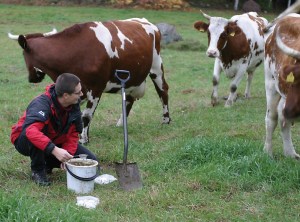
Studies of ecosystem function are studies of action: of insects pollinating flowers, of predators killing pests – and in our case (well, more often than not) of beetles disposing of dung. To isolate the effects of the critters that we think will matter, we need to selectively include or exclude them. If we think a particular species or species group is responsible for a certain function, then we test this by keeping it in or out of enclosures. If we want to look at effects of species diversity, then we create communities of different species richness.

Research on dung beetles is far from boring. © Kari Heliövaara.

Depending on the target organism, this is sometimes easy and sometimes difficult. But it almost invariably proves to be fun! We enjoy the challenge of inventing new techniques for unravelling ecosystem functions sustained by insects. Working on dung beetles – as we tend to do – can be messy, but it’s definitely never boring.

In targeting ecosystem functions, the real trick is to make the experiments relevant. What we want to understand are the effects of changes occurring in the real world. All too often studies of ecosystem functions have been focused on artificial species pools in artificial settings. To see how we have solved this, we’ll give you a quick look at our dungy portfolio of approaches to date. Continue reading “Disentangling Ecosystem Functions: Our Imagination is the Limit”

New Associate Editors

Over the next few weeks we will be welcoming three new Associate Editors to Methods in Ecology and Evolution. Susan Johnston (University of Edinburgh, UK) became a member of the Associate Editor Board on Monday 5 October. She will be joined on 19 October by Natalie Cooper (Natural History Museum, London, UK) and finally by Luísa Carvalheiro (University of Brasília, Brazil) on 2 November. You can find out … Continue reading New Associate Editors

Issue 2.6

Our last issue for 2011 is out. Issue 2.6 is packed with the latest methodological developments. We have four new articles on monitoring: from positional accuracy in the field by Mike Dodd to distance sampling butterflies by Nick Isaac and colleagues, to how to account for non-independent detection of individuals by Julien Martin and collaborators and, finally, to a class of spatial capture-recapture models for … Continue reading Issue 2.6