Bats aren’t just for Halloween: Insectivorous Bats in North America

Post provided by CHLOE ROBINSON (@CVROBINSON92)
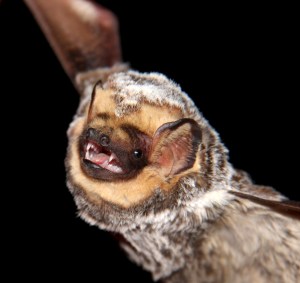
The Hoary bat (Lasiurus cinereus) is the most widespread bat in the US. ©Veronica Zamora-Gutierrez

Hello! This is my first post as Blog Editor for Methods in Ecology and Evolution and I’m thrilled to be starting with an exciting, thought-provoking topic in the wake of Halloween. But first, let me introduce myself. I currently work as a Postdoctoral Fellow and Project Manager in the Hajibabaei Lab at the Centre for Biodiversity Genomics (University of Guelph, ON, Canada) and my undergraduate and postgraduate degrees are both from Swansea University (UK). My research background is largely focused around the application of environmental DNA (i.e. free DNA found in natural environments) to detect and monitor aquatic species and answer ecological questions through both single-species detection and DNA metabarcoding.

At the moment, I’m working on the STREAM project, which combines community-based monitoring with DNA metabarcoding to gain a better understanding of freshwater health across Canada. One of my favourite parts about being in this position is the opportunity to get involved with other research being conducted in the Hajibabaei Lab. This is how I branched out into the wonderful world of bat ecology. Continue reading “Bats aren’t just for Halloween: Insectivorous Bats in North America”

New Associate Editors

Today we are welcoming two new Associate Editors to Methods in Ecology and Evolution: Huijie Qiao (Chinese Academy of Sciences, China) and Veronica Zamora-Gutierrez (Unidad Durango, Mexico and University of Southampton, UK). They have both joined on a three-year term and you can find out more about them below. Huijie Qiao “My research is focused broadly on macroecology. I work to clarify the theory and methodology behind ecological niche modelling … Continue reading New Associate Editors

Also of Interest… Journal of Applied Ecology

Post provided by Aaron M. Ellison

The Struggle is Real: Finding Interesting and Relevant Articles

Where to start? We are awash in data, information, papers, and books. There are hundreds of ecological and environmental journals published regularly around the world; the British Ecological Society alone publishes five journals and is now accepting submissions for a sixth (more information on People and Nature here).

None of us has time even to click on the various articles flagged by alerts, feeds, or keywords, and few even browse tables of contents (which are becoming irrelevant as we move to DOIs and immediate-online publication). Increasingly, we rely on our friends, colleagues, students, and mentors to point us towards papers we might find interesting – further evidence, I suppose, of the importance of good networks for knowledge creation and scientific understanding.

Regular readers of Methods in Ecology and Evolution or this Methods blog may not realise how many methodological papers are published routinely in our BES sister journals. In this inaugural posting of Also of interest…, I highlight three papers recently published in Journal of Applied Ecology that introduce and apply new, model-based methodology to interesting ecological questions. The specific methods are like many seen in the pages of Methods in Ecology and Evolution and suggest general approaches for modelling and studying complex ecological and environmental phenomena. Continue reading “Also of Interest… Journal of Applied Ecology”

Building Universal PCR Primers for Aquatic Ecosystem Assessments

Post provided by Vasco Elbrecht Many things can negatively affect stream ecosystems – water abstraction, eutrophication and fine sediment influx are just a few. However, only intact freshwater ecosystems can sustainably deliver the ecosystem services – such as particle filtration, food biomass production and the supply of drinking water – that we rely on. Because of this, stream management and restoration has often been in the … Continue reading Building Universal PCR Primers for Aquatic Ecosystem Assessments

When Measuring Biodiversity, Do Individuals Matter?

Post provided by Samuel RP-J Ross

Close up of a black-capped babbler (Pellorneum capistratum), one of the species included in our study.
Close up of a black-capped babbler (Pellorneum capistratum), one of the species in our study.

Our newly-developed method simulates intraspecific trait variation when measuring biodiversity. This gives us an understanding of how individual variation affects ecosystem processes and functioning. We were able to show that accounting for within-species variation when measuring functional diversity can reveal details about ecological communities which would otherwise remain unseen. Namely, we found a negative impact of selective-logging on birds in Borneo when accounting for intraspecific variation which we could not detect when ignoring intraspecific variation.

Why Biodiversity Matters

Biodiversity is important for many reasons. One of the main reasons is its contribution to the range of goods and services provided by ecosystems (i.e. ecosystem services) that we can take advantage of, such as natural food resources or climatic regulation. It’s generally believed that biodiversity contributes to these services by increasing and maintaining ‘ecosystem functioning’ – often defined as the rate at which ecosystems are turning input energy (e.g. sunlight) into outputs (e.g. plant biomass). Continue reading “When Measuring Biodiversity, Do Individuals Matter?”

Celebrating Wetlands Today, Protecting Them for Tomorrow

Post Provided by JULIA CHERRY, UNIVERSITY OF ALABAMA

Today is World Wetlands Day, a day to raise awareness about wetlands and the many ecosystem services that they provide. Wetlands are broadly defined as areas saturated or inundated with water for periods long enough to generate anaerobic soils and support water-loving plants. They include bogs, swamps, floodplain forests, marshes and mangroves.

Some may wonder why these habitats deserve their own day of recognition, as wetlands can evoke images of the soggy, unpleasant wild places– the “ghast pools” of Dante’s Divine Comedy or the “waste places” of Beowulf. Unfortunately, these descriptions overshadow the true beauty and value of the world’s diverse wetland ecosystems. For those of us dedicated to researching and enjoying wetlands, these areas are worth appreciating every day of the year for numerous reasons.

In honor of World Wetlands Day, I will make the case for wetlands and highlight an example of a new research tool designed to understand how coastal wetlands may respond to sea-level rise.

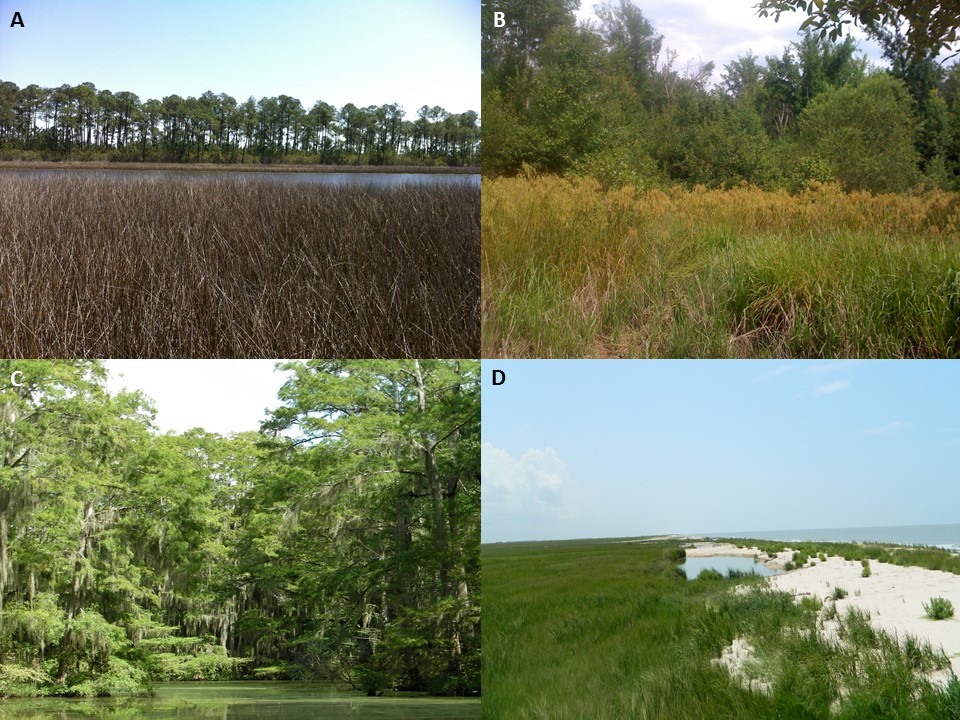
Wetland habitats, including (A) a marine-dominated coastal marsh and maritime pine island complex (Grand Bay National Estuarine Research Reserve, Mississippi, USA), (B) a freshwater floodplain marsh (Hale County, Alabama, USA), (C) a cypress-tupelo swamp (Perry Lakes, Alabama, USA), and (D) a Gulf of Mexico salt marsh (Rockefeller Wildlife Refuge, Louisiana, USA). ©Julia Cherry

Continue reading “Celebrating Wetlands Today, Protecting Them for Tomorrow”

New Associate Editors

Over the next few weeks we will be welcoming three new Associate Editors to Methods in Ecology and Evolution. Susan Johnston (University of Edinburgh, UK) became a member of the Associate Editor Board on Monday 5 October. She will be joined on 19 October by Natalie Cooper (Natural History Museum, London, UK) and finally by Luísa Carvalheiro (University of Brasília, Brazil) on 2 November. You can find out … Continue reading New Associate Editors