R-Ladies: For More Balance in the R Community!

The theme for this year’s International Women’s Day is #BalanceForBetter. So, we decided that we’d like to take this opportunity to promote an organisation that supports and empowers women and gender minorities in STEM fields that still suffer from underrepresentation. As a journal, we publish a lot of articles on software and code that are used in the study of different fields in ecology and evolutionary biology. We have a wide audience of R coders and R users who follow us on social media and read our blog. With that in mind, R-Ladies seemed like a fairly obvious group for us to promote…

Post provided by MAËLLE SALMON and HANNAH FRICK, two members of the R-LADIES GLOBAL TEAM.

What is R-Ladies?

R-Ladies is a global grassroots organisation whose aim is to promote gender diversity in the R community. The R community suffers from an underrepresentation of gender minorities (including but not limited to cis/trans women, trans men, non-binary, genderqueer, agender). This can be seen in every role and area of participation: leaders, package developers, conference speakers, conference participants, educators, users (see recent stats). What a waste of talent!

As a diversity initiative, the mission of R-Ladies is to achieve proportionate representation by encouraging, inspiring, and empowering people of genders currently underrepresented in the R community. So our primary focus is on supporting minority gender R enthusiasts to achieve their programming potential. We’re doing this by building a collaborative global network of R leaders, mentors, learners, and developers to help and encourage individual and collective progress worldwide. Continue reading “R-Ladies: For More Balance in the R Community!”

Integrating Evolution and Ecology

©H. Zell
©H. Zell

The latest Methods in Ecology and Evolution Virtual Issue – ‘Integrating Evolution and Ecology‘ – is in honour of the late Isabelle Olivieri (1957-2016): an international, interdisciplinary and ground-breaking biologist. It was edited by Louise Johnson and James Bullock and features papers on topics she researched, and in many cases pioneered. But it might perhaps have been more difficult to find 15 Methods papers on areas outside of Isabelle’s research interests!

Isabelle was the first Professor of Population Genetics at Montpellier, a past President of the European Society for Evolutionary Biology (2007-2009), and a member of the European Molecular Biology Organization. She spanned subject boundaries as easily as she collaborated across geographical borders. Her publications range through metapopulation and dispersal ecology, host-parasite coevolution, life history, invasive species and conservation ecology. In keeping with this breadth of interests, she also combined theory easily with experiment, and worked with a wide range of study systems from mites to Medicago. Continue reading “Integrating Evolution and Ecology”

The Future of Research and Publishing in Evolutionary Biology

Are you coming to the Evolution 2018 in Montpellier? Want to share your views on the future of evolution research? Fancy some beer, wine and snacks on us?

We know the history of research and publications in evolution, but what will the future hold?

We would like to invite you to participate in an exciting focus session centred around what the future research landscape might look like through the eyes of up-and-coming researchers.

When: Tuesday 21 August between 14:00 and 16:00

Where:  Bar Les Loges, Grand Hotel du Midi, Montpellier

We’re looking for active researchers (based in universities, research institutes, government agencies, NGOs or the private sector) within about 10 years of having been awarded a PhD. Experienced PhD students who have published in peer reviewed academic journals are also welcome to join. Continue reading “The Future of Research and Publishing in Evolutionary Biology”

Practical Tools: A New Article Type and a Virtual Issue

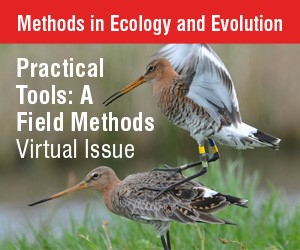
Today, we’re pleased to announce that we’re launching a new article type for Methods in Ecology and Evolution: Practical Tools. Like our Applications articles, Practical Tools will be short papers (up to 3000 words). They’ll focus on new field techniques, equipment or lab protocols. From this point forward, our Applications papers will solely focus on software and code.

Practical tools need to clearly demonstrate how tools designed for specific systems or problems can be adapted for more general use. Online supporting information can include specific instructions, especially for building equipment. You can find some examples of Applications that would now fit into this article type here and here.

To help launch our new article type, we asked four of our Associate Editors – Pierre Durand, Graziella Iossa, Nicolas Lecomte and Andrew Mahon – to put together a Virtual Issue of papers about Field Methods that have previously been published in the journal. All of the articles in ‘Practical Tools: A Field Methods Virtual Issue‘ will be free to everyone for the next month. You can find out a bit more about each of the four sections of the Virtual Issue below. Continue reading “Practical Tools: A New Article Type and a Virtual Issue”

Virtually Trekking Across the Pond with the Newest Senior Editor: Aaron M. Ellison

Post Provided by Aaron Ellison

I’m delighted to be the newest member of the diverse team of Senior and Associate Editors who have made Methods in Ecology and Evolution one of the premier journals in the field. After 15 years working on the lead editorial teams of Ecology and Ecological Monographs, I’m really looking forward to applying my editorial energies to the ESA’s friendly competitor on the other side of the ‘pond’.

My background includes:

  • an undergraduate degree in East Asian Philosophy
  • a PhD in evolutionary ecology
  • research and teaching on the natural history and population, community, and landscape ecology of plants and animals (mostly invertebrates) in the marine intertidal and subtidal, among salt marshes and mangroves, tropical and temperate forests, and carnivorous plant bogs
  • extensive forays into statistics, mathematics, and software engineering
  • increasing attention to the history and practice of art and architecture and their relationship to ecological theory
  • a quirky social-media persona
  • and more than two decades of work in editing and publishing journals with scientific societies.

All of these things contribute to my open, catholic approach to scientific research, teaching, and publishing, and their relationship to the broader world.

The editors of Methods are always interested in seeing papers on methodological advances and approaches that lead to new directions. We love reading about creative solutions for new challenges in ecological and evolutionary research and applications in the broadest sense. As a new Senior Editor, I’m especially hoping to encourage more papers in three areas: field methods (about which I’ve published two of my own papers in Methods), reproducibility, and science communication. Continue reading “Virtually Trekking Across the Pond with the Newest Senior Editor: Aaron M. Ellison”

How Strong is Natural Selection? Stitching Together Linear and Nonlinear Selection on a Single Scale

Post provided by Robert May Prize Winner Jonathan Henshaw

Some individuals survive and reproduce better than others. Traits that help them do so may be passed on to the next generation, leading to evolutionary change. Because of this, evolutionary biologists are interested in what differentiates the winners from the losers – how do their traits differ, and by how much? These differences are known as natural selection.

Linear and Nonlinear Selection

Traditionally, natural selection is separated into linear selection (differences in average trait values) and nonlinear selection (any other differences in trait distributions between winners and the rest). For example, successful individuals might be unusually close to average: this is known as stabilizing selection. Alternatively, winners might split into two camps, some with unusually high trait values, and others with unusually low trait values. This is disruptive selection (famously thought to explain the ur-origin of sperm and eggs). Stabilizing and disruptive selection are important types of nonlinear selection. In general, though, the trait distribution of successful individuals can differ from the general population in arbitrarily complicated ways.

When individuals with larger trait values have higher fitness on average (left panel), the trait distribution of successful individuals is shifted towards the right (right panel, orange curve). The difference in mean trait values between the winners and the general population is called linear selection.

Continue reading “How Strong is Natural Selection? Stitching Together Linear and Nonlinear Selection on a Single Scale”

2017 Robert May Prize Winner: Jonathan Henshaw

The Robert May Prize is awarded annually for the best paper published in Methods in Ecology and Evolution by an Early Career Researcher. We’re delighted to announce that the 2017 winner is Jonathan Henshaw, for his article ‘A unified measure of linear and nonlinear selection on quantitative traits.

The standard approach to quantifying natural selection, developed by Lande and Arnold, does not allow for comparable metrics between linear (i.e. selection on the mean phenotype) and nonlinear (i.e. selection on all other aspects of the phenotypic distribution, including variance and the number of modes) selection gradients. Jonathan Henshaw’s winning submission provides the first integrated measure of the strength of selection that applies across qualitatively different selection regimes (e.g. directional, stabilizing or disruptive selection). Continue reading “2017 Robert May Prize Winner: Jonathan Henshaw”

Issue 9.2

Issue 9.2 is now online!

The February issue of Methods is now online!

This double-size issue contains six Applications articles (one of which is Open Access) and two Open Access research articles. These eight papers are freely available to everyone, no subscription required.

 Temperature Manipulation: Welshofer et al. present a modified International Tundra Experiment (ITEX) chamber design for year-round outdoor use in warming taller-stature plant communities up to 1.5 m tall.This design is a valuable tool for examining the effects of in situ warming on understudied taller-stature plant communities

 ZoonThe disjointed nature of the current species distribution modelling (SDM) research environment hinders evaluation of new methods, synthesis of current knowledge and the dissemination of new methods to SDM users. The zoon R package aims to overcome these problems by providing a modular framework for constructing reproducible SDM workflows.

 BEIN R Package: The Botanical Information and Ecology Network (BIEN) database comprises an unprecedented wealth of cleaned and standardised botanical data. The bien r package allows users to access the multiple types of data in the BIEN database. This represents a significant achievement in biological data integration, cleaning and standardisation.

Continue reading “Issue 9.2”

A New Method for Computing Evolutionary Rates and Rate Shifts

Post provided by Pasquale Raia

Phylogenetic Effects

Today, everyone knows about the importance of accounting for phylogenetic effects when it comes to understanding trait evolution. How to account for phylogenetic effects is another matter though.

A couple of years ago, I was having a discussion on the R-sig-phylo blog and dared to define the Brownian Motion (BM) as kind of a null hypothesis that more realistic scenarios should be compared to. Maybe I crossed a line or made too simplistic a statement (see Adams and Collyer’s article in Systematic Biology for an explanation of why this matter is far trickier and more complicated than my reply suggested). The point is, my comment was hotly contested and a colleague ‘put the onus on me’ to do something better than the almighty (emphasis mine) BM.

The RRphylo method was my attempt to do just that. It may not be better than BM, but it is different. Often, that can be exactly what you need. Continue reading “A New Method for Computing Evolutionary Rates and Rate Shifts”

Exploring Coevolutionary History: Do Entire Communities Shape the Evolution of Individual Species?

Post provided by Laura Russo, Katriona Shea, and Adam Miller

Diffuse Coevolution

Interactions between plants and pollinators tend to be highly generalized.

In 1980, Janzen published an article titled “When is it coevolution?” where he explained the concept of diffuse coevolution: the idea that evolution of interacting species is shaped by entire communities, rather than simple paired interactions. This idea, though compelling, remains poorly understood, and strong evidence of diffuse coevolution acting on a community is lacking. Perhaps this is because there’s a lack of consensus on what would constitute evidence in support of the concept of diffuse coevolution, or, indeed, coevolution in general (Nuismer et al 2010). Continue reading “Exploring Coevolutionary History: Do Entire Communities Shape the Evolution of Individual Species?”