Do-it-yourself fishing and climate scenario experiments with a marine ecosystem model

Post provided by Michael Heath, Tom Doherty,  Jack Laverick & Douglas Speirs

Herring is a planktivorous fish species. Credit: Atle Grimsby.

World Fisheries Day, celebrated on November 21, is dedicated to highlighting the critical importance of healthy ocean ecosystems and to ensure sustainable stocks of fisheries in the world. Pressure to find ecologically sustainable strategies for harvesting food from the sea is getting ever stronger, especially in the face of changing climate. However, the question is complex because the harvestable species live in a complex food web where everything is directly or indirectly connected to everything else. Models for carrying out scenario analyses on the impact of fisheries management options on food webs are usually the preserve of trained experts.

In this blog post, Michael Heath of the University of Strathclyde guides us through how using a new marine modelling package and online app, published in their recent Methods in Ecology and Evolution paper ‘StrathE2E2: An R package for modelling the dynamics of marine food webs and fisheries.’, makes these analyses easily accessible to anyone with just basic website skills.

Continue reading “Do-it-yourself fishing and climate scenario experiments with a marine ecosystem model”

Jellyfish Help Scientists to Fight Food Fraud

Below is a press release about the Methods paper ‘Stable isotope-based location in a shelf sea setting: accuracy and precision are comparable to light-based location method‘ taken from the University of Southampton.

©Katie St John Glew
©Katie St John Glew

Animals feeding at sea inherit a chemical record reflecting the area where they fed, which can help track their movements, according to a new study by scientists from the University of Southampton.

Chemical testing of the source of marine food products could be a powerful tool to help to fight food fraud, maintain healthy sustainable fish stocks or marine protected areas, and ensure consumer confidence in marine eco-labelling. Continue reading “Jellyfish Help Scientists to Fight Food Fraud”

What fish ears can tell us about sex, surveillance and sustainability

Below is a press release about the Methods paper, ‘Quantifying physiological influences on otolith microchemistry, from the University of Southampton:

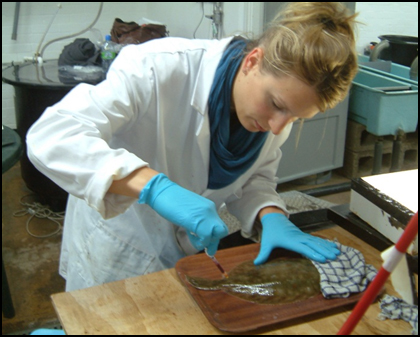
Dr Anna Sturrock blood sampling plaice ©Anna Sturrock

Scientists at the University of Southampton have found a way to pry into the private lives of fish – by looking in their ears!

By studying ear stones in fish, which act as tiny data recorders, scientists can now reveal migration patterns and even provide insights into their sex life.

Managing fish stocks in a sustainable way is a major challenge facing scientists, conservationists, policy makers and fishermen. To get the best results, accurate information about the movements of fish in the wild is needed but gathering this information is extremely difficult. Continue reading “What fish ears can tell us about sex, surveillance and sustainability”