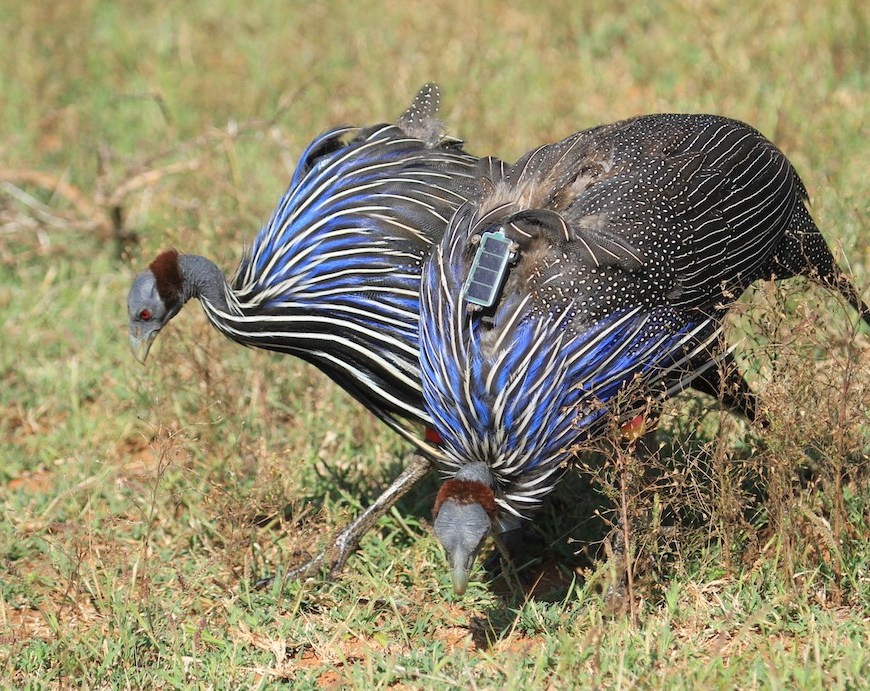
Miniaturisation of technology has made GPS tags increasingly accessible for studying animal behaviour. However, limitations in battery life introduces challenging trade-offs in data collection. In this blog post, Charlotte Christensen and Damien Farine discuss how these sampling trade-offs can impact studies that use GPS tags to study social animals.
Female mountain lion collared in Washington USA in late December 2021.
Information on how and even why terrestrial mammals move through their habitat landscapes is important for forming the foundation of how to manage and conserve species. For elusive mountain lions, GPS data is particularly vital for monitoring these important apex predators in relation to their ecosystems and the people they share the land with. In this blog post, the team discusses their novel motion model, published in Methods in Ecology and Evolution, which helps us understand the movement of mountain lions from GPS location data.
Working on FLightR, the package for analysis of data obtained from solar geolocation tracking devices, we were haunted by the unpleasant feeling of investing in technology which will soon be out of date. Until now solar geolocators have been popular in ornithological studies. This is because they’re small, light-weight (< 1/3 g) tracking devices that can be deployed even on miniature birds, such as swallows and warblers. They’ve also been the longest-lasting data loggers, with the most storage space and, of course, the most affordable ones.
Are Solar Geolocators Finished?
There are apparent drawbacks of using this technique though. To begin with, solar geolocation simply does not work for some species. You can’t use it to study birds living in dense tropical forests or in cavities, because of the light-pattern bias. For the same reason, it doesn’t provide fantastic results in light-polluted areas. Data from geolocators cannot be retrieved remotely, and this is why you need to have high recapture rates for the species you’re studying. Continue reading “The Future of Solar Geolocation Tracking is NOW”


 Methods Blog