Post provided by Marta Skowron Volponi Has the buzzing sound of a wasp flying past your ear ever made you recoil in fear of being stung? What if these buzzes are a warning display aimed at potential predators, just like the bees’ and wasps’ bright colouration that sends a message: “don’t touch me, I’m dangerous”? Or perhaps they are audio messages meant for other wasps? … Continue reading The buzzOmeter: Recording buzzing insects in motion
A central component of an organism’s fitness is its ability to successfully reproduce. This includes finding a potential mate and successful mating. For plants, movement of pollen from an anther to a conspecific stigma is essential for successful reproduction, but directly tracking movement of individual pollen grains heretofore has been impossible (with the exception of those species of orchids and milkweeds whose pollen comes in large packages (pollinia)). Knowing how pollen move around, whether or not they successfully fertilize ovules, is also central to understanding the evolution and ecology of flowering plants (angiosperms) and floral traits.
Plant-pollinator interactions are often considered to be the textbook example of co-evolution. But specialised interactions between plants and pollinators are the exception, not the rule. Plants tend to be visited by many different putative pollinator species, and pollinating insects tend to visit many plant hosts. This means that diffuse co-evolution is a much more likely driver of speciation in these communities. So, the standard phylogenetic methods for evaluating co-evolution aren’t applicable in most plant-pollinator interactions. Also, many plant-pollinator communities involve insect species for which we do not yet have fully resolved phylogenies. Continue reading “2018 Robert May Prize Winner: Laura Russo”
Bush-crickets are a little-known group of insects that inhabit our marshes, grasslands, woods, parks and gardens. Some may be seen in the summer when they are attracted to artificial lights, but as most produce noises that are on the edge of human hearing, we know little about their status. There are suggestions that some bush-crickets may be benefiting from climate change, while others may be affected by habitat changes. But how to survey something that is difficult to see and almost impossible to hear? Continue reading “Sounding Them Out: A Unique Conservation Tool for Monitoring Bush-Crickets”
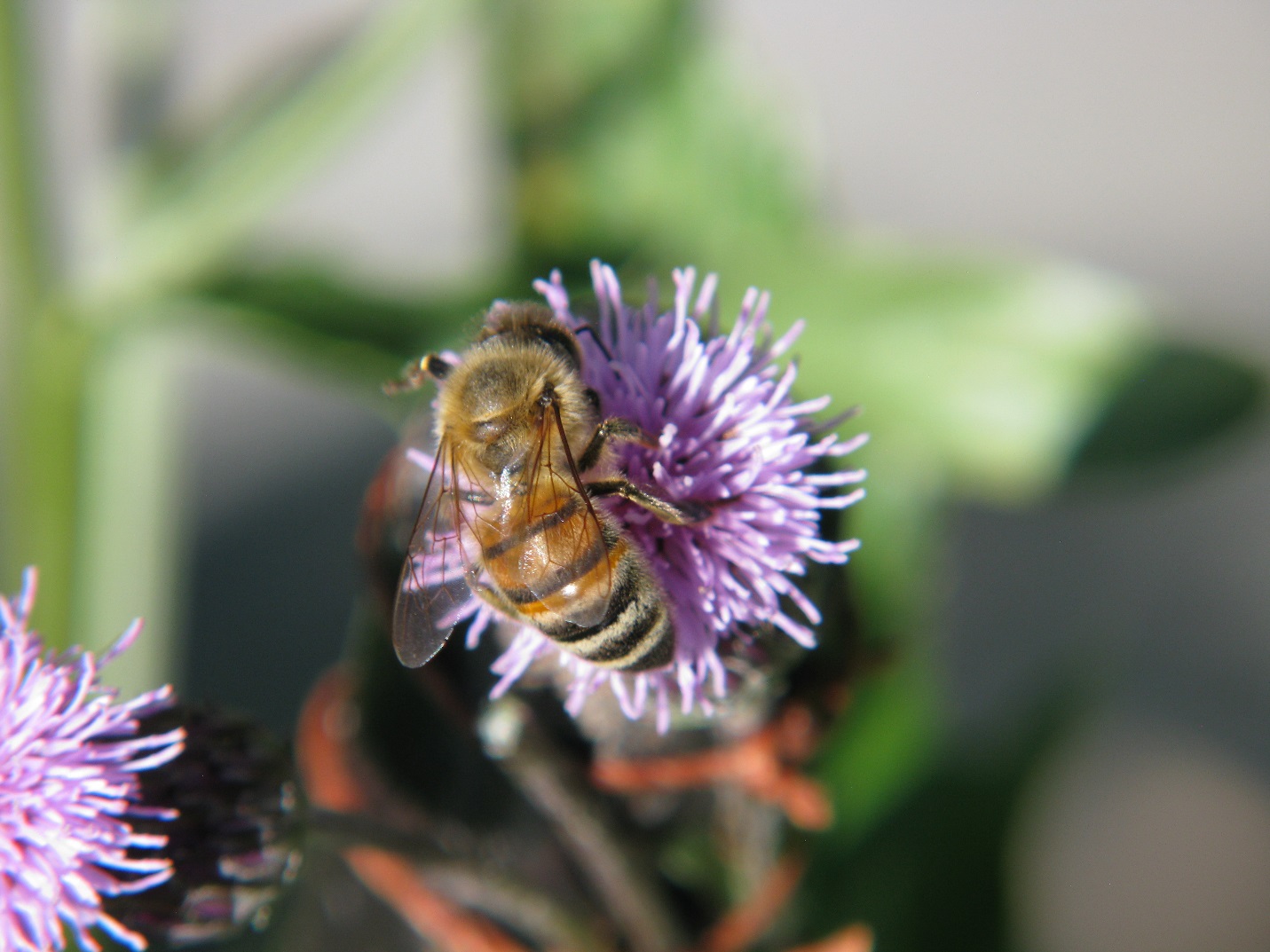
Image from the Canon PowerShot camera with CHDK script ‘Motion Detect Plus’. The thistle flower being visited by ♀ honeybee Apis mellifera L.
Pollinators have fascinated ecologists for decades, and they have traditionally been monitored by on-site human observations. This can be a time-consuming enterprise and – more importantly – species identification and recordings of behaviour have to be registered at the time of observation. This has two complications:
While writing notes, or recording them electronically, the observer cannot continue focusing on the animal or behaviour in question.
Such data then have to be transcribed, with the risk of making transcription errors.
Bringing Monitoring into the 21st Century
Although on-site human observations have predominated, today’s widespread availability of digital monitoring equipment has enabled unique data on flower visitors to be collected. In my research, I have used a time-efficient automated procedure for monitoring flower-visiting animals – namely foraging bumblebees visiting focal white clovers and honeybees visiting thistles.
Studies of ecosystem function are studies of action: of insects pollinating flowers, of predators killing pests – and in our case (well, more often than not) of beetles disposing of dung. To isolate the effects of the critters that we think will matter, we need to selectively include or exclude them. If we think a particular species or species group is responsible for a certain function, then we test this by keeping it in or out of enclosures. If we want to look at effects of species diversity, then we create communities of different species richness.
Depending on the target organism, this is sometimes easy and sometimes difficult. But it almost invariably proves to be fun! We enjoy the challenge of inventing new techniques for unravelling ecosystem functions sustained by insects. Working on dung beetles – as we tend to do – can be messy, but it’s definitely never boring.
In targeting ecosystem functions, the real trick is to make the experiments relevant. What we want to understand are the effects of changes occurring in the real world. All too often studies of ecosystem functions have been focused on artificial species pools in artificial settings. To see how we have solved this, we’ll give you a quick look at our dungy portfolio of approaches to date. Continue reading “Disentangling Ecosystem Functions: Our Imagination is the Limit”






 Methods Blog