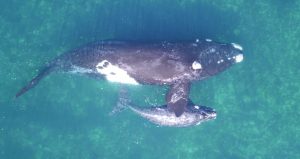
How to weigh a whale

Post provided by Nathan Hirtle (he/him)

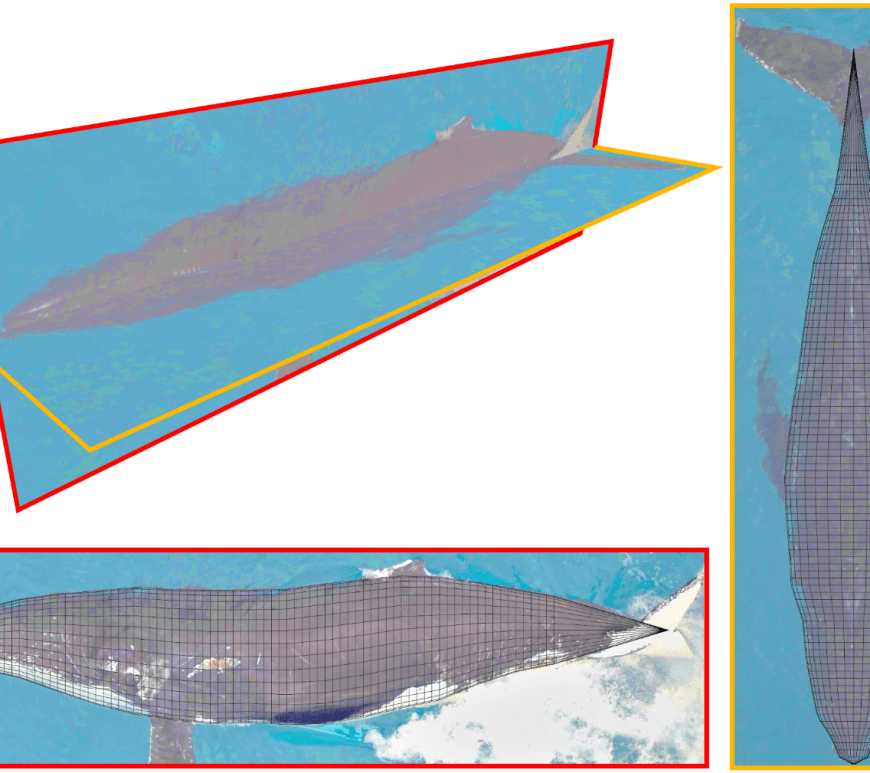
A whale’s size not only provides information on its own health, but also the status of the marine ecosystem in which it lives. So how do scientists weigh the biggest creatures on planet? In this blog post, Nathan Hirtle shares insight from his recent paper on measuring the volume of whales using drone images.

Continue reading “How to weigh a whale”

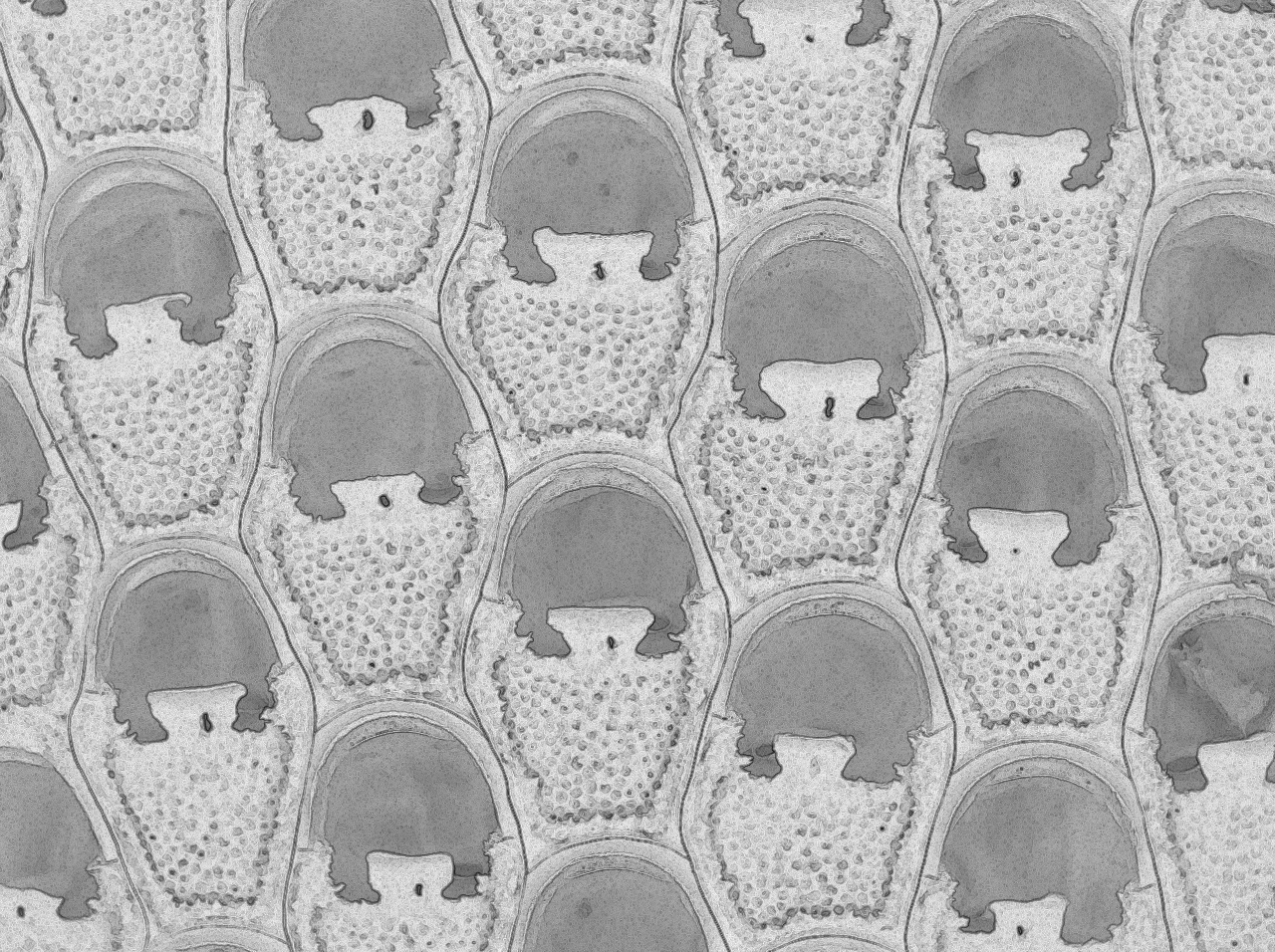
A Multiple-Part Morphospace

Post provided by Daniel Thomas

Many biologists dedicate their careers to finding out why life has taken the shape it has. Darwinian natural selection gives us the how, but researchers are deeply interested in why we find particular morphologies amongst certain organisms, when these morphologies arose, and what these morphologies mean for the organisms and the communities in which they reside. In this post, Daniel Thomas (Massey University, New Zealand) describes the philosophy behind the new morphoBlocks package for R. The package is presented in a new paper within the ‘Realising the promise of large data and complex models’ Special Feature for Methods in Ecology and Evolution. Researchers interested in exploring the morphoBlocks package are encouraged to try these three vignettes.

Continue reading “A Multiple-Part Morphospace”

Cover Stories: Making strides towards weighing whole wildlife populations in 3D

Post provided by Michelle Shero

A grey seal pup next to the unoccupied aerial system (UAS) used in this study. Photo credit: Michelle Shero.

To survive and reproduce, all animals must be able to extract sufficient energy from their environment. It takes energy to forage, but animals can recover those calories if they can successfully capture enough prey – and the animal’s weight tells us about its net energetic costs versus gains. Animals that remain in positive energy-balance can then afford to devote more energy towards growth and reproduction. In this blog post, Michelle Shero of Woods Hole Oceanographic Institution guides us through a new method outlined in her team’s recent Methods in Ecology and Evolution paper ‘Tracking wildlife energy dynamics with unoccupied aircraft systems and three-dimensional photogrammetry’. The team uses drone imagery to 3-D model and ‘weigh’ large groups of free-living animals.

Continue reading “Cover Stories: Making strides towards weighing whole wildlife populations in 3D”

The need to quantify complex shapes

Robert May Prize Shortlisted Article

Post provided by Arthur Porto

Credit: Kjetil Voje

Each year Methods in Ecology and Evolution awards the Robert May Prize to the best paper in the journal by an author at the start of their career. Arthur Porto has been shortlisted for his article ‘ML‐morph: A fast, accurate and general approach for automated detection and landmarking of biological structures in images’. In this blog, Arthur discusses how his paper came to be and describes development of the ML-morph pipeline.

Continue reading “The need to quantify complex shapes”

Issue 11.4: Population Dynamics, Machine Learning, Morphometrics and More

The April issue of Methods is now online!

The latest issue of Methods in Ecology and Evolution is now online! This month’s issue is a little shorter than our last few. But, as they say, good things come in small packages!

Senior Editor Lee Hsiang Liow has selected six Featured Articles this month. You can find out about all of them below. We’ve also got five Applications articles and a Practical Tools article in the April issue that we’re going to cover. Those six papers are freely available to everyone – no subscription required!

On top of all that, the April issue includes articles on camera traps, land cover classification, presence-absence sampling and more.

Continue reading “Issue 11.4: Population Dynamics, Machine Learning, Morphometrics and More”

Researchers Use Drones to Weigh Whales

Below is a press release about the Methods in Ecology and Evolution article ‘Estimating body mass of free‐living whales using aerial photogrammetry and 3D volumetrics‘ taken from the British Ecological Society.

A southern right whale female rolling on her side and exposing her lateral side to the surface while gently touching her calf. ©Fredrik Christiansen

Researchers have devised a way to accurately estimate the weight of free-living whales using only aerial images taken by drones. By measuring the body length, width and height of free-living southern right whales photographed by drones, researchers were able to develop a model that accurately calculated the body volume and mass of the whales.

Because of their large size and aquatic life, previously the only way to obtain data on the body mass of whales was to weigh dead or stranded individuals.

The innovative method can be used to learn more about the physiology and ecology of whales. “Knowing the body mass of free-living whales opens up new avenues of research. We will now be able to look at the growth of known aged individuals to calculate their body mass increase over time and the energy requirements for growth. We will also be able to look at the daily energy requirements of whales and calculate how much prey they need to consume.” said Assistant Professor Fredrik Christiansen from Aarhus Institute of Advanced Studies in Denmark and lead author of the study. Continue reading “Researchers Use Drones to Weigh Whales”

Issue 7.10

Issue 7.10 is now online!
The October issue of Methods is now online!

This month’s issue contains three Applications articles and two Open Access articles, all of which are freely available.

– CODYN: New analytical tools applied to long-term data demonstrate that ecological communities are highly dynamic over time. The R package, library(“codyn”), helps ecologists implement these tools and gain insi–ghts into ecological community dynamics.

– Geometric Morphometrics: A tool for the R statistical environment that optimises the smoothing procedure for 3D surfaces used in Geometric Morphometrics.

– TRAPPER: Open source, multi-user software that facilitates analysis of videos and images, provides spatial filtering and web-mapping, allows flexible implementation of specific data collection protocols, and supports data re-use and (re)discovery.

Continue reading “Issue 7.10”
Issue 7.5

Issue 7.5 is now online!

The May issue of Methods is now online!

This month’s issue contains two Applications articles and two Open Access articles, all of which are freely available.

piecewiseSEM: A practical implementation of confirmatory path analysis for the R programming language. This package extends the method to all current (generalized) linear, (phylogenetic) least-square, and mixed effects models, relying on familiar R syntax. The article also includes two worked examples.

 RPANDA: An R package that implements model-free and model-based phylogenetic comparative methods for macroevolutionary analyses. It can be used to:

  1. Characterize phylogenetic trees by plotting their spectral density profiles
  2. Compare trees and cluster them according to their similarities
  3. Identify and plot distinct branching patterns within trees
  4. Compare the fit of alternative diversification models to phylogenetic trees
  5. Estimate rates of speciation and extinction
  6. Estimate and plot how these rates have varied with time and environmental variables
  7. Deduce and plot estimates of species richness through geological time. Continue reading “Issue 7.5”