Choosing Where to Submit: Is Your Manuscript Right for MEE?

You’ve spent months, or even years, working on a project. You’ve finalised your manuscript and you’re ready to submit. But which journal should you send your paper to?

@ Colin (click image to see original)

In recent years, this question has only gotten harder. As more and more journals enter the market, the decision of where to send your paper is becoming increasingly confusing. With predatory journals muddying the waters and an increasing pressure to publish, deciding where to submit can be a daunting task for even seasoned academics.

Is Methods in Ecology and Evolution the right journal for your manuscript? Is your manuscript right for Methods? Hopefully this blog post will give you a set of tools to make that decision a little easier. Most of these can be applied to other journals too (although some may need to be tweaked a little). Continue reading “Choosing Where to Submit: Is Your Manuscript Right for MEE?”

National Honey Bee Day 2015

Happy National Honey Bee Day everyone!

As you may know, tomorrow (Saturday 22 August) is National Honey Bee Day in the USA. To mark the day we will be highlighting some of the best papers that have been published on bees and pollinators in Methods in Ecology and Evolution.

You can find out more about National Honey Bee Day (and about bees in general) HERE.

Without further ado though, here are a few of the best Methods papers related to Honey Bees:

Wildebeast graze on the cover of MEE 2.5Honey Bee Risk Assessment

Our Honey Bee highlights begin with Hendriksma et al.’s article ‘Honey bee risk assessment: new approaches for in vitro larvae rearing and data analyses‘. Robust laboratory methods for assessing adverse effects on honey bee brood are required for research into the issues contributing to global bee losses. To facilitate this, the authors of this article recommend in vitro rearing of larvae and suggest some appropriate statistical tools for the related data analyses. Together these methods can help to improve the quality of environmental risk assessment studies on honey bees and secure honey bee pollination. As this article was published over two years ago, it can be accessed for free by anyone.

Continue reading “National Honey Bee Day 2015”

Issue 6.8

Issue 6.8 is now online!

The August issue of Methods is now online!

This month’s issue contains two Applications article and one Open Access article, all of which are freely available.

LEA: This R package enables users to run ecological association studies from the R command line. It can perform analyses of population structure and genome scans for adaptive alleles from large genomic data sets. The package derives advantages from R programming functionalities to adjust significance values for multiple testing issues and to visualize results.

PIPITS: An open-source stand-alone suite of software for automated processing of Illumina MiSeq sequences for fungal community analysis. PIPITS exploits a number of state of the art applications to process paired-end reads from quality filtering to producing OTU abundance tables.

Giovanni Strona and Joseph Veech provide this month’s Open Access article. Many studies have focused on nestedness, a pattern reflecting the tendency of network nodes to share interaction partners, as a method of measuring the structure of ecological networks. In ‘A new measure of ecological network structure based on node overlap and segregation‘ the authors introduce a new statistical procedure to measure both this kind of structure and the opposite one (i.e. species’ tendency against sharing interacting partners).

In addition to this, our August issue features articles on Estimating Diversity, Ecological Communities and Networks, Genetic Distances and Immunology. Continue reading “Issue 6.8”

Animal-eye view of the world revealed with new visual software

Below is a press release about the Open Access Methods paper ‘Image calibration and analysis toolbox – a free software suite for objectively measuring reflectance, colour and pattern‘ taken from the University of Exeter:

New camera technology that reveals the world through the eyes of animals has been developed by University of Exeter researchers. The details are published today in the journal Methods in Ecology and Evolution.

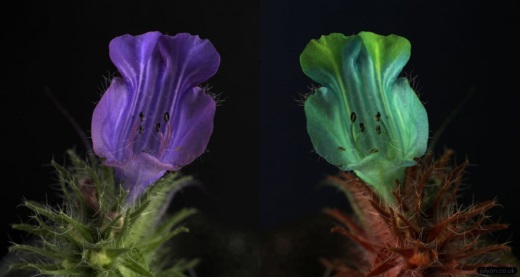
Echium angustifolium in Tenerife (Borage family). To us the flowers are a fairly uniform purple, but bees can see two UV absorbent patches at the top of the flower.

The software, which converts digital photos to animal vision, can be used to analyse colours and patterns and is particularly useful for the study of animal and plant signalling, camouflage and animal predation, but could also prove useful for anyone wanting to measure colours accurately and objectively.

The software has already been used by the Sensory Ecology group in a wide range of studies, such as colour change in green shore crabs, tracking human female face colour changes through the ovulation cycle, and determining the aspects of camouflage that protect nightjar clutches from being spotted by potential predators. Continue reading “Animal-eye view of the world revealed with new visual software”

Issue 6.7

Issue 6.7 is now online!

The July issue of Methods is now online!

This month’s issue contains two Applications article and one Open Access article, all of which are freely available.

fuzzySim: Binary similarity indices are widely used in ecology. This study proposes fuzzy versions of the binary similarity indices most commonly used in ecology, so that they can be directly applied to continuous (fuzzy) rather than binary occurrence values, producing more realistic similarity assessments. fuzzySim is an open source software package which is also available for R.

 Actave.net: A freely accessible, web-based analysis tool for complex activity data, actave.net provides cloud-based and automatic computation of daily aggregates of various activity parameters based on recorded immersion data. It provides maps and graphs for data exploration, download of processed data for modelling and statistical analysis, and tools for sharing results with other users.

Anna Sturrock et al. provide this month’s Open Access article. In ‘Quantifying physiological influences on otolith microchemistry‘ the authors test relationships between otolith chemistry and environmental and physiological variables. The influence of physiological factors on otolith composition was particularly evident in Sr/Ca ratios, the most widely used elemental marker in applied otolith microchemistry studies. This paper was reported on in the media recently. You can read more about it here.

Our July issue also features articles on Monitoring, Remote Sensing, Conservation, Genetics and three papers on Statistics. Continue reading “Issue 6.7”

Issue 6.6

Issue 6.6 is now online!

The June issue of Methods is now online!

This month’s issue contains one Applications article and one Open Access article.

VirtualCom: A simple and readily usable tool that will help to resolve theoretical and methodological issues in community ecology. VirtualCom simulates the evolution of the pool of regionally occurring species, the process-based assembly of native communities and the invasion of novel species into native communities. One of the authors of this Application is the 2014 Robert May Young Investigator Prize Winner, Laure Gallien.

Calibrating animal-borne proximity loggers, this month’s only Open Access article, comes from Christian Rutz et al. The authors calibrated a recently developed digital proximity-logging system (‘Encounternet’) for deployment on a wild population of New Caledonian crows. They show that, using signal-strength information only, it is possible to assign crow encounters reliably to predefined distance classes, enabling powerful analyses of social dynamics. Their study demonstrates that well-calibrated proximity-logging systems can be used to chart social associations of free-ranging animals over a range of biologically meaningful distances.

Our June issue also features articles on Phylogenetic MethodsPhysiological Ecology, Biomonitoring and Conservation, Species Distribution Monitoring and Bioinformatics. Continue reading “Issue 6.6”

Issue 6.5

Issue 6.5 is now online!

The May issue of Methods is now online!

We have two freely available articles this month: one Application and one Open Access Article.

rSPACE: An open-source R package for implementing a spatially based power analysis for designing monitoring programs. This method incorporates information on species biology and habitat to parameterize a spatially explicit population simulation.

Tim Lucas et al. provide this month’s Open Access article: A generalised random encounter model for estimating animal density with remote sensor data. The authors have developed a Generalised Random Encounter Model (gREM) to estimate absolute animal density from count data from both camera traps and acoustic detectors. They show that gREM produces accurate estimates of absolute animal density for all combinations of sensor detection widths and animal signal widths. This model is applicable for count data obtained in both marine and terrestrial environments, visually or acoustically. It could be used for big cats, sharks, birds, echolocating bats, cetaceans and much more. Continue reading “Issue 6.5”

Issue 6.4: Opportunities at the Interface Between Ecology and Statistics

Issue 6.4 is now online!

© Chun-Huo Chiu and Ching-Wen Cheng

The April issue of Methods, which includes our latest Special Feature: “Opportunities at the Interface Between Ecology and Statistics” is now online!

Opportunities ar the Interface Between Ecology and Statistics is a collection of eight articles which arose from the Eco-Stats Symposium at the University of New South Wales (Australia) in July 2013.This Symposium was designed to be a collaborative forum for researchers with interests in ecology and statistics. It brought together internationally recognised leaders in these two fields (such as Jane Elith, Trevor Hastie, Anne Chao and Shirley Pledger) – many of whom have contributed articles to this Special Feature.

The Eco-Stats Symposium was arranged around five special topics, all of which are represented in this issue of Methods. Those five topics are:

In his Editorial for the Special Feature, Guest Editor David Warton suggests that one of the reasons for the success of Methods in Ecology and Evolution may be that it provides a forum for statisticians and ecologists to interact. The articles in this issue, and the conference that gave rise to them, show that these interactions can provide significant benefits for both groups.

There will be another Eco-Stats Symposium at the University of New South Wales in December of this year (8-10 December, 2015).
For more details on this, please click here.
Continue reading “Issue 6.4: Opportunities at the Interface Between Ecology and Statistics”

Issue 6.3

Issue 6.3 is now online!

The March issue of Methods is now online!

We have three freely available Applications articles in this issue. Anyone can access these with no subscription required and no charge to download.

TR8: This R package was built to provide plant scientists with a simple tool for retrieving plant functional traits from freely accessible online traitbases.

StereoMorph: A new R package for the rapid and accurate collection of 3D landmarks and curves using two standard digital cameras.

MotionMeerkat: A new standalone program that identifies motion events from a video stream. This tool reduces the time needed to review videos and accommodates a variety of inputs.

This month we have a total of FIVE Open Access articles. That makes eight articles in this issue of Methods in Ecology and Evolution that you can read for free!

Continue reading “Issue 6.3”

Volume 3 Issue 1: Now online

It seems that from the number of submissions we receive at the journal, Methods in Ecology and Evolution has filled an important niche. As our editor-in-chief, Rob Freckleton, wrote to introduce our second volume: “those doing science need to be kept up to date on new approaches, and those developing new methods need a place to publish, as well as be supported in getting their … Continue reading Volume 3 Issue 1: Now online