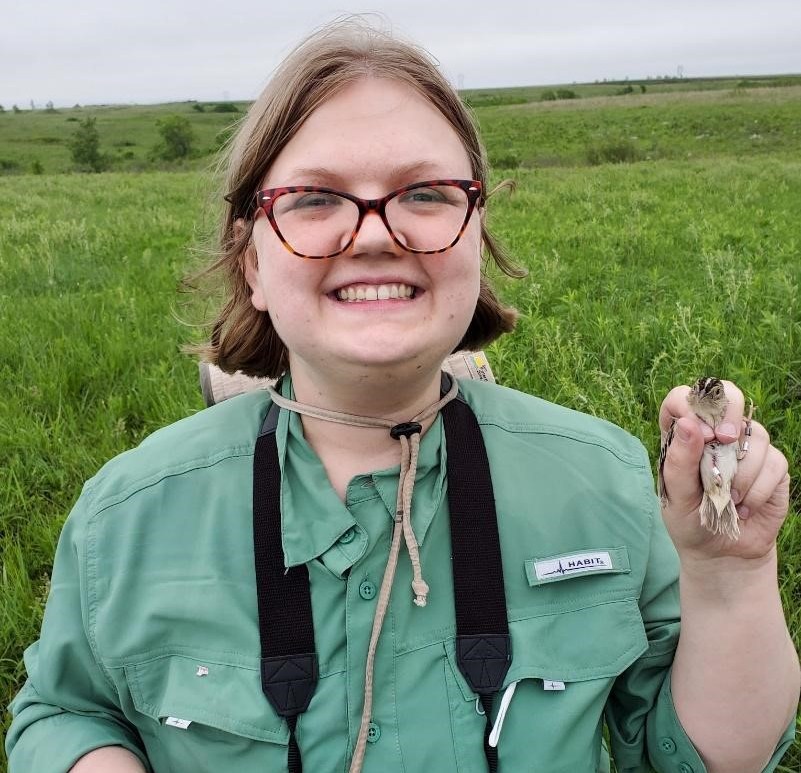
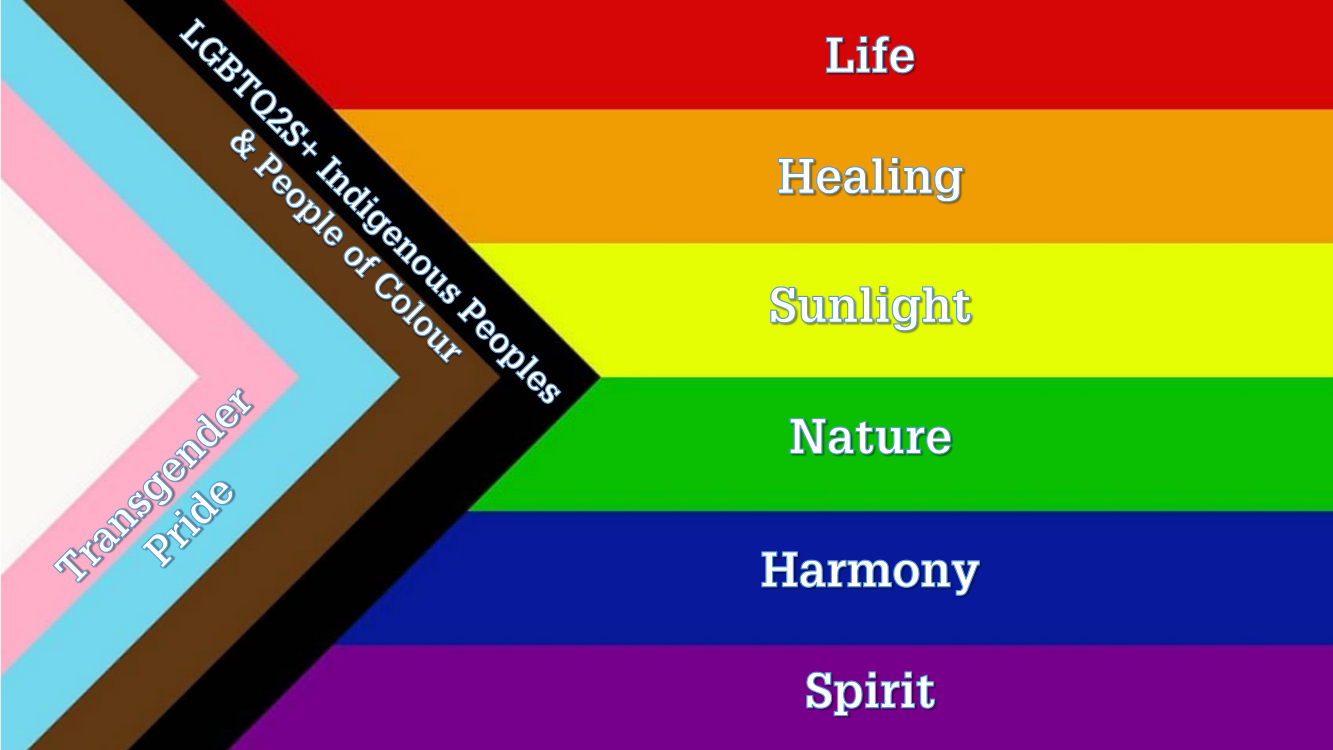
The Rainbow Research series returns to the British Ecological Society to celebrate Pride month 2022! These special posts promote visibility and share stories from STEM researchers who belong to the LGBTQIA2S+ community. Each post is connected to one of the themes represented by the colours in the Progress Pride flag (Daniel Quasar 2018). In this post, Sara Blunk shares her love of birds and experiences being an LGBTQ+ student.
Today, science extends beyond the research bench or the field site more often than ever before. Scientists are continuously interacting with educators and the general public, and people are reciprocating the interest with a drive to be involved.
With this integration of science and the public, citizen-science efforts to crowdsource information have become increasingly popular (check out Zooniverse, SciStarter, NASA Citizen Science Projects, Project FeederWatch, and Foldit to get involved!). In the birding community, enthusiasts have been observing and recording birds for decades, but now there are methods for immediate data sharing among the community (eBird).
On many evenings during spring and fall migration, tens of millions of birds take flight at sunset and pass over our heads, unseen in the night sky. Though these flights have been recorded for decades by the National Weather Services’ network of constantly-scanning weather radars, until recently these data have been mostly out of reach for bird researchers.
A study led by researchers at the University of Southampton has used data collected by volunteer bird watchers to study how the importance of wildlife habitat management depends on changing temperatures for British birds.
Working on FLightR, the package for analysis of data obtained from solar geolocation tracking devices, we were haunted by the unpleasant feeling of investing in technology which will soon be out of date. Until now solar geolocators have been popular in ornithological studies. This is because they’re small, light-weight (< 1/3 g) tracking devices that can be deployed even on miniature birds, such as swallows and warblers. They’ve also been the longest-lasting data loggers, with the most storage space and, of course, the most affordable ones.
Are Solar Geolocators Finished?
There are apparent drawbacks of using this technique though. To begin with, solar geolocation simply does not work for some species. You can’t use it to study birds living in dense tropical forests or in cavities, because of the light-pattern bias. For the same reason, it doesn’t provide fantastic results in light-polluted areas. Data from geolocators cannot be retrieved remotely, and this is why you need to have high recapture rates for the species you’re studying. Continue reading “The Future of Solar Geolocation Tracking is NOW”
Opportunistically collected species observation data, or citizen science data, are increasingly available. Importantly, they’re also becoming available for regions of the world and species for which few other data are available, and they may be able to fill a data gap.
In Sweden, over 60 million citizen science observations have been collected – an impressive number given that Sweden has a population of about 10 million people and that the Swedish Species Observation System, Artportalen, was created in 2000. For bird-watchers (or plant, fungi, or other animal enthusiasts), this is a good website to bookmark. It will give you a bit of help in finding species and as a bonus, has a lot of pretty pictures of interesting species. Given the amount of data citizen science can provide in areas with few other data, it’s important to evaluate whether they can be used reliably to answer questions in applied ecology or conservation. Continue reading “Can Opportunistically Collected Citizen Science Data Create Reliable Habitat Suitability Models for Less Common Species?”
Researchers are increasingly interested in how social behaviour influences a range of biological processes. Social data have the interesting mathematical property that the number of potential connections among individuals is typically much larger than the number of individuals (because individuals can interact with every other member of their group). This introduces a huge challenge when it comes to collecting data on social interactions—not only does the amount of data needed increase exponentially with group size, the data can also be more difficult to record.
Larger groups have more simultaneous interactions, making it harder for observers to capture a complete or representative sample. It’s also more difficult for observers to tell individuals apart in larger groups. Coloured markers are often used to distinguish different members of a group – the bigger the group, the more complex the markers are needed.
Group-level properties or behaviours can also emerge or change rapidly over time or depending on the situation. This means that observations have to be made at high temporal resolution. To study social behaviour with group sizes that resemble those occurring in nature, we need new techniques to extract sufficient information from social groups. Continue reading “The Social Life of Birds: A New Technique for Studying Behavioural Ecology”
Ecologists have long been fascinated by animal sounds and in recent decades there’s been growing interest in the field of ‘bioacoustics’. This has partially been driven by the availability of high-definition digital audio recorders that can withstand harsh field conditions, as well as improvements in software technology that can automate sound analysis.
Each year an uncountable number of airborne organisms, mainly birds and insects, venture out on long journeys across the globe. In particular, the mass movements of birds have fascinated humankind for hundreds of years and inspired a wealth of increasingly sophisticated studies. The development and improvement of individual tracking devices in animal research and has provided amazing insights into such extensive journeys. Study of mass movements of biological organisms is still a challenge on continent-wide or cross-continental scales.
One tool that can effectively track and/or monitor large numbers of birds is radar technology. Radars offer many advantages over other methods such as visual counts or ringing. They’re less expensive, need less effort, offer better visibility and detectability, and are more applicable for large-scale monitoring. Networks of meteorological radars (as opposed to individual radars) seem particularly promising for large-scale studies. Continue reading “Radar Wind Profilers: A Widespread but Unused Remote Sensing Tool for Migration Ornithologists”
Understanding key habitat requirements is critical to the conservation of species at risk. For highly mobile species, discerning what is key habitat as opposed to areas that are simply being traversed (perhaps in the search for key habitats) can be challenging. For seabirds, in particular, it can be difficult to know which areas in the sea represent key foraging grounds. Devices that record birds’ diving behaviour can help shed light on this, but they’re expensive to deploy. In contrast, devices that record the birds’ geographic position are more commonly available and have been around for some time.




 Methods Blog