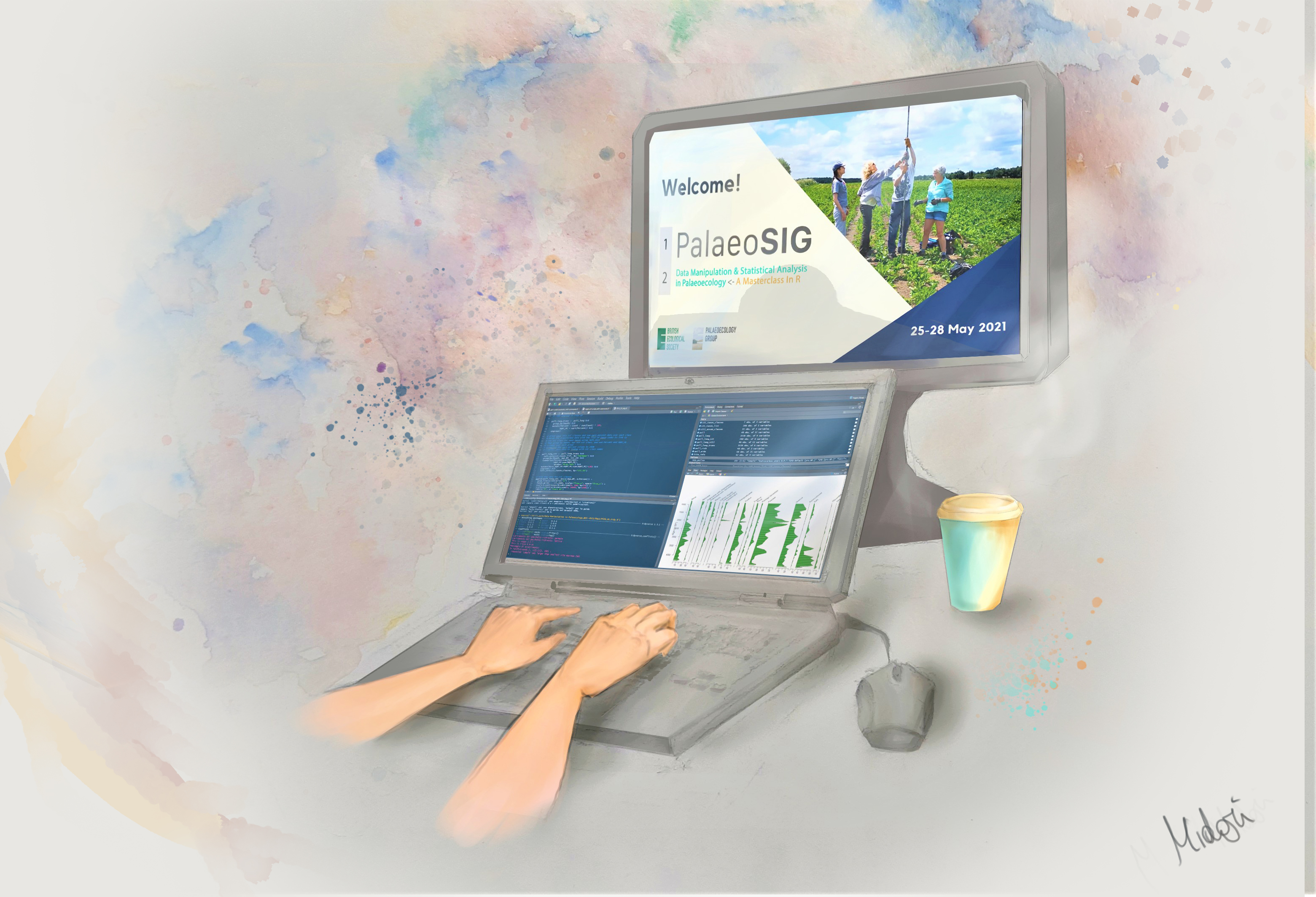
Midori Yajima graduated from an MSc in Ecology with a project on palaeoecology and decided to join the online workshop Data Manipulation and Statistical Analysis in Palaeoecology: A Masterclass in R, set up by the Palaeoecology Special Interest Group (PalaeoSIG). In this post, Midori discusses some highlights from the workshop and emphasises the importance of a research community when navigating the programming realm.
The answer to this question depends on a reef’s location, given that shark abundances can vary with primary productivity and other oceanographic features. It also depends on which time period you chose as your reference point. Shark abundances can fluctuate over the course of a few hours – as well as over days to years to decades and beyond. Even if you chose the same time and place as the person before you, you might have come up with a slightly different answer. This variation in how we determine baselines – overlaid on a backdrop of natural variation in shark communities over space and time – can contribute to differing perceptions about what’s natural or what a depleted population can possibly be restored to.
The latest issue of Methods in Ecology and Evolution is now online! This month’s issue is a little shorter than our last few. But, as they say, good things come in small packages!
Executive Editor Aaron Ellison has selected six Featured Articles this month. You can find out about all of them below. We’ve also got five Applications articles in the March issue that we’re going to cover.
The source of occurrence data: fossil collections (photo by Konstantin Frisch).
To find out about changes in ancient ecosystems we need to analyse fossil databases that register the taxonomy and stratigraphic (temporal) positions of fossils. These data can be used to detect changes of taxonomic diversity and to draft time series of originations and extinctions.
The story would be so simple if it wasn’t the effects of heterogeneous and incomplete sampling: the white spots in our understanding of where and when species lived exactly. This phenomenon decreases the fidelity of face-value patterns extracted from the fossil record, making them less reliable. It must be considered if we want to get a glimpse into the biology or the distribution of life in space and time. Naturally, several metrics have been proposed to overcome this problem, each claiming to accurately depict the patterns of ancient life. Continue reading “Revisiting Past Biodiversity with the divDyn R Package”
This post presents our reflections from two sessions at the first British Ecological Society Annual Meeting since the Palaeoecology Special Interest Group (SIG) was formed. Did the term “palaeoecology” make you want to stop reading? Then you’re not alone – our field of ecology seems to have drifted apart from neoecology over the last couple decades. We seem to have been separated by our choice of methods, rather than brought together by the fascinating, complex and essential challenges of better understanding ecosystem function that we share.
The diversity of talks at BES 2018 showed that ecologists working on time scales beyond the scope of direct study are researching the same urgent, exciting questions as other flavours of ecology. And that they are doing it by using an ever-growing range of methods and technologies. The Thematic Session ‘Advancing Our Understanding of Long-Term Ecology’ showcased advances in studies of long-term ecology. The Palaeoecology Oral Session demonstrated the diversity within this field. We don’t have room to mention all presenters, so we’d like to highlight contributions from two speakers in each session which demonstrate how strong the shared ground between palaeoecology and neoecology is. Continue reading “Methods in Temporal Ecology”
I had the pleasure of delivering one of the plenary talks at the first (hopefully of many) Crossing the Palaeontological – Ecological Gap meeting held in the University of Leeds on August 30th and 31st. I’m a geologist and a botanist, so this is a topic that’s close to my heart and my professional interests.
As we move into an ecologically uncertain future with pressures of climate change, land-use change and resource limitations, the fossil record offers the only truly long-term record of how Earth’s ecosystems respond to major environmental upheaval driven by climate change events. The fossil record is, of course, not without its problems – there are gaps, not everything fossilises in the same way or numbers, and comparisons to today’s ecology are extremely difficult. It’s these difficulties (and other challenges) that make the uniting of palaeontology and ecology essential to fully address how plants, animals and other organisms have responded to major changes in the past. Perhaps uniting them could give us an idea of what to expect in our near-term future, as carbon dioxide levels return to those not previously experienced on Earth since the Pliocene, over 2 million years ago. Continue reading “What the Past Can Tell Us About the Future: Notes from Crossing the Palaeontological – Ecological Gap”
Today is the first day of the Crossing the Palaeontological-Ecological Gap (CPEG) conference. The aim of the conference is to open a dialogue between palaeontologists and ecologists who work on similar questions but across vastly different timescales. This splitting of temporal scales tends to make communication, data integration and synthesis in ecology harder. A lot of this comes from the fact that palaeontologists and ecologists tend to publish in different journals and attend different meetings.





 Methods Blog