Revisiting Past Biodiversity with the divDyn R Package

Post provided by ÁDÁM T. KOCSIS

The source of occurrence data: fossil collections (Early Jurassic ammonites in the collection of the University of Erlangen-Nuremberg, photo by Konstantin Frisch)
The source of occurrence data: fossil collections (photo by Konstantin Frisch).

To find out about changes in ancient ecosystems we need to analyse fossil databases that register the taxonomy and stratigraphic (temporal) positions of fossils. These data can be used to detect changes of taxonomic diversity and to draft time series of originations and extinctions.

The story would be so simple if it wasn’t the effects of heterogeneous and incomplete sampling: the white spots in our understanding of where and when species lived exactly. This phenomenon decreases the fidelity of face-value patterns extracted from the fossil record, making them less reliable. It must be considered if we want to get a glimpse into the biology or the distribution of life in space and time. Naturally, several metrics have been proposed to overcome this problem, each claiming to accurately depict the patterns of ancient life. Continue reading “Revisiting Past Biodiversity with the divDyn R Package”

The BES Macroecology (& Macroevolution) SIG: Who We Are, What We Do and What to Look Out for at #BES2018

Post provided by Natalie Cooper

Defining macroecology should be easy; it’s just ecology at large spatial scales, right? In reality though, it’s a little more complex than that. No-one agrees on exactly how large the spatial scale should be, and many studies that could be macroecology may also be defined as biogeography, landscape ecology, community ecology etc. Working at large spatial scales can also mean working at large temporal scales, often in deep-time. So there’s a lot of overlap with studies of macroevolution both on living and extinct species too.

This breadth of definitions means the BES Macroecology Special Interest Group (or BES Macro as we usually call it) has members with interests across ecology, evolution and palaeontology. Probably the most common statement at any of our events is “I’m not a macroecologist but…”. So, if you’re interested in broad-scale ecology and evolution, in a living or palaeo context, the SIG is for you, even if you don’t identify as a macroecologist! Continue reading “The BES Macroecology (& Macroevolution) SIG: Who We Are, What We Do and What to Look Out for at #BES2018”

What the Past Can Tell Us About the Future: Notes from Crossing the Palaeontological – Ecological Gap

Post provided by Karen Bacon

I had the pleasure of delivering one of the plenary talks at the first (hopefully of many) Crossing the Palaeontological – Ecological Gap meeting held in the University of Leeds on August 30th and 31st. I’m a geologist and a botanist, so this is a topic that’s close to my heart and my professional interests.

How Palaeoecology Can Help Us Today

©Gail Hampshire
©Gail Hampshire

As we move into an ecologically uncertain future with pressures of climate change, land-use change and resource limitations, the fossil record offers the only truly long-term record of how Earth’s ecosystems respond to major environmental upheaval driven by climate change events. The fossil record is, of course, not without its problems – there are gaps, not everything fossilises in the same way or numbers, and comparisons to today’s ecology are extremely difficult.  It’s these difficulties (and other challenges) that make the uniting of palaeontology and ecology essential to fully address how plants, animals and other organisms have responded to major changes in the past. Perhaps uniting them could give us an idea of what to expect in our near-term future, as carbon dioxide levels return to those not previously experienced on Earth since the Pliocene, over 2 million years ago. Continue reading “What the Past Can Tell Us About the Future: Notes from Crossing the Palaeontological – Ecological Gap”

Crossing the Palaeontological-Ecological Gap

Today is the first day of the Crossing the Palaeontological-Ecological Gap (CPEG) conference. The aim of the conference is to open a dialogue between palaeontologists and ecologists who work on similar questions but across vastly different timescales. This splitting of temporal scales tends to make communication, data integration and synthesis in ecology harder. A lot of this comes from the fact that palaeontologists and ecologists tend to publish in different journals and attend different meetings.

Methods in Ecology and Evolution is one of few ecological journals that attracts submissions from both ecologists and palaeontologists. To highlight this, we’ve released a Virtual Issue, also called Crossing the Palaeontological-Ecological Gap. Continue reading “Crossing the Palaeontological-Ecological Gap”

Topography of Teeth: Tools to Track Animal and Ecosystem Responses to Environmental Changes

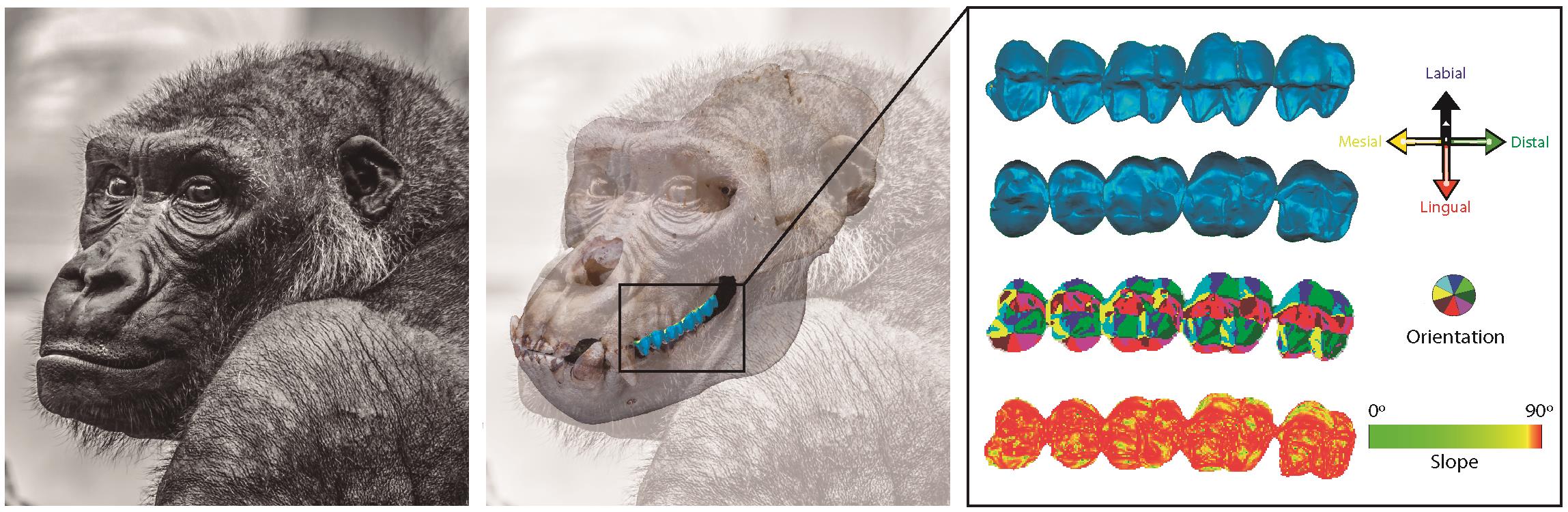
Below is a press release about the Methods paper ‘Inferring diet from dental morphology in terrestrial mammals‘ taken from the Smithsonian Institution.

By charting the slopes and crags on animals’ teeth as if they were mountain ranges, scientists at the Smithsonian’s National Museum of Natural History have created a powerful new way to learn about the diets of extinct animals from the fossil record.

Understanding the diets of animals that lived long ago can tell researchers about the environments they lived in and help them piece together a picture of how the planet has changed over deep time. The new quantitative approach to analysing dentition, reported on 21 November in the journal Methods in Ecology and Evolution, will also give researchers a clearer picture of how animals evolve in response to changes in their environment.

gorilla
A 3D reconstruction of the teeth of a western gorilla (Gorilla gorilla).

Continue reading “Topography of Teeth: Tools to Track Animal and Ecosystem Responses to Environmental Changes”

Robert May Prize 2011

Each year our editors select the best paper published in Methods by a young researcher. We are delighted to announce that this year’s winner of the Robert May Prize is Tyler Kuhn for his paper co-authored with Arne Ø. Mooers and Gavin H. Thomas A simple polytomy resolver for dated phylogenies published in vol. 2.5 of the journal. Tyler and co-authors present a simple approach … Continue reading Robert May Prize 2011

Watch the CEE meeting, Integrating ecology into macroevolutionary research

By way of an introduction to this blog post, watch this! Back in March the Centre for Ecology and Evolution in London organised a meeting that brought together top researchers in macroevolution. The idea of the meeting was to highlight how advances in the study of macroevolution could be made by a closer integration with ecology, and the incoroporation of ecological ideas and ecological models. … Continue reading Watch the CEE meeting, Integrating ecology into macroevolutionary research

Methods digest – June 2010

Here is the methods digest update for June 2010 – do let me know if there is anything that you think I should feature. In Oikos Novak & Wooton have a paper on using indices to quantify the effects of comeptition and Landau & Ryan present new ‘null model tests for presence-absence data’ (NMTPAs). A paper in Conservation Letters by Michael Kearney et al. evaluates species … Continue reading Methods digest – June 2010