Post provided by Quinn Asena Uncovering signals from the past Understanding interactions among organisms, and between organisms and their environment, has been a cornerstone of ecology as long as we have been busying ourselves with the lives of other species. How do plants and animals facilitate or compete with each other? How do they respond to the continuous challenge of changing climates or new neighbors? … Continue reading From pattern to process: estimating species interactions and driver-species relationships from count data
An Asian, female Senior Editor under 45? Progressive! I have loved Methods in Ecology and Evolution since it appeared in 2010 and am thrilled to have been selected to join Rob, Bob and Jana to help with the journal’s continued development.
OK, so you want to know who the new Senior Editor on the MEE block is. I’m just another scientist, I guess. On the outside, we look different but on the inside, we’re all the same. (OK, perhaps we are a little different, even on the inside, but that makes life and research interesting, right?)
The Global Pollen Project is a new, online, freely available tool developed to help people identify and disseminate palynological resources. Palynology – the study of pollen grains and other spores – is used across many fields of study modern and fossil vegetation dynamics, forensic sciences, pollination, beekeeping, and much more. This platform helps to facilitate cross/multi-disciplinary integration and discussion, outsourcing identifications, expertise and the sharing of knowledge.
Pollen’s Role in Plant Conservation
Successful conservation of rare, threatened, and valuable plants is dependent on an understanding of the threats that they face. Also, conservationists must prioritise species and populations based on their value to humans, which may be cultural, economic, medicinal, etc. The study of fossil pollen (palaeoecology), deposited through time in sediments from lakes and bogs, can help inform the debate over which species to prioritise: which are native, and when did they arrive? How did humans impact species richness? By establishing such biodiversity baselines, policymakers can make more informed value judgements over which habitats and species to conserve, especially where conservation efforts are weighted in favour of native and/or endemic flora. Continue reading “Tiny Grains, Big Data: The Global Pollen Project”
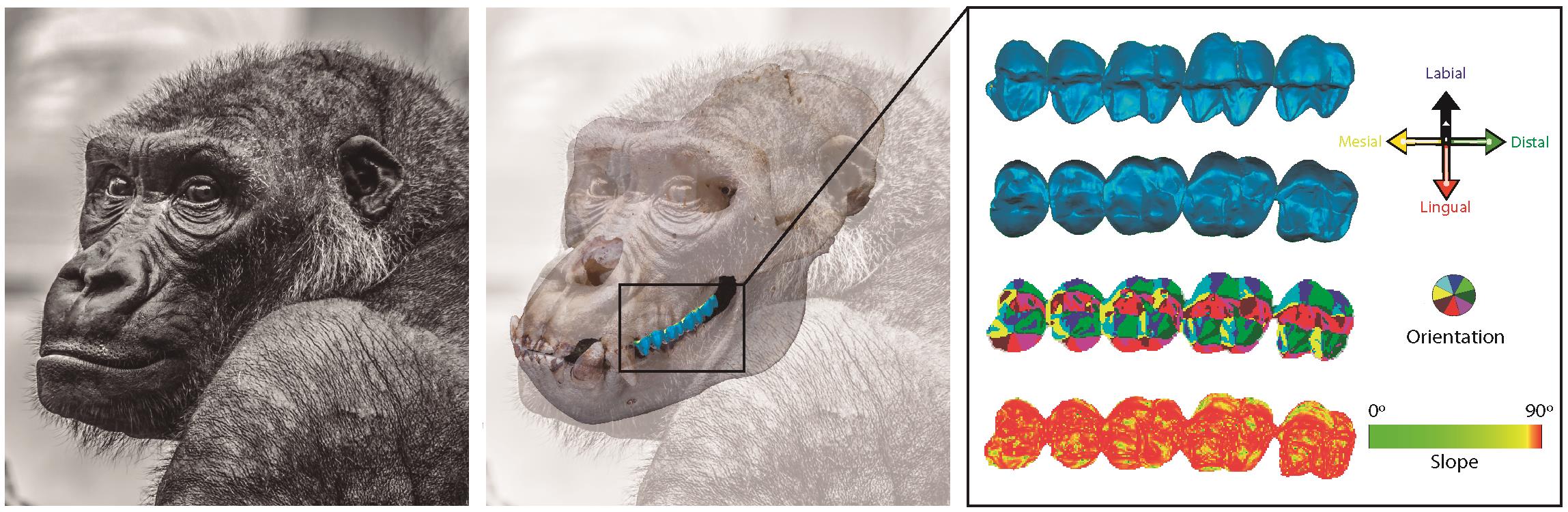
By charting the slopes and crags on animals’ teeth as if they were mountain ranges, scientists at the Smithsonian’s National Museum of Natural History have created a powerful new way to learn about the diets of extinct animals from the fossil record.
Understanding the diets of animals that lived long ago can tell researchers about the environments they lived in and help them piece together a picture of how the planet has changed over deep time. The new quantitative approach to analysing dentition, reported on 21 November in the journal Methods in Ecology and Evolution, will also give researchers a clearer picture of how animals evolve in response to changes in their environment.
A 3D reconstruction of the teeth of a western gorilla (Gorilla gorilla).
Today, on International Owl Awareness Day (August 4), we celebrate the research we have done to better understand owls and their prey. There are over 200 extant species of owls, a handful of which have geographic distributions spanning several continents (i.e., barn owl, snowy owl, short-eared owl, long-eared owl). So no matter where you are in the world you’re probably not too far away from an owl.
In the US, July is National Bison Month but most people in Europe are totally oblivious to it. I wasn’t even aware of it before being asked to write this blog post in connection with our recent Methods in Ecology and Evolution paper about quantifying population sizes of large herbivores. Some will argue that it is because we don’t ‘do’ day, month, state or national animals on this side of the Atlantic as much as the Americans do.
But another reason is that the European bison, Bison bonasus bonasus, is simply not sufficiently well-known or associated with European nature in the public’s mind. This is particularly true in Western Europe where this species has been extinct since medieval times.
Early European accounts from North America reported huge bison populations – with estimates of up to 60 million – moving to and fro in the great bison belt. These past migratory movements across the Great Plains are familiar well beyond the US and feed our view of untamed wilderness prior to the impact of European ’civilisation’. In contrast, there are hardly any records of European bison numbers until just before the last wild one was reported killed in Poland in 1921. Continue reading “European Bison, Rewilding and Dung Fungal Spore”


 An Asian, female Senior Editor under 45? Progressive! I have loved



 Methods Blog