Issue 8.8

Issue 8.8 is now online!

The August issue of Methods is now online!

This issue contains two Applications articles and two Open Access articles. These four papers are freely available to everyone, no subscription required.

 Paco: An R package that assesses the phylogenetic congruence, or evolutionary dependence, of two groups of interacting species using both ecological interaction networks and their phylogenetic history.

 Open MEE: Open Meta-analyst for Ecology and Evolution (Open MEE) addresses the need for advanced, easy-to-use software for meta-analysis and meta-regression.It offers a suite of advanced meta-analysis and meta-regression methods for synthesizing continuous and categorical data, including meta-regression with multiple covariates and their interactions, phylogenetic analyses, and simple missing data imputation.

Continue reading “Issue 8.8”

Tiny Grains, Big Data: The Global Pollen Project

Post Provided by Andrew Martin

A drawer from the Oxford Long-Term Ecology Lab (OxLEL) pollen reference collections, which has been digitised into the Global Pollen Project reference set.

The Global Pollen Project is a new, online, freely available tool developed to help people identify and disseminate palynological resources. Palynology – the study of pollen grains and other spores – is used across many fields of study modern and fossil vegetation dynamics, forensic sciences, pollination, beekeeping, and much more. This platform helps to facilitate cross/multi-disciplinary integration and discussion, outsourcing identifications, expertise and the sharing of knowledge.

Pollen’s Role in Plant Conservation

Successful conservation of rare, threatened, and valuable plants is dependent on an understanding of the threats that they face. Also, conservationists must prioritise species and populations based on their value to humans, which may be cultural, economic, medicinal, etc. The study of fossil pollen (palaeoecology), deposited through time in sediments from lakes and bogs, can help inform the debate over which species to prioritise: which are native, and when did they arrive? How did humans impact species richness? By establishing such biodiversity baselines, policymakers can make more informed value judgements over which habitats and species to conserve, especially where conservation efforts are weighted in favour of native and/or endemic flora. Continue reading “Tiny Grains, Big Data: The Global Pollen Project”

Estimating the Size of Animal Populations from Camera Trap Surveys

Below is a press release about the Methods paper ‘Distance sampling with camera traps‘ taken from the Max Planck Society.

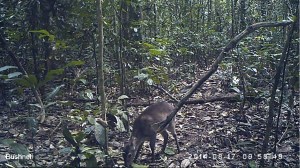
A Maxwell's duiker photographed using a camera trap. Marie-Lyne Després-Einspenner
A Maxwell’s duiker photographed using a camera trap. ©Marie-Lyne Després-Einspenner

Camera traps are a useful means for researchers to observe the behaviour of animal populations in the wild or to assess biodiversity levels of remote locations like the tropical rain forest. Researchers from the University of St Andrews, the Max Planck Institute for Evolutionary Anthropology (MPI-EVA) and the German Centre for Integrative Biodiversity Research (iDiv) recently extended distance sampling analytical methods to accommodate data from camera traps. This new development allows abundances of multiple species to be estimated from camera trapping data collected over relatively short time intervals – information critical to effective wildlife management and conservation.

Remote motion-sensitive photography, or camera trapping, is revolutionising surveys of wild animal populations. Camera traps are an efficient means of detecting rare species, conducting species inventories and biodiversity assessments, estimating site occupancy, and observing behaviour. If individual animals can be identified from the images obtained, camera trapping data can also be used to estimate animal density and population size – information critical to effective wildlife management and conservation. Continue reading “Estimating the Size of Animal Populations from Camera Trap Surveys”

New Associate Editors

Today we are welcoming four new Associate Editors to Methods in Ecology and Evolution. Graziella Iossa (University of Lincoln) and Theoni Photopoulou (Nelson Mandela Metropolitan University) are joining as regular Associate Editors and Simon Jarman (Unversity of Porto) and Daniele Silvestro (University of Gothenburg) will be working on Applications articles. You can find out more about all of our new Associate Editors below. Graziella Iossa “I am … Continue reading New Associate Editors

Movement Ecology: Stepping into the Mainstream

Post provided by Theoni Photopoulou

“Movement is the glue that ties ecological processes together”
from Francesca Cagnacci et al. 2010

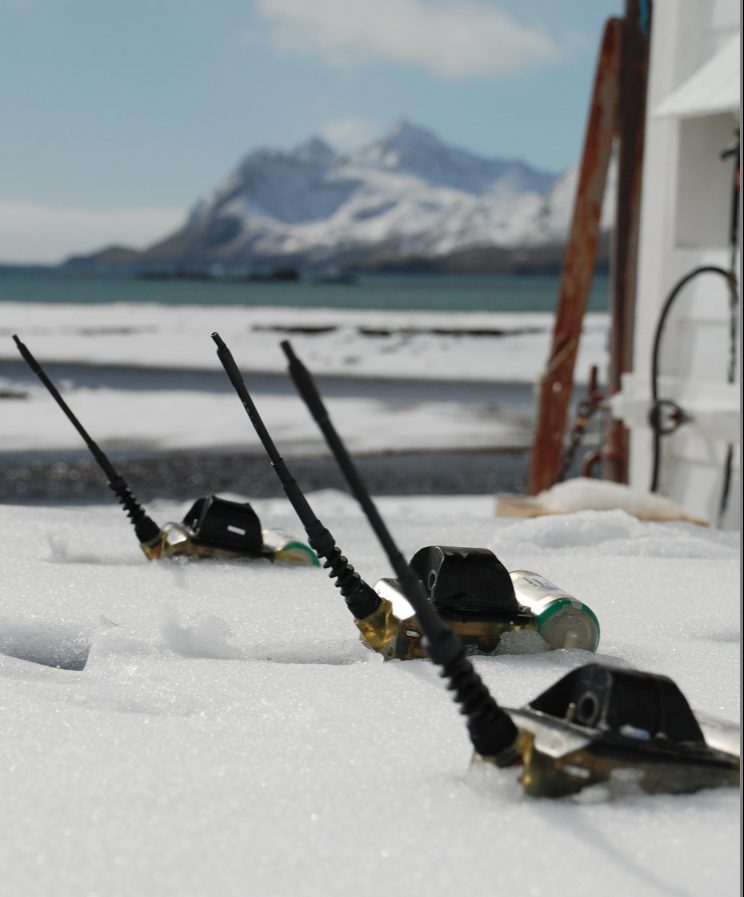
CTD-SRDL telemetry tags being primed for deployment. ©Theoni Photopoulou

Movement ecology is a cross-disciplinary field. Its main aim is to quantitatively describe and understand how movement relates to individual and population-level processes for resource acquisition and, ultimately, survival. Today the study of movement ecology hinges on two 21st century advances:

  1. Animal-borne devices/tags (biologging science, Hooker et al., 2007) and/or remote sensing technology to quantify movement and collect data from remote or otherwise challenging environments
  2. Computational power sufficient to manipulate, process and analyse substantial volumes of data

Although datasets often involve small numbers of individuals, each individual can have thousands – sometimes even millions – of data points associated with it. Study species have tended to be large birds and mammals, due to the ease of tag attachment. However, the trend for miniaturisation of tags and the development of remote detection technologies (such as radar, e.g. Capaldi et al., 2000), have allowed researchers to track and study ever smaller animals. Continue reading “Movement Ecology: Stepping into the Mainstream”

Issue 7.12

Issue 7.12 is now online!

The final 2016 issue of Methods is now online!

This month’s issue contains four Applications articles and two Open Access articles, all of which are freely available.

– iNEXT: The R package iNEXT (iNterpolation/EXTrapolation) provides simple functions to compute and plot the seamless rarefaction and extrapolation sampling curves for the three most widely used members of the Hill number family (species richness, Shannon diversity and Simpson diversity).

– camtrapR: A new toolbox for flexible and efficient management of data generated in camera trap-based wildlife studies. The package implements a complete workflow for processing camera trapping data.

– rotl: An R package to search and download data from the Open Tree of Life directly in R. It uses common data structures allowing researchers to take advantage of the rich set of tools and methods that are available in R to manipulate, analyse and visualize phylogenies.

– Fluctuating-temperature chamber: A design for economical, programmable fluctuating-temperature chambers based on a relatively small commercially manufactured constant temperature chamber modified with a customized, user-friendly microcontroller.

Continue reading “Issue 7.12”

Issue 7.9

Issue 7.9 is now online!

The September issue of Methods is now online!

This month’s issue contains two Applications articles and three Open Access articles, all of which are freely available.

– Arborist Throw-Line Launcher: A cost-effective and simple alternative for collecting leaves and seeds from tall trees. The authors have also provided some tutorial videos on YouTube.

– ctmm: An R package which implements all of the continuous-time stochastic processes currently in use in the ecological literature and couples them with powerful statistical methods for autocorrelated data adapted from geostatistics and signal processing.

Continue reading “Issue 7.9”

Estimating Shifts in Species Distribution: An Interview with James Thorson

David Warton (University of New South Wales) interviews James Thorson (NOAA) about his paper Model-based inference for estimating shifts in species distribution, area occupied and centre of gravity. The article is included in the August 2016 issue of Methods in Ecology and Evolution.  They discuss how to estimate changes in distribution shifts accounting for changes in the spatial distribution of sampling intensity, James’ current workplace NOAA, his academic background and what trouble he is planning to get up to next.

Continue reading “Estimating Shifts in Species Distribution: An Interview with James Thorson”

European Bison, Rewilding and Dung Fungal Spore

Post provided by AMBROISE BAKER

In the US, July is National Bison Month but most people in Europe are totally oblivious to it. I wasn’t even aware of it before being asked to write this blog post in connection with our recent Methods in Ecology and Evolution paper about quantifying population sizes of large herbivores. Some will argue that it is because we don’t ‘do’ day, month, state or national animals on this side of the Atlantic as much as the Americans do.

The European bison survived from extinction thanks to about 50 individuals kept in zoos. The species has been reintroduced in the wild in several European countries but remains ‘Vulnerable’ according to the IUCN criteria.
The European bison survived extinction thanks to ~50 individuals kept in zoos. It has been reintroduced in several countries but remains ‘Vulnerable’. ©4028mdk09

But another reason is that the European bison, Bison bonasus bonasus, is simply not sufficiently well-known or associated with European nature in the public’s mind. This is particularly true in Western Europe where this species has been extinct since medieval times.

Early European accounts from North America reported huge bison populations – with estimates of up to 60 million – moving to and fro in the great bison belt. These past migratory movements across the Great Plains are familiar well beyond the US and feed our view of untamed wilderness prior to the impact of European ’civilisation’. In contrast, there are hardly any records of European bison numbers until just before the last wild one was reported killed in Poland in 1921. Continue reading “European Bison, Rewilding and Dung Fungal Spore”

Spatially-explicit Power Analysis: A First Step for Occupancy-Based Monitoring

Post provided by Martha Ellis and Jody Tucker

Where’s Waldo? Trying to find this fisher somewhere in a giant landscape is going to be tricky! ©Mike Schwartz
Where’s Waldo? Trying to find this little guy somewhere in a giant landscape is going to be tricky! © Mike Schwartz

The seemingly basic question of whether a population is increasing, decreasing, or stable can be one of the most difficult to answer. Collecting data on rare and elusive species is hard. Imagine trying to detect a handful of fisher or wolverine across hundreds of thousands of acres – it is physically demanding, time consuming and logistically complicated. And that’s just to do it once! To monitor a population for changes, you have to repeat these surveys regularly over many years. The long-term monitoring that is necessary for conservation requires careful planning and a substantial commitment of resources and funding. So before we spend these valuable resources, it’s critical to know whether the data we are collecting can help us to answer our questions. Continue reading “Spatially-explicit Power Analysis: A First Step for Occupancy-Based Monitoring”