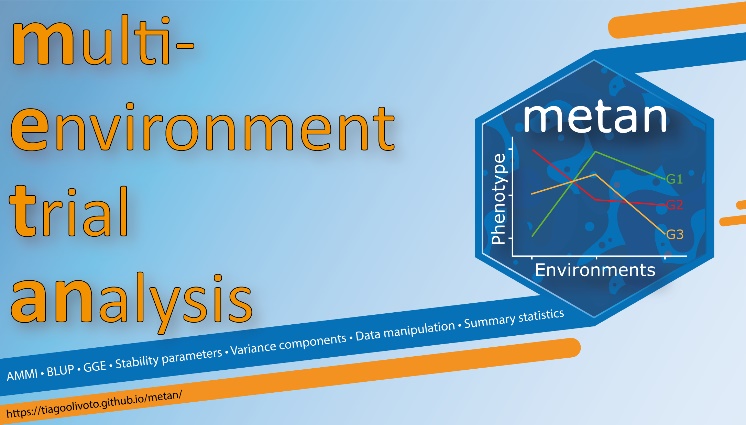
Em nosso recente artigo na Methods in Ecology and Evolution, Alessandro D. Lúcio e eu descrevemos um novo pacote R para análise de ensaios multi-ambientes chamado metan. Ensaios multi-ambientes são um tipo de ensaio em programas de melhoramento de plantas, onde vários genótipos são avaliados em um conjunto de ambientes. A análise desses dados requer a combinação de várias abordagens, incluindo manipulação, visualização e modelagem de dados. A versão estável mais recente do metan (v1.5.1) está disponível agora no repositório CRAN. Então, pensei em compartilhar a história da minha primeira incursão no uso do R criando um pacote e submetendo um artigo para uma revista que nunca havia submetido antes.
In our recent paper in Methods in Ecology and Evolution, Alessandro Lúcio and I describe a new R package, metan, for multi-environment trial analysis. Multi-environment trials are a kind of trial in plant breeding programs where several genotypes are evaluated in a set of environments. Analyzing such data requires the combination of several approaches including data manipulation, visualization and modelling. The latest stable version of metan (v1.5.1) is now on CRAN. So, I want to share the history about my first foray into using R, creating an R package, and submitting a paper to a journal that I’ve never had submitted before.
Are you coming to the Evolution 2018 in Montpellier? Want to share your views on the future of evolution research? Fancy some beer, wine and snacks on us?
We know the history of research and publications in evolution, but what will the future hold?
We would like to invite you to participate in an exciting focus session centred around what the future research landscape might look like through the eyes of up-and-coming researchers.
We’re looking for active researchers (based in universities, research institutes, government agencies, NGOs or the private sector) within about 10 years of having been awarded a PhD. Experienced PhD students who have published in peer reviewed academic journals are also welcome to join. Continue reading “The Future of Research and Publishing in Evolutionary Biology”
Formatting manuscripts for submission can take a long time.
Formatting a manuscript for journal submission can be time-consuming and frustrating work, especially for the first version. To make things a little bit simpler for our authors, we now have just a few small formatting requirements for initial submissions.
To have a paper considered in Methods in Ecology and Evolution it just needs to:
Be double line spaced and in a single column
Be within the word count (6000-7000 words for Standard Articles, 3000 words for Applications)
Follow the standard manuscript structure: Author details, Abstract (must be numbered according to journal style), Keywords, Introduction, Materials and Methods, Results, Discussion
This means that you do not need to worry about the format of your references, the placement of your figures (they can be within the text, at the end of the document or uploaded as separate files), whether or not you have used scientific names or anything else like that. Continue reading “New Initial Submission Requirements”
“If the reviewer doesn’t get it, you haven’t explained it clearly enough!” This is one quote from my PhD supervisor that I haven’t forgotten. Getting research funded and published depends to a very large extent on our ability to get the point across. Although scientific texts appear to differ wildly from other forms of writing, a good research paper actually follows the same basic principles of effective communication as a newspaper article or advertising text.
There are some fairly simple guidelines on presenting and structuring written information to get the point across and highlight the key messages that are very useful for manuscripts, thesis chapters, proposals, basically any kind of academic writing. At Functional Ecology, we’ve collected tips and tricks from various sources to help authors effectively communicate their research and ideas. Here are our key points:
The central principle for any type of communication is: know your audience. A research paper isn’t just about presenting information – it’s about communicating your research to others. When you start preparing a manuscript, you need to think about who will read it. In the first instance, this is probably a busy editor or reviewer, so you should make sure that you get your key messages across without making your readers work too hard. Good science writing isn’t about using clever-sounding words and sentences, it’s about getting the point across in such a way that readers can understand the research and reach the right conclusion (i.e. the one you want them to reach). Continue reading “Writing Manuscripts: The Alternative ‘Guide to Authors’”
You’ve spent months, or even years, working on a project. You’ve finalised your manuscript and you’re ready to submit. But which journal should you send your paper to?
@ Colin (click image to see original)
In recent years, this question has only gotten harder. As more and more journals enter the market, the decision of where to send your paper is becoming increasingly confusing. With predatory journals muddying the waters and an increasing pressure to publish, deciding where to submit can be a daunting task for even seasoned academics.
While our Editor-in-Chief will be chairing a session on methods in ecology and evolution at the BES Annual Meeting 2011, our Journal Coordinator is running a lunchtime workshop on publishing science in the online age. Journalist and blogger Ed Yong, Open Science advocate Ross Mounce, and BES journal editors Marc Cadotte and David Gibson, will all be talking about the various ways in which online communication has the potential to revolutionise … Continue reading Publishing science in the online age
As I have just been involved with setting up a new journal with Wiley-Blackwell and the BES, I was asked to contribute to a planning session for Austral Ecology considering the question, “what will journals look like in 10 years?” Here are some of my thoughts that I contributed. First, we should be clear that if we look back 10 years, journals have changed a … Continue reading INTECOL 2009 – What will journals look like in 10 years?


 Methods Blog