Key Technologies Used to Build the plant Package (and Maybe Soon Some Other Big Simulation Models in R)

Post provided by RICH FITZJOHN and DANIEL FALSTER

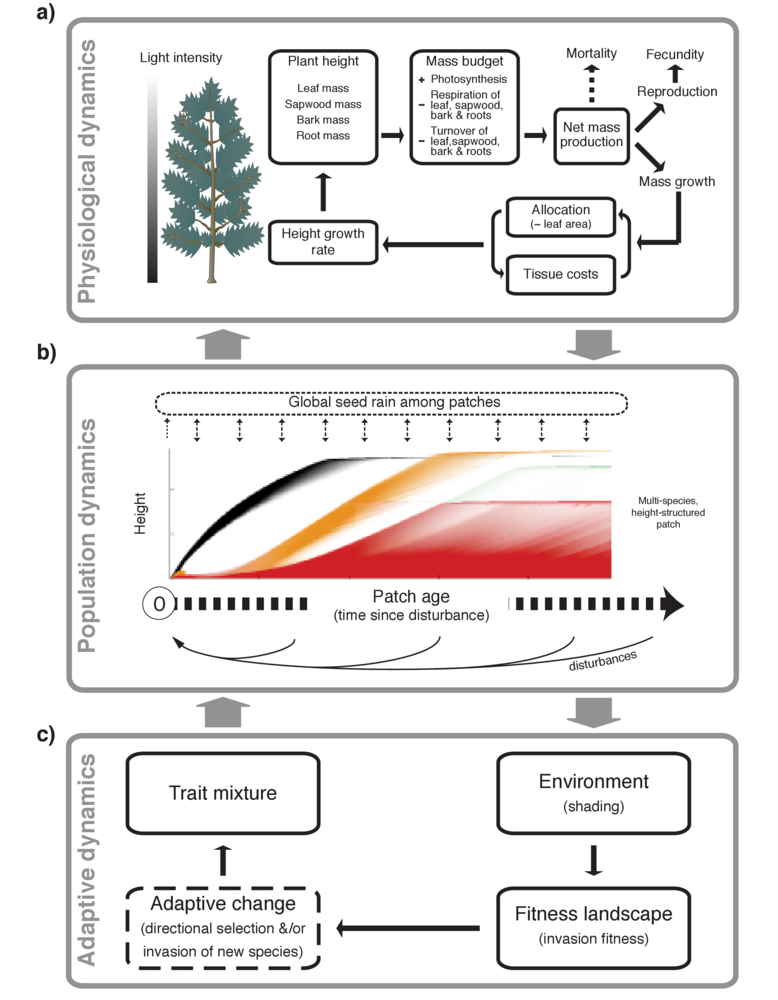
Our paper in Methods in Ecology and Evolution describes a new software package, plantplant is an individual-based simulation model that simulates the growth of individual trees, stands of competing plants, or entire metacommunities under a disturbance regime, using common physiological rules and trait-based functional trade-offs to capture differences among species.

Non-Linear Processes and Thousands of Plants

Since the development of gap models in the 1970s (e.g. Botkin 1972), researchers have been using computer simulations to investigate how elements of plant biology interact with competition and disturbance regimes to influence vegetation demography, structure and diversity. Simulating the competitive interactions among many thousands of plants, however, is no easy task.

Despite widespread recognition of the importance of key non-linear processes — such as size-structured competition, disturbance, and trait-based trade-offs — for vegetation dynamics, relatively few researchers have been brave (or daft) enough to try and incorporate such processes into their models. The situation is most extreme in theoretical ecology, where much contemporary theory (e.g. coexistence theory, neutral theory) is still built around completely unstructured populations.

Features of plant

Key processes modelled within the plant package.

The plant package attempts to change that by providing an extensible, open source framework for studying trait-, size- and patch-structured dynamics. One thing that makes the plant model significant is the focus on traits. plant is one of several attempts seeking to integrate current understanding about trait based trade-offs into a model of individual plant function (see also Moorcroft et al 2001Sakschewski et al 2015).

A second feature that makes the plant software significant, is it that is perhaps the first example where a computationally intensive model has been packaged up in a way that enables widespread usage, makes the model more usable and doesn’t  sacrifice speed.

In this post we will describe the key technologies used to build the plant software. Continue reading “Key Technologies Used to Build the plant Package (and Maybe Soon Some Other Big Simulation Models in R)”

Methods Beyond the Population

Post Provided by SEAN MCMAHON and JESSICA METCALF

Demography Beyond the Population” is a unique Special Feature being published across the journals of the British Ecological Society.  The effort evolved from a symposium of the same name hosted in Sheffield, UK last March. Both the meeting and the Special Feature were designed to challenge ecologists from a range of fields whose research focuses on populations.
The participants were charged with sharing how they are pushing the work they do beyond the stage where the population is the focus into research where the population is just the beginning and the focus spans scales, systems and tools. This encompasses a broad suite of biological research, including range modelling, disease impacts on communities, biogeochemistry, evolutionary theory, and conservation biology. The meeting was a great success, and this Special Feature should be equally valuable to the broad readership of the BES journals.

Methods in Ecology and Evolution has a special place in the Special Feature, hosting four papers. These papers not only introduce new efforts in population biology, they provide the methods that other scientists can use to implement them. With the tools provided by these four papers, researchers will be able to advance forest modelling, evolutionary theory, climate change biology and statistical inference of hidden population parameters.  Seriously good stuff! Continue reading “Methods Beyond the Population”

Measuring Survival Selection in Natural Populations: How important is recapture probability?

Post Provided by John Waller

The “Lande-Arnold” Approach

Damselflies marked in the field, which will hopefully be recaptured later. This small insect at our field site had only about 10% recapture probability.

The quantification of survival selection in the field has a long history in evolutionary biology. A considerable milestone in this field was the highly influential publication by Russel Lande and Steve Arnold in the early 1980s.

The practical implementation of Lande and Arnold’s method involved simply fitting a linear model with standardized response (survival) and explanatory (trait) variables values with quadratic terms (multiplied by two). This straightforward method allowed evolutionary biologists to measure selection coefficients using commonly available statistical software and these estimates could be used directly within a quantitative genetic framework.  Continue reading “Measuring Survival Selection in Natural Populations: How important is recapture probability?”

Issue 6.12

Issue 6.12 is now online!

The December issue of Methods is now online! 

Our final issue of 2015 contains one Applications article and two Open Access articles, all of which are freely available.

stagePOP: A tool for predicting the deterministic dynamics and interactions of stage-structured populations (i.e. where the life cycle consists of distinct stages, for example eggs, juveniles and reproductive adults). The continuous-time formulation enables stagePop to easily simulate time-varying stage durations, overlapping generations and density-dependent vital rates.

Julia Cherry et al. provide one of this month’s Open Access articles. In ‘Testing sea-level rise impacts in tidal wetlands: a novel in situ approach‘ the authors describe the use of experimental weirs that manipulate water levels to test sea-level rise impacts in situ and at larger spatial scales. This new method can provide more robust estimates of sea-level rise impacts on tidal wetland processes. This article was accompanied by a press release when it was published in Early View. You can read more about this article here.

Our September issue also features articles on Biodiversity, Demography, Predator-Prey Interactions, Animal Communication and much more. Continue reading “Issue 6.12”

Building a Better Indicator

Post Provided by Charlie Outhwaite & Nick Isaac

Nick and Charlie are giving a presentation on ‘Biodiversity Indicators from Occurrence Records’ at the BES Annual Meeting on Wednesday 16 December at 13:30 in Moorfoot Hall. Charlie will also be presenting a poster on Tuesday 15 December between 17:00 and 18:30 on ‘Monitoring the UK’s less well-studied species using biological records‘ in the Lennox Suite.

Biodiversity Indicators are some of the most important tools linking ecological data with government policy. Indicators need to summarise large amounts of information in a format that is accessible to politicians and the general public. The primary use of indicators is to monitor progress towards environmental targets. For the UK, a suite of indicators are produced annually which are used to monitor progress towards the Aichi targets of the Convention on Biological Diversity as well as for European Union based commitments.  However, this is complicated by the fact that biodiversity policy within the UK is devolved to each of the four nations, so additional indicators have been developed to monitor the commitments of each country.

© Dave Colliers
© Dave Colliers

A range of biodiversity indicators exist within this suite covering the five strategic goals of the Convention; which include addressing the causes of biodiversity loss, reducing pressures on biodiversity and improving status of biodiversity within the UK. Within strategic goal C (improve status of biodiversity by safeguarding ecosystems, species and genetic diversity) there are currently 11 “State” indicators that use species data to monitor progress towards the targets underlying this goal. Most existing species based indicators use abundance data from large scale monitoring schemes with systematic protocols. However, there are other sources of data, such as occurrence records, that can offer an alternative if they are analysed using the appropriate methods. This post will discuss the development of species indicators for occurrence records to complement the current UK species based indicators, specifically relating to the C4b priority species indicator and the D1c pollinators indicator. Continue reading “Building a Better Indicator”

A Quickstart Guide for Building Your First R Package

Post Provided By DR IAIN STOTT

Iain is a Postdoctoral Researcher at the Max Planck Institute for Demographic Research and the MaxO Center at the University of Southern Denmark. He is currently working as a part of MaxNetAging, a Research Network on Aging. Iain was one of the presenters at the UK half of the Methods in Ecology and Evolution 5th Anniversary Symposium in April. You can watch his talk, ‘Methods Put to Good Use: Advances in population ecology through studies of transient demography’ here.

If you’re anything like me, you might experience a minor existential crisis weekly. As scientists we question the world around us and, for me, this questioning turns all-too-often inwards to my career. I don’t think that’s unusual: ask any scientist about their ‘Plan B’, and the extent to which it’s thought through is often astonishing (if a café-cum-cocktail bar ever opens in Glasgow’s West End, which specialises in drinks that employ spice blends from around the world and are named after old spice trade routes and trading vessels, then you know I’ve jumped the science ship).

Contributing open-source software is something which has made my work feel a bit more relevant and helped me feel a bit less of an imposter. I’ll explain why that is, give some tips to beginners for building a first R package, and hopefully persuade other (especially early-career) researchers to do the same. Continue reading “A Quickstart Guide for Building Your First R Package”

National Wildlife Day 2015

Happy National Wildlife Day everyone!

Today is 10th National Wildlife Day. As we have done for a few awareness days this year (Bats, Biodiversity and Bees so far) we are marking the day by highlighting some of our favourite Methods in Ecology and Evolution articles on the subject. Obviously ‘wildlife’ is a pretty big topic, so we have narrowed our focus (slightly) to monitoring wildlife (with one or two additional papers that we didn’t want to leave out).

This list is certainly not exhaustive and there are many more wonderful articles on these topics in the journal. You can see more of them on the Wiley Online Library.

If you would like to learn more about National Wildlife Day, you may wish to visit the organisation’s website, follow them on Twitter and Facebook or check out today’s hashtag: #NationalWildlifeDay.

Without further ado though, please enjoy our selection of Methods articles for National Wildlife Day:

Integrating Demographic Data

Our National Wildlife Day celebration begins with an article from our EURING Special Feature. Robert Robinson et al. present an approach which allows important demographic parameters to be identified, even if they are not measured directly, in ‘Integrating demographic data: towards a framework for monitoring wildlife populations at large spatial scales‘. Using their approach they were able to retrieve known demographic signals both within and across species and identify the demographic causes of population decline in Song Thrush and Lawping.


Continue reading “National Wildlife Day 2015”

International Day for Biological Diversity 2015

Happy International Day for Biological Diversity everyone!

As you may know, today (Friday 22 May) is the United Nations Day for Biodiversity and we are celebrating by highlighting some of the best papers that have been published on biodiversity in Methods in Ecology and Evolution. This is by no means an exhaustive list and you can find many more articles on similar topics on the Wiley Online Library (remember, if you are a member of the BES, you can access all Methods articles free of charge).

If you would like to learn more about the International Day for Biological Diversity, you may wish to visit the Convention on Biological Diversity website, follow them on Twitter or check out today’s hashtag: #IBD2015.

Without further ado though, here are a few of the best Methods papers on Biological Diversity:

Methods Cover - August 2012Biodiversity Soup

We begin with an Open Access article from one of our Associate Editors, Douglas Yu (et al.). This article was published in the August issue of 2012 and focuses on the metabarcoding of arthropods. The authors present protocols for the extraction of ecological, taxonomic and phylogenetic information from bulk samples of arthropods. They also demonstrate that metabarcoding allows for the precise estimation of pairwise community dissimilarity (beta diversity) and within-community phylogenetic diversity (alpha diversity), despite the inevitable loss of taxonomic information.

Continue reading “International Day for Biological Diversity 2015”

Issue 6.5

Issue 6.5 is now online!

The May issue of Methods is now online!

We have two freely available articles this month: one Application and one Open Access Article.

rSPACE: An open-source R package for implementing a spatially based power analysis for designing monitoring programs. This method incorporates information on species biology and habitat to parameterize a spatially explicit population simulation.

Tim Lucas et al. provide this month’s Open Access article: A generalised random encounter model for estimating animal density with remote sensor data. The authors have developed a Generalised Random Encounter Model (gREM) to estimate absolute animal density from count data from both camera traps and acoustic detectors. They show that gREM produces accurate estimates of absolute animal density for all combinations of sensor detection widths and animal signal widths. This model is applicable for count data obtained in both marine and terrestrial environments, visually or acoustically. It could be used for big cats, sharks, birds, echolocating bats, cetaceans and much more. Continue reading “Issue 6.5”

Issue 6.3

Issue 6.3 is now online!

The March issue of Methods is now online!

We have three freely available Applications articles in this issue. Anyone can access these with no subscription required and no charge to download.

TR8: This R package was built to provide plant scientists with a simple tool for retrieving plant functional traits from freely accessible online traitbases.

StereoMorph: A new R package for the rapid and accurate collection of 3D landmarks and curves using two standard digital cameras.

MotionMeerkat: A new standalone program that identifies motion events from a video stream. This tool reduces the time needed to review videos and accommodates a variety of inputs.

This month we have a total of FIVE Open Access articles. That makes eight articles in this issue of Methods in Ecology and Evolution that you can read for free!

Continue reading “Issue 6.3”