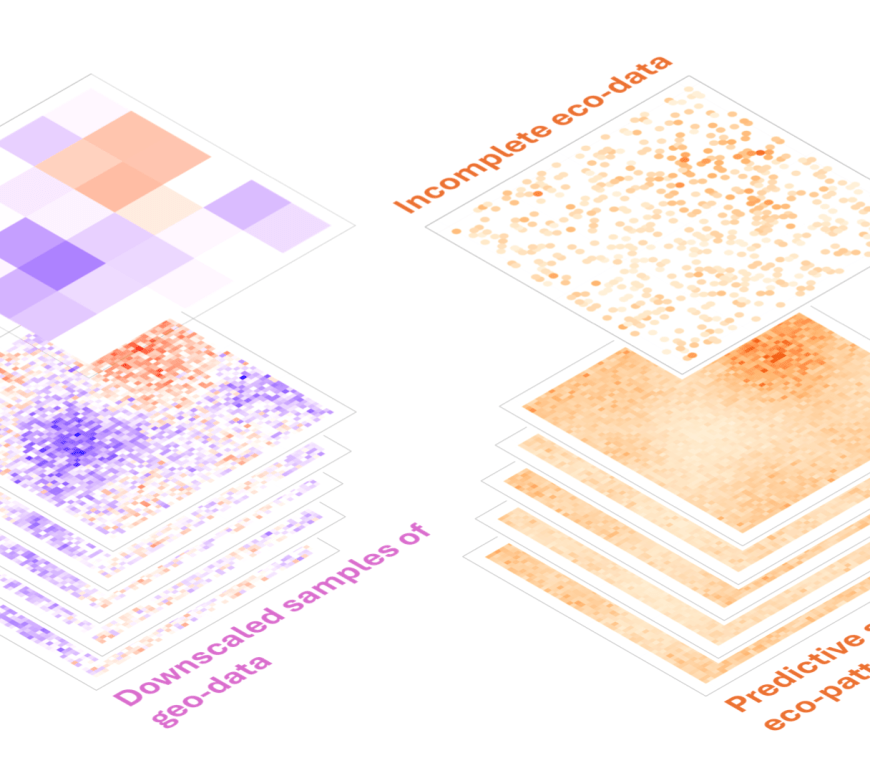
Grace Ridder: Generating spatially realistic environmental null models with the shift-&-rotate approach helps evaluate false positives in species distribution modelling

Throughout March and April, we are featuring articles shortlisted for the 2024 Robert May Prize. The Robert May Prize is awarded by the British Ecological Society each year for the best paper in Methods in Ecology and Evolution written by an early career author. Grace Ridder’s article ‘Generating spatially realistic environmental null models with the shift-&-rotate approach helps evaluate false positives in species distribution modelling‘ is one … Continue reading Grace Ridder: Generating spatially realistic environmental null models with the shift-&-rotate approach helps evaluate false positives in species distribution modelling

Tackling uncertainty in landscape connectivity

Post provided by Maëlis Kervellec  An Increased Interest Towards Landscape Connectivity Human activities not only contribute to climate change by producing greenhouse gases, but also directly degrade habitats. According to the 2019 IPBES report , about 75% of the Earth’s land surfaces have been heavily modified. Moreover, in Europe, 50% of the land is within 1.5 kilometres of a road (Torres, Jaeger, and Alonso, 2016 ). This … Continue reading Tackling uncertainty in landscape connectivity

New Associate Editors

Today we are welcoming two new Associate Editors to Methods in Ecology and Evolution: Huijie Qiao (Chinese Academy of Sciences, China) and Veronica Zamora-Gutierrez (Unidad Durango, Mexico and University of Southampton, UK). They have both joined on a three-year term and you can find out more about them below. Huijie Qiao “My research is focused broadly on macroecology. I work to clarify the theory and methodology behind ecological niche modelling … Continue reading New Associate Editors

Can Opportunistically Collected Citizen Science Data Create Reliable Habitat Suitability Models for Less Common Species?

Post provided by Ute Bradter, Mari Jönsson and Tord Snäll

Detta blogginlägget är tillgängligt på svenska

Opportunistically collected species observation data, or citizen science data, are increasingly available. Importantly, they’re also becoming available for regions of the world and species for which few other data are available, and they may be able to fill a data gap.

Siberian jay ©Ute Bradter

In Sweden, over 60 million citizen science observations have been collected – an impressive number given that Sweden has a population of about 10 million people and that the Swedish Species Observation System, Artportalen, was created in 2000. For bird-watchers (or plant, fungi, or other animal enthusiasts), this is a good website to bookmark. It will give you a bit of help in finding species and as a bonus, has a lot of pretty pictures of interesting species. Given the amount of data citizen science can provide in areas with few other data, it’s important to evaluate whether they can be used reliably to answer questions in applied ecology or conservation. Continue reading “Can Opportunistically Collected Citizen Science Data Create Reliable Habitat Suitability Models for Less Common Species?”

Issue 7.8

Issue 7.8 is now online!

The August issue of Methods is now online!

This month’s issue contains two Applications articles and two Open Access articles, all of which are freely available.

Plant-O-Matic: A free iOS application that combines the species distribution models with the location services built into a mobile device to provide users with a list of all plant species expected to occur in the 100 × 100 km geographic grid cell corresponding to the user’s location.

RClone: An R package built upon genclone software which includes functions to handle clonal data sets, allowing:

  • Checking for data set reliability to discriminate multilocus genotypes (MLGs)
  • Ascertainment of MLG and semi-automatic determination of clonal lineages (MLL)
  • Genotypic richness and evenness indices calculation based on MLGs or MLLs
  • Describing several spatial components of clonality

Continue reading “Issue 7.8”

Statistical Ecology Virtual Issue

StatEcolVI_WebAdAt the last ISEC, in Montpellier in 2014, an informal survey suggested that Methods in Ecology and Evolution was the most cited journal in talks. This reflects the importance of statistical methods in ecology and it is one reason for the success of the journal. For this year’s International Statistcal Ecology Conference in Seattle we have produced a virtual issue that presents some of our best recent papers which cross the divide between statistics and ecology. They range over most of the topics covered at ISEC, from statistical theory to abundance estimation and distance sampling.

We hope that Methods in Ecology and Evolution will be equally well represented in talks in Seattle, and also – just as in Montpellier – some of the work presented will find its way into the pages of the journal in the future.

Without further ado though, here is a brief overview of the articles in our Statistical Ecology Virtual Issue: Continue reading “Statistical Ecology Virtual Issue”

Issue 7.5

Issue 7.5 is now online!

The May issue of Methods is now online!

This month’s issue contains two Applications articles and two Open Access articles, all of which are freely available.

piecewiseSEM: A practical implementation of confirmatory path analysis for the R programming language. This package extends the method to all current (generalized) linear, (phylogenetic) least-square, and mixed effects models, relying on familiar R syntax. The article also includes two worked examples.

 RPANDA: An R package that implements model-free and model-based phylogenetic comparative methods for macroevolutionary analyses. It can be used to:

  1. Characterize phylogenetic trees by plotting their spectral density profiles
  2. Compare trees and cluster them according to their similarities
  3. Identify and plot distinct branching patterns within trees
  4. Compare the fit of alternative diversification models to phylogenetic trees
  5. Estimate rates of speciation and extinction
  6. Estimate and plot how these rates have varied with time and environmental variables
  7. Deduce and plot estimates of species richness through geological time. Continue reading “Issue 7.5”

New Associate Editors

Today we are welcoming three new Associate Editors to Methods in Ecology and Evolution: Nick Golding (University of Melbourne, Australia), Rachel McCrea (University of Kent, UK) and Francesca Parrini (University of the Witwatersrand, South Africa). They have all joined on a three-year term and you can find out more about them below. Nick Golding “I develop statistical models and software for mapping the distributions of species and diseases. I’m particularly interested in … Continue reading New Associate Editors

Recent content and new video

Lots of exciting content has recently gone online. Firstly, two interesting new applications (as always free): simapse, simulation maps for ecological niche modelling in Python and nadiv, an R package for estimating non-additive genetic variances in animal models. Also, two research articles. In the first, Julien Beguin and colleagues introduce an alternative procedure for fitting Bayesian hierarchical spatial models (BHSM) with quite general spatial covariance … Continue reading Recent content and new video