Cover Stories: Overlooked primary producers key to accurate trophic position estimation

Post provided by Matthew Ramirez, Alexi Besser, Seth Newsome, and Kelton McMahon
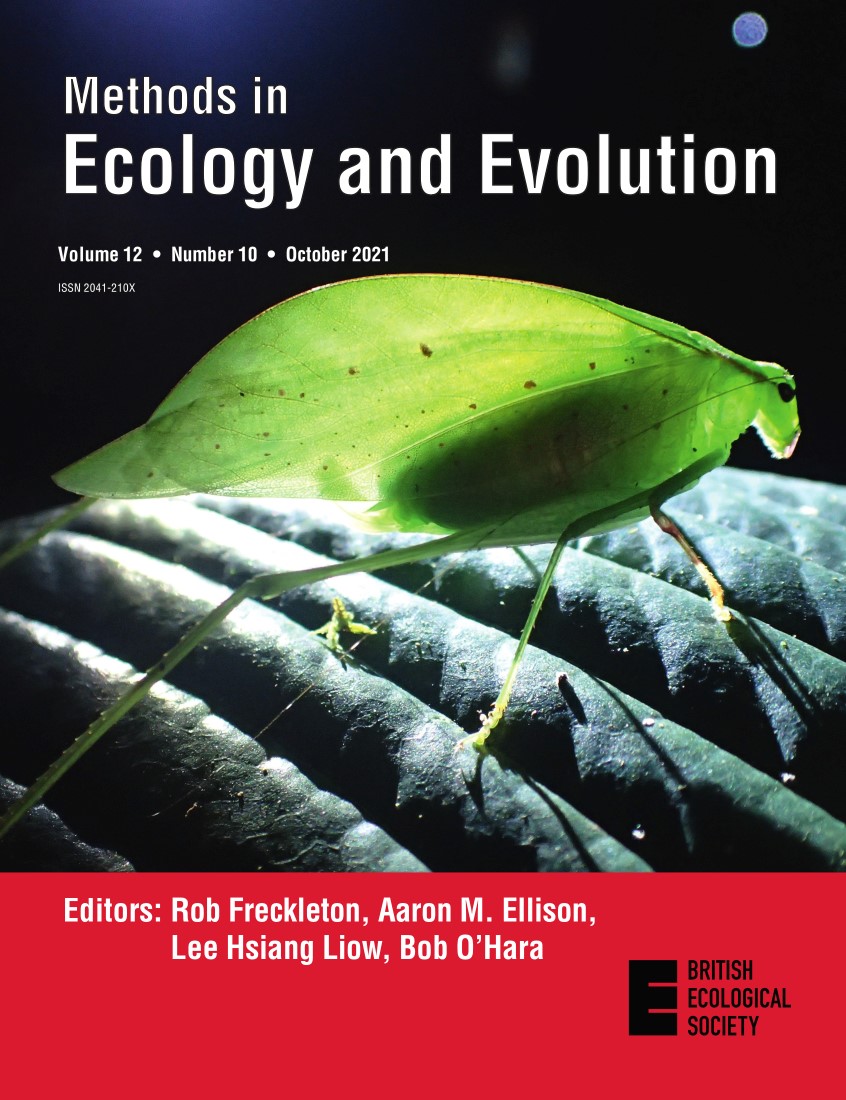
The cover of our October issue shows a katydid feeding on a leaf in the Tirimbina Rainforest National Wildlife Refuge of Costa Rica. Once digested, nitrogen from the leaf is incorporated into the katydid’s tissues in the form of amino acids, with slight modification to their stable nitrogen isotope values (δ15N). In this post the authors discuss the importance of understanding and accounting for variability in primary producer amino acid δ15N values when characterizing where consumers are positioned within food webs, detailed in their Methods in Ecology and Evolution article “Meta-analysis of primary producer amino acid δ15N values and their influence on trophic position estimation.”

Continue reading “Cover Stories: Overlooked primary producers key to accurate trophic position estimation”

New Associate Editor: David Soto

Today, we are pleased to be the latest new member of the Methods in Ecology and Evolution Associate Editor Board. David Soto joins us from the University of Leuven in Belgium and you can find out a little more about him below. David Soto “I am an isotope ecologist with interests in developing new stable isotope methods and techniques for tracing spatio-temporal changes in food webs, and understanding … Continue reading New Associate Editor: David Soto

Jellyfish Help Scientists to Fight Food Fraud

Below is a press release about the Methods paper ‘Stable isotope-based location in a shelf sea setting: accuracy and precision are comparable to light-based location method‘ taken from the University of Southampton.

©Katie St John Glew
©Katie St John Glew

Animals feeding at sea inherit a chemical record reflecting the area where they fed, which can help track their movements, according to a new study by scientists from the University of Southampton.

Chemical testing of the source of marine food products could be a powerful tool to help to fight food fraud, maintain healthy sustainable fish stocks or marine protected areas, and ensure consumer confidence in marine eco-labelling. Continue reading “Jellyfish Help Scientists to Fight Food Fraud”

Why Accurate Stable Isotope Discrimination Factors are so Important: A cautionary tale (involving kea)

Post provided by AMANDA GREER

Stable isotopes as a tool for ecologists

Our research into the foraging ecology of this cheeky parrot (kea: Nestor notabilis) prompted us to develop a simple method to establish discrimination factors © Andruis Pašukonis
Our research into the foraging ecology of this cheeky parrot (kea: Nestor notabilis) prompted us to develop a simple method to establish discrimination factors © Andruis Pašukonis

Isotopes are atoms that have the same number of protons and electrons but differ in their number of neutrons; they are lighter and heavier forms of the same element. Unlike radioactive isotopes, stable isotopes do not decay over time.

The ratio of heavy to light stable carbon (δ13C) and nitrogen (δ15N) isotopes in an animal’s tissues depend on its diet, although offset by a certain amount. This integration of δ13C and δ15N from an animal’s diet into its tissues allows ecologists to use stable isotope analysis to investigate a species’ present and historical diets, food-web structures, niche shifts,  migration patterns and more.   Continue reading “Why Accurate Stable Isotope Discrimination Factors are so Important: A cautionary tale (involving kea)”