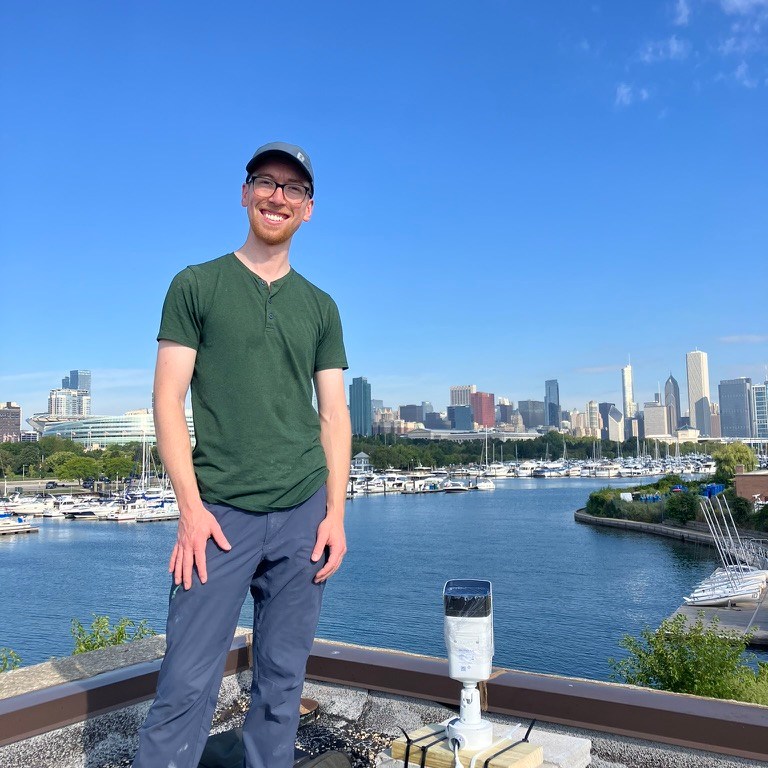
Throughout March and April, we are featuring articles shortlisted for the 2024 Robert May Prize. The Robert May Prize is awarded by the British Ecological Society each year for the best paper in Methods in Ecology and Evolution written by an early career author. Benjamin Van Doren’s article ‘Nighthawk: Acoustic monitoring of nocturnal bird migration in the Americas‘ is one of those shortlisted for the award.
The paper
What is your shortlisted paper about, and what are you seeking to answer with your research?
Migratory birds play essential roles in ecosystems, but they have experienced stark population declines in recent decades. Most birds migrate at night, when direct observation is challenging, so we need other methods to monitor their movements. One possibility is by recording the vocalizations that many migrating birds regularly produce during flight. However, identifying these “flight calls” has traditionally required long hours of work by highly trained individuals. Our paper presents a machine learning model called Nighthawk that automates this process, opening the door for acoustic monitoring of bird migration to become feasible across large scales.

Were you surprised by anything when working on it? Did you have any challenges to overcome?
Part of our research compared observations of migrating birds derived from acoustic data to primarily visual observations collected by citizen scientists. These are two very different modalities, yet we found surprisingly close correspondence between these two methods. This gives us confidence that acoustic approaches for monitoring bird movements could be widely useful.
This work required a deep dive into the world of neural networks and machine learning, which was a challenge for me given my primarily biology background. It required many long and often frustrating nights of coding. It was also very rewarding, and I was fortunate to have supportive collaborators along the way.
What is the next step in this field going to be?
The world of bioacoustics is rapidly growing, buoyed by machine learning and AI. Only a few years ago, these computational methods were all but inaccessible to those without extensive experience in the field. Increasingly, however, these approaches are becoming part of the standard biology toolkit. Our next steps in this work will include building the infrastructure to facilitate large-scale bioacoustic monitoring in real time. We have already begun these efforts through a research project in Chicago, USA – you can view our live dashboard of acoustic detections at https://www.migrationbiology.org/chicago.
What are the broader impacts or implications of your research for policy or practice?
Acoustic monitoring is a tool that can be employed not only by researchers, but by industry and as part of policy. As one example, collisions with buildings and other structures are a leading cause of anthropogenic mortality on birds, and these are often mediated by light pollution and movement (e.g., wind turbine blades). Automated acoustic methods could help inform targeted curtailment of turbines or reducing unnecessary lighting to help protect migrants during periods of heavy migration. In general, these methods can help us understand the risks of current and planned building projects for migratory birds.
The author
How did you get involved in ecology?
I’ve been interested in birds and nature for almost as long as I can remember, and bird migration is a phenomenon that inspires much wonder in me. As an undergraduate, I sought opportunities to be involved in migration ecology research. The fact that billions of birds migrate at night, making their way across the world while most humans are asleep—or, at the very least, unaware—has always made bird migration a captivating phenomenon for me.

What is your current position?
I recently started as an Assistant Professor at the University of Illinois Urbana-Champaign in Illinois, USA. I work in the Department of Natural Resources and Environmental Sciences. My lab’s website is https://migrationecology.org.
Have you continued the research your paper is about?
Yes! We are actively applying and expanding on the results of this research. We and others are using the Nighthawk model to power acoustic monitoring of bird migration at several sites in the US. Most recently, we launched a monitoring project with collaborators in Veracruz, Mexico.
What one piece of advice would you give to someone in your field?
When in doubt about a decision related to science, I’ve always tried to choose the option that most excites and inspires me. Of course, this isn’t always possible, but I’ve rarely regretted making a decision this way!
 Methods Blog