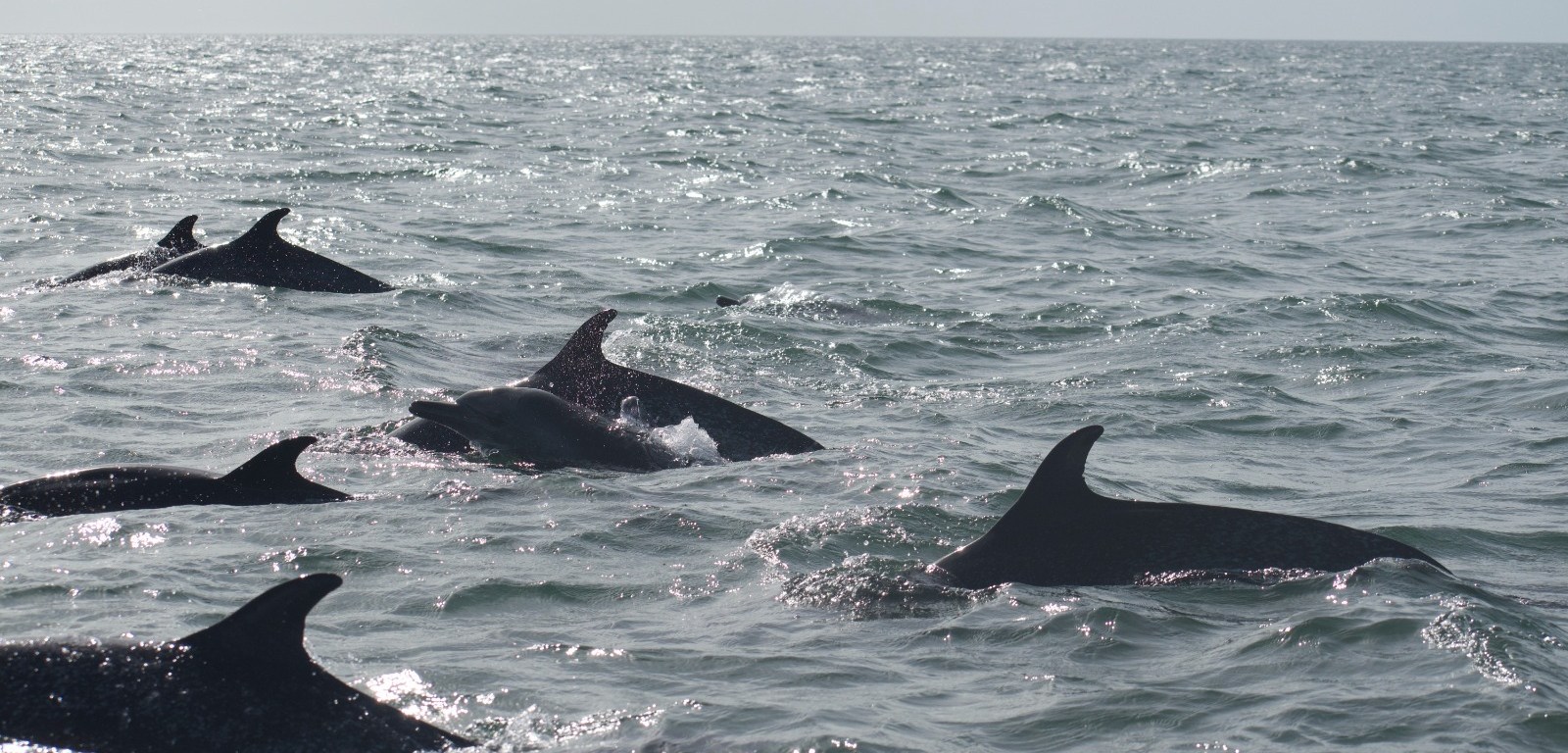
Post provided by Maia Austen
Introduction: Why toothed whale voices matter
I’m a PhD candidate in the ONDAS Lab at the University of Vermont, advised by Dr. Laura May-Collado. My PhD looks to utilize machine learning analysis to better understand how and why dolphins communicate with each other.
Toothed whales – like dolphins and belugas – are among the most acoustically sophisticated animals on Earth. Their vocal repertoires often include a remarkable range of tonal sounds, or whistles, that can serve all kinds of social functions: identifying individuals, signalling group identity, etc. Yet despite this complexity, most species still lack detailed vocal repertoire descriptions, especially when compared to better-studied groups like birds and primates.


Left: Maia Austin collecting acoustic data in the field from wild dolphins, Credit: Laura May-Collado; Right: Collage of Dolphin Whistle, Credit: Emma Gagne and Manali Rege-Colt
When I began my PhD in 2020, global fieldwork was at a standstill. So, I focused my project on existing data from our collaborators (Dr. Joëlle de Weerdt, Dr. Eric Angel Ramos, and Dr. Nicola Ransome) and my advisor Dr. Laura May-Collado’s earlier PhD field recordings. We knew we wanted to explore how to measure and compare the size and structure of these whistle repertoires; something fundamental to understanding social behaviour, environmental responses, and the evolution of communication.
The challenge: complexity, data, and a lack of standards
Toothed whale whistles are rich and varied, but that makes them tricky to analyse. With no standard methods for comparing repertoires between species or populations, and limited tools that can handle the complexity of their vocalisations, researchers have often struggled to quantify them in consistent ways. To face these challenges, we teamed up with Dr. Julie Oswald, a leader in developing tools for dolphin signal analysis.
Together we set out to fix that.
What we did: a primer for acoustic repertoire analysis
Our new study offers a primer: a hands-on guide for researchers who want to use machine learning tools to analyse tonal vocalisations. We tested six widely used bioacoustics software packages – Luscinia, Beluga, ARTwarp, DeepSqueak, PAMGuard, and SASLab – on acoustic data from four dolphin species. We evaluated these tools for how well they detect, extract, and categorise tonal sounds.

We found that manual or semi-automated approaches (like Luscinia, Beluga, and DeepSqueak) were better at detecting usable contours than fully automated tools. For categorising the sounds, we compared two “hard” clustering approaches (ARTwarp and DeepSqueak) and a “fuzzy” multivariate approach using Luscinia’s built-in tools. While the methods varied, they produced similar species rankings in terms of repertoire size.
We also included ways to estimate repertoire size using three common statistical approaches: the Coupon Collector, Capture-Recapture, and Hill Numbers. Each has strengths, but Hill Numbers stood out for adjusting better to uneven sampling, something we often face in wildlife studies.
Why it matters: beyond dolphins
This primer isn’t just for dolphin researchers. These methods can be adapted to study vocal repertoires in any species that produces tonal sounds – including other whales, seals, manatees, bats, rodents, birds, and primates. Understanding how animals communicate isn’t just a scientific question; it’s an ecological and ethical one. As soundscapes shift and species face new pressures, vocal repertoires may change in response. Tools like those in this primer can help us monitor those changes more precisely and meaningfully, guiding both research and conservation.
Our hope is that this primer will not only support new studies in acoustic communication, but also spark further innovation and collaboration across disciplines and species.
Making this accessible
Acoustic monitoring has become a standard component of fauna monitoring studies, making data from many species and regions readily available via sound databases. Therefore, we designed this primer to be accessible to researchers with a range of experience. Whether you’re comfortable writing R scripts or are just beginning to explore machine learning, the supplementary materials offer annotated code, sample datasets, and guidance for adapting the tools to new systems—including birds, bats, primates, and more.
Machine learning can seem intimidating, but we emphasize that human expertise remains essential: selecting parameters, validating clusters, and interpreting results are all tasks that require biological understanding. The goal isn’t to replace human input; it’s to empower it.
What’s next: mapping voices, social lives, and evolutionary pathways
This primer lays the groundwork for a series of exciting new directions in our lab.
First, we’re exploring what happens when two species share the same soundscape. In parts of Central and South America, bottlenose dolphins and Guiana dolphins live in overlapping habitats and even form mixed-species groups. We’re studying how these encounters shape their vocal repertoires—do their repertoires overlap or remain distinct? And depending on the direction of the changes, is there evidence for vocal mimicry? Does one species lead the changes more than the other?
In another ongoing project, we’re zooming in on a single population of bottlenose dolphins in Bocas del Toro, Panama, where we’re investigating how individual vocal diversity relates to social connections. Do dolphins with more social ties have larger or more varied repertoires? We’re combining acoustic data with social network analysis to find out.
Finally, our lab is part of a major new initiative led by Dr. Laura May-Collado: an NSF CAREER funded project (Award #2335991) that, using the tools described in our paper in combination with phylogenetic methods, aims to uncover the evolutionary and ecological drivers of vocal repertoire evolution in toothed whales. This study brings together field research, machine learning, and evolutionary modelling to answer big-picture questions about communication, adaptation, and survival in a rapidly changing ocean.

Together, these projects push us closer to understanding the incredible complexity of toothed whale communication—and how we can protect it.
To find out more about this project, read our paper and check out my GitHub page (https://github.com/austinmaia/ml-framework-repertoire/wiki).
 Methods Blog