Post provided by Xiaojie Gao
I am a remote sensing ecologist currently working as a postdoctoral researcher at Harvard Forest department of Harvard University. My research focuses on mapping and understanding the impacts of climate change and human activities on the terrestrial vegetation ecosystems.

The development of the pnetr R package for forest ecosystem modeling was inspired by my own research interest in understanding how vegetation phenology interacts with various ecological variables to influence carbon and water cycles. Vegetation phenology––the timing of vegetation’s life-cycle events such as leaf-out and leaf-fall––is “nature’s calendar”, regulating the seasonal exchange of materials and energy between the land surface and the atmosphere. Observations have shown that spring phenology has been advancing ~3 days per decade in many extra-tropical regions due to climate change. However, the consequences of these shifts and their interactions with ecosystem processes remain poorly understood.
To investigate these processes, researchers often correlate phenological shifts to other ecological variables. However, although this approach attempts to control for confounding factors, it rarely captures the complex, non-linear interactions among ecosystem processes. As a result, the inferred causal effects and underlying mechanisms carry substantial uncertainty.
More broadly and more importantly, to advance our ecological theory, we need ecosystem models that elucidate complex ecological interactions and iteratively testing and updating these processes when new knowledge emerges. However, despite recent technological developments, testing hypotheses in most ecosystem models and updating model structures are not trivial tasks. Due to computational complexity and historical reasons, most existing ecosystem models are implemented in lower-level programming languages such as FORTRAN, C++, and C#, which increase the technical barriers for ecologists to modify model structures. Consequently, while many new scientific findings have led to suggestions for new or altered representations of certain ecological processes, implementing these suggestions is often far from straightforward.
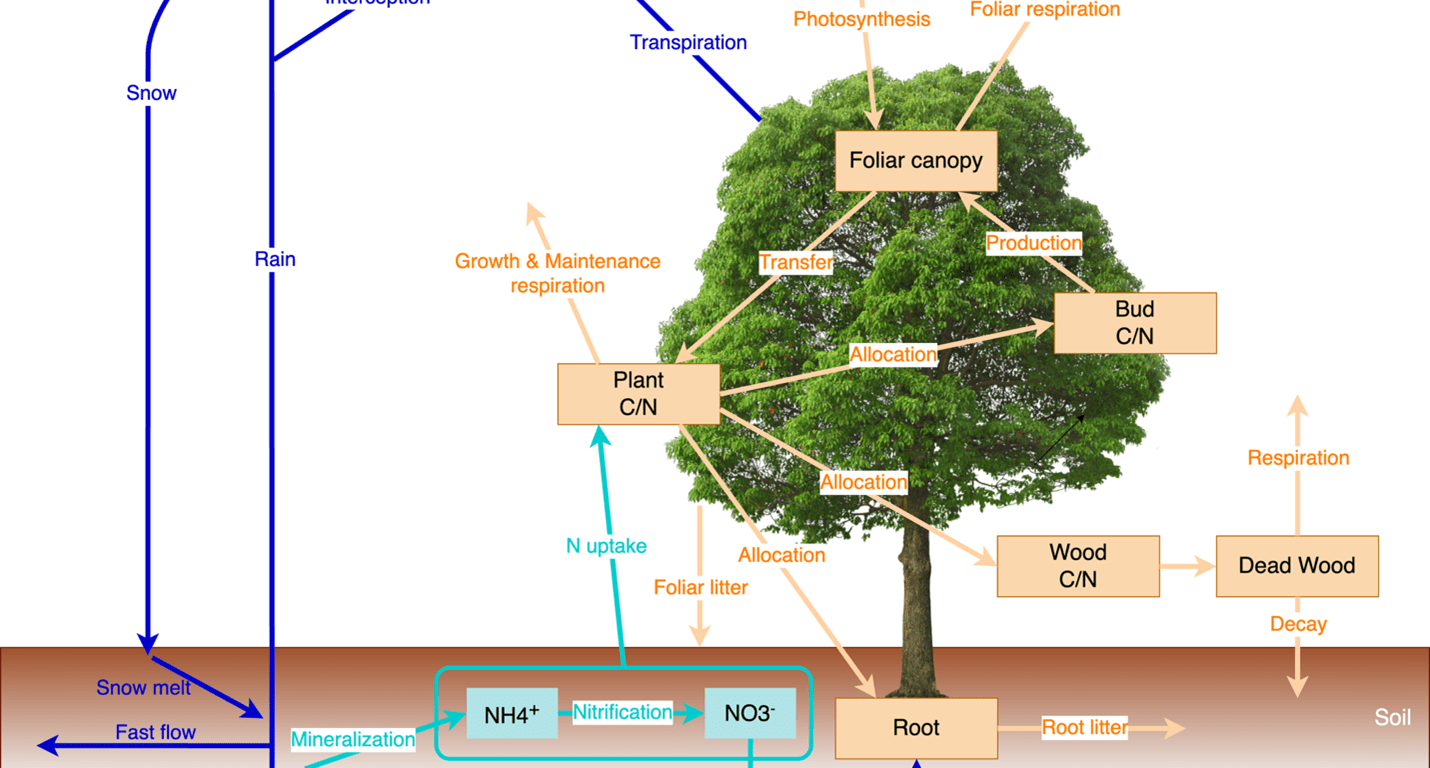
To address these challenges, we developed an easy-to-manage modelling framework––the pnetr R package––to implement the family of the PhotosyNthesis and EvapoTranspiration (PnET) ecosystem models. R is probably the most widely used programming language in the ecology field so its technical barrier for ecologists is low. We chose PnET models because they contain essential processes demonstrating carbon, water, and nitrogen cycles in relatively parsimonious ways so that they are computationally feasible in R. We also provide comprehensive algorithm documentation for major processes implemented in the models, which not only are references for users but also make pnetr useful in hands-on teaching. Moreover, although pnetr is a package, we highly encourage ecologists to modify the code scripts on GitHub to test their hypothetical processes of interest. As an example, in our paper, we showcase how modifying the phenology process can help us understand the impacts of phenological shifts on carbon sequestration and storage.

We hope pnetr can facilitate further development of ecological theory and increase the technical accessibility of ecosystem modelling and ecological forecasting.
Read our full article here and explore the pnetr package on GitHub.
 Methods Blog