Post provided by Diandra Duengen
What is IBAC?
In 2025, the biennial meeting of the International Bioacoustics Society (IBAC) took place in Kerteminde, Denmark, the country in which the society was originally founded. IBAC’s aim is “[…] to promote international participation throughout the entire field of bioacoustical activity.” Since IBAC was founded in 1969, 27 bioacoustic symposia and congresses in 13 different countries have been organized. IBAC covers a wide variety of bioacoustics topics, bridging the fields of biology and acoustics.
What I particularly enjoy about the IBAC conferences is the kind and open community and their multidisciplinary nature: IBAC brings together researchers from many different backgrounds – physiologists, ethologists, engineers, and many more – all sharing their passion for animals and the diversity of sounds they produce and perceive. The rather informal atmosphere and approachability of all members foster open discussions and exchange of ideas, often leading to cooperations. I wholeheartedly recommend attending IBAC conferences, particularly for early career scientists who can make first contact with renowned researchers right here.
What is bioacoustics?
According to IBAC, “Bioacoustics is the result of a happy marriage between the love of nature and the love of sound”. In fact, bioacoustics covers a broad range of topics, from acoustic communication, mechanisms of sound reception and production, to soundscape research (including both biological and geophysical sound sources, such as rain or wind), and the effects of anthropogenic noise. Other areas include acoustic communication through ultra- or infra-sounds (sounds outside the human hearing range), or how different species develop or learn their vocal behavior.
Why study bioacoustics?
To me, as someone working with marine mammals, bioacoustics is particularly fascinating because communication underwater differs markedly from communication on land. Underwater vision is often limited or impaired (for example, in murky water), but sounds travel about four times faster in water than in air. This has driven a range of auditory and vocal adaptations across species. For instance, toothed whales evolved echolocation, allowing them to “see” through sound, whereas many baleen whales communicate over vast distances using low-frequency vocalizations that propagate much farther than high-frequency sounds – which are more readily absorbed by seawater.
About me
I got to know IBAC in 2023, through my PhD supervisor Prof. Andrea Ravignani. I was very lucky to participate in 2023’s conference in Japan: The kind atmosphere and plethora of information I received back then made me want to attend the next meeting as well. Luckily, the BES agreed on sponsoring my conference registration fee, as I transitioned from my PhD to pursuing the next career step. IBAC 2025 was a completely different experience from the one in Japan, as I had moved from being an “all‑in PhD student” to a PhD candidate on the verge of defending my thesis. At IBAC 2025, I presented my final thesis chapter; an excellent opportunity to practice for the upcoming defense! This year’s conference also allowed me to finally meet a few researchers whose work I had long admired but whom I had never encountered in person. I am especially grateful for this opportunity and for the stimulating discussions that emerged from it.
About the 2025 conference and highlights
This year’s meeting was filled with a variety of exciting topics. From September 7th to September 12th, 2025, the conference spanned quite a range of bioacoustics, from non-linear phenomena (acoustic irregularities in sounds that appear “harsh” to the listener) and the perception and production of sounds, to passive acoustic monitoring (acoustically “surveying” the environment and its sounds), acoustic communication, and environmental noise.
Two of the talks, both on underwater bioacoustics, particularly captured my interest, for two very different reasons.
In her symposium talk, Saliza Bono talked about the potential impact of vessel noise on the acoustic behavior of Indo-Pacific humpback dolphins. In her exciting study in Northwest Peninsula Malaysia, she investigated whether this vulnerable (IUCN) to endangered (Malaysian) species’ whistle rate and selected whistle parameters are influenced by vessel noise. Whistles are a specific type of vocalization that dolphins use to acoustically communicate. Through visual observations above water, and hydrophone recordings underwater, the researchers investigated the dolphins’ whistles in different behavioral situations (e.g., foraging, socializing, etc.) before, during and after a boat passed by. They found that humpback dolphins’ acoustic behavior indeed changes – likely as a result of the boat noise. Specifically, they found that in small groups, whistle rate significantly decreased from before a boat encounter to after, and whistle duration during boat encounters were significantly longer than before or after a boat passed by. Also, while the dolphins were travelling, the whistle rate was significantly higher before a boat passed by, compared to during and after boat presence, which could indicate a disruption of communication during travelling. Such disruptions could have a negative impact on group cohesion and/or coordination. This talk gave an interesting insight into the acoustic behavior of dolphins during noisy situations underwater and exemplifies why it matters to have a closer look: Smaller groups showed more “disturbances” than larger groups, which indicates that they are more vulnerable. I valued the talk for its important topic, clarity and for the structured way in which this very relevant research was presented.
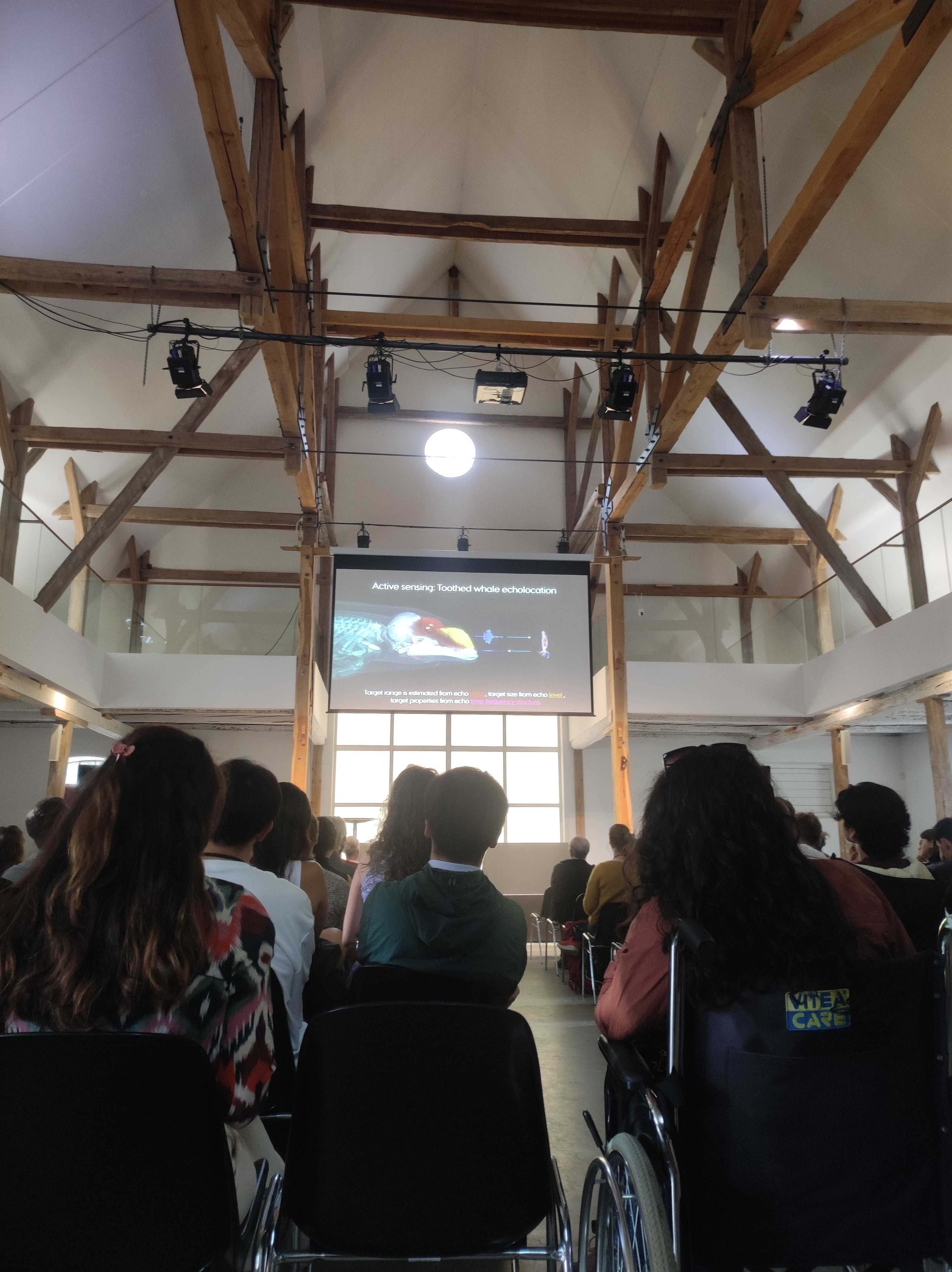
Another highlight for me was the opening plenary by Peter Madsen. He shared his scientific journey, from an early ambition to understand the function of the sperm whale’s nose to key contributions showing that this extraordinary structure serves as a sound generator. In fact, sperm whales produce the loudest biological sounds on earth, and hearing parts of the story behind how this knowledge developed over time was fascinating. What made this plenary particularly compelling was not just the science itself, but the narrative behind it. From a PhD student, who built his own acoustic recording equipment to collect data, to becoming a well-acknowledged professor, providing valuable research on – amongst others – cetacean bioacoustics. It illustrated how sustained dedication, technical innovation, and curiosity contribute to building a scientific career. Personally, as a fellow whale nerd, his plenary both informed and inspired me. It reinforced why long-term dedication to a question matters, and how innovation often begins with hands-on problem solving. As the very first presentation, it set an energizing tone for the rest of the conference and highlighted the importance of combining technical skills with scientific imagination.
Other Conference Highlights
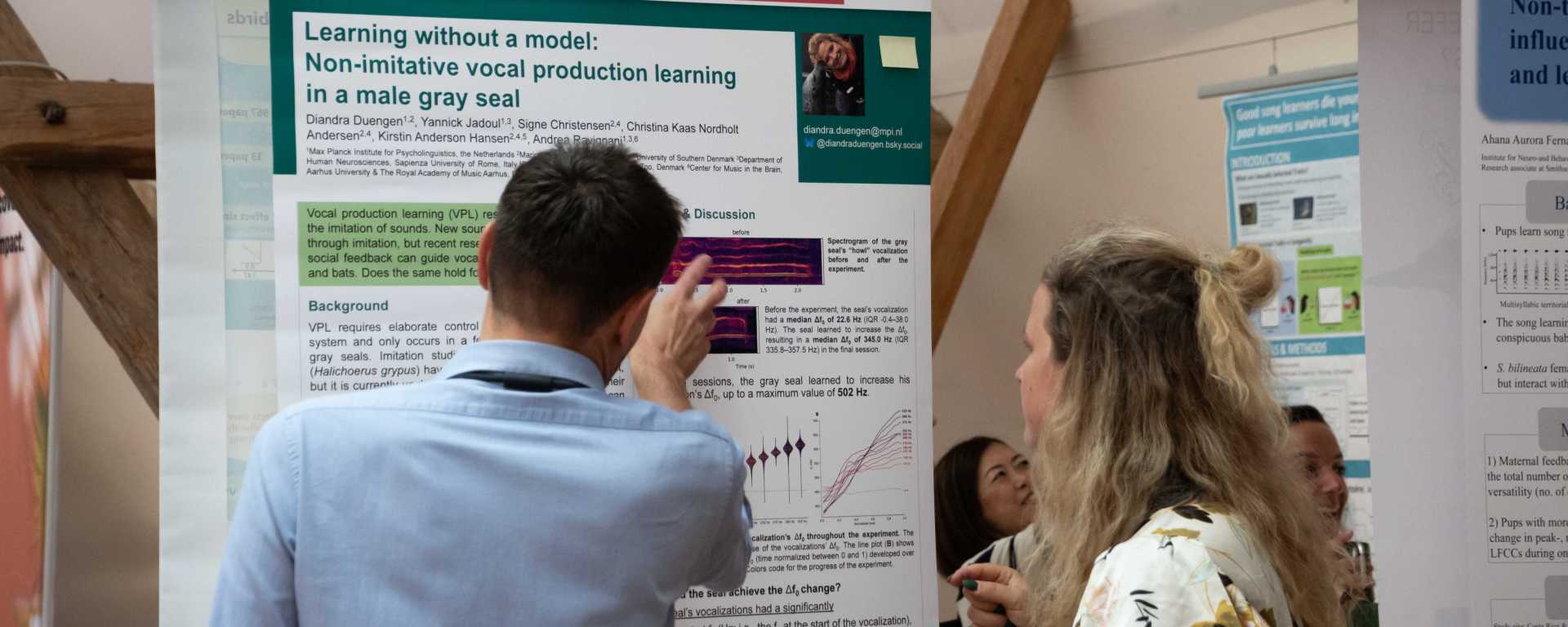
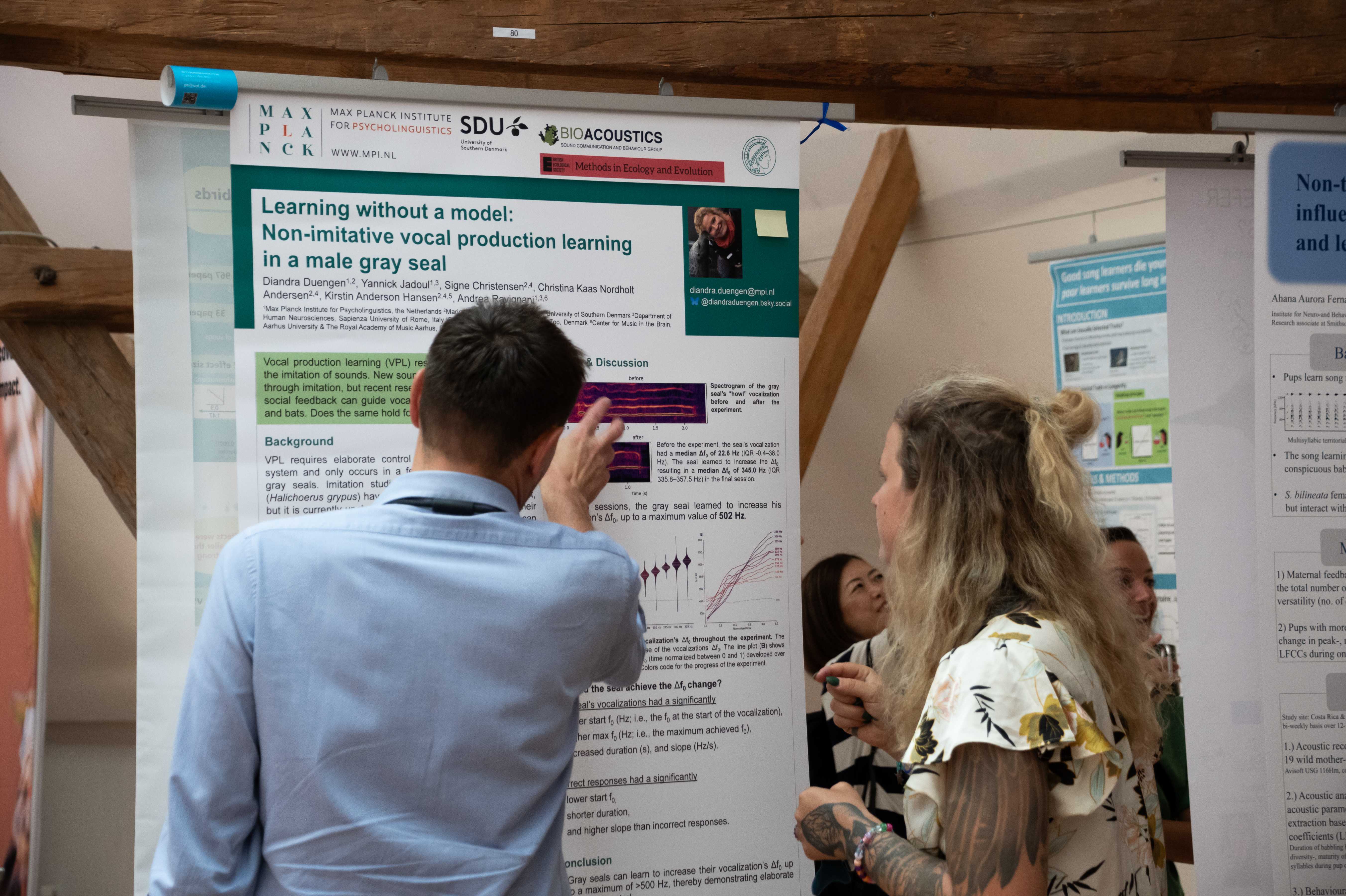
Another conference highlight was the four poster sessions, which I found exceptional for a conference. In a large, bright hall with wooden beams, there was ample space to showcase a wide range of bioacoustics research, attracting considerable interest from the attendees. From underwater soundscapes to human speech analysis, and from bat dialects to dolphin whistle types and variation, the poster session offered notable diversity. During two of the poster sessions, I presented my own research on vocal learning in gray seals: Vocal production learning is the remarkable ability of learning new sounds or changing existing ones, quite rare among non-human mammals. Only some whale, bat, elephant, and seal species have been shown to be vocal learners.
Of course, there also was a conference dinner, and it came with quite a fun activity: an animal imitation contest. There was a series of contestants that were to imitate animal sounds (here comes the vocal learning!), in any species of choice. From raven to koala (incl. fun visual performance!), to different bird species – this animal contest was a blast!
What’s next
As I have successfully defended my PhD just one month after participating in IBAC 2025, I hope to be attending my next IBAC as a PostDoc researcher. I am indeed very much looking forward to the next conference, which will take place in Kruger National Park, South Africa, in 2027.
Recommended Reading
Interested in further reading? Please find a few relevant references below.
International bioacoustics society: www.ibac.info
Non-linear phenomena: Volume 380 Issue 1923 | Philosophical Transactions of the Royal Society B | The Royal Society
Noise pollution: https://doi.org/10.3389/fmars.2019.00606, https://doi.org/10.1016/j.tree.2009.08.002
Vocal learning: Volume 376 Issue 1836 | Philosophical Transactions of the Royal Society B | The Royal Society
 Methods Blog