Post provided by Yannek Käber and Maximilian Pichler
We met at YOMOS, a workshop for early-career researchers and young modelers in ecology supported by the German Society for Ecology, and we came at modeling from opposite ends. Yannek builds dynamic forest models, which are mechanistic models that integrate decades of ecological reasoning about how trees grow, compete, and die. Max builds machine learning models for ecology that are flexible, data-hungry, and correlative, and thus mostly indifferent to what theory says a process “should” look like. The two traditions are usually treated as competitors, with one emphasizing interpretability and inherited knowledge, and the other prioritizing predictive power and letting the data speak for themselves. We wanted to find a way to combine the best of the two worlds by building a forest model that is mechanistic where mechanism matters and empirical everywhere else. The result of that idea is FINN (Forest Informed Neural Networks).
When you start working with dynamic forest models, the first thing you inherit is someone else’s thinking. Dynamic forest models are the subject of many research projects and are used and developed by senior scientists, postdoctoral researchers, and doctoral students, and the knowledge embedded in them offers a great starting point for young researchers to grasp the complexity of forest ecosystem dynamics as a whole. But these models also carry the legacy of their creators and developers. That legacy is a well-trodden path: it lets young researchers absorb the ideas and thinking of the ecologists who built these models, but it is so comfortable to keep walking that it quietly predefines a range of model structures for which alternative formulations may remain undiscovered. That is the path we wanted to step off.
In 2023, our initial idea was to develop a simple modular model that only grows more complex when the data justify it. This matters because complexity has a cost: the more interlinkages and dynamic elements a model contains, the more its complexity inflates and the harder it becomes to fully understand and validate the sum of its parts. Combining different parts into a model is anything but straightforward, and we lack a systematic approach to infer formulations of complex processes in dynamic models. After some early attempts with Lotka-Volterra and Beverton-Holt based models, we concluded that a generic forest gap model structure was needed to (a) capture processes at the demographic process level of regeneration, growth, and mortality; (b) provide a basic representation of competition; and (c) offer a direct link to existing forest models in the lineage of JABOWA.
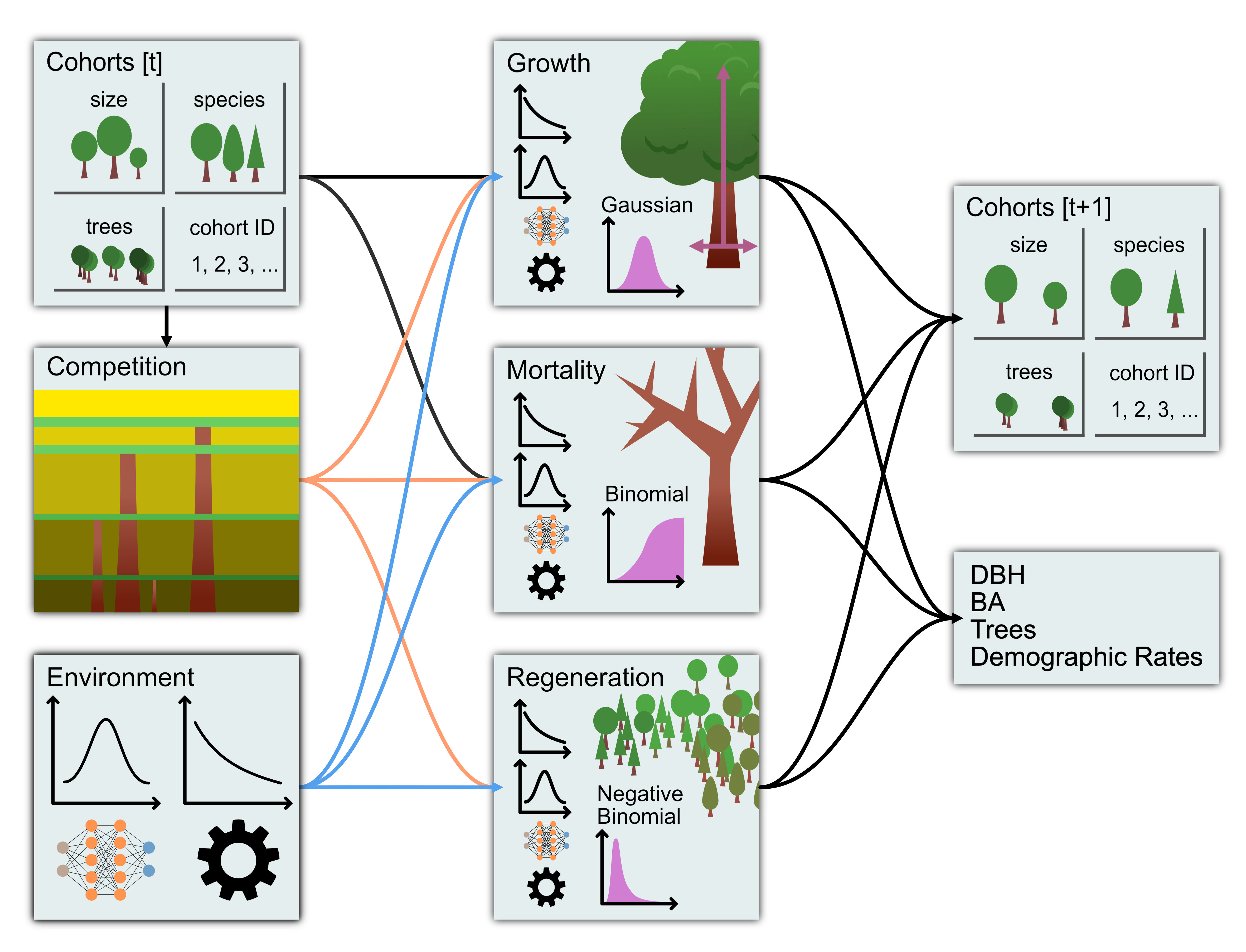
While we spent a substantial amount of our time finding a reasonable structure for the mechanistic (process-based) version of FINN, our actual goal was to streamline this exact process by making it possible to replace each process with a deep neural network: a flexible empirical module that adjusts to the model’s overall structure by recovering the best predictive functional form.
The Barro Colorado Island 50-ha plot offered a great test ground for our model. Here we could iteratively check whether FINN reproduces basic forest dynamics. At the same time, the results from Rüger et al. (2020) gave us a blueprint for how a simple empirical model can simulate reasonable succession trajectories, and therefore a target to aim for.
Our findings show that the approach works. Replacing the growth process in FINN with a deep neural network lets us recover the best predictive functional form while obtaining a fully end-to-end calibrated hybrid forest model, hybrid in the sense of keeping a mechanistic scaffold while inferring the rest of the model from empirical data alone. Having explored these ideas at one specific site in a tropical forest, we are now looking forward to testing how FINN can absorb patterns of forest dynamics at larger spatial scales and under higher environmental variation.
Our approach provides the interface for unlocking inference within the mechanistic constraints of a dynamic forest model from multi-modal observational data. Built on a classic forest gap model, FINN keeps the most generic elements of dynamic forest modeling while offering new opportunities to diverge from the path that forest modelers have walked for more than 50 years, since the development of JABOWA. In the near future we will provide an R package, tutorials, and hopefully new insights across the broad continuum between empirical and process-based forest modeling.
Read the full article here.

