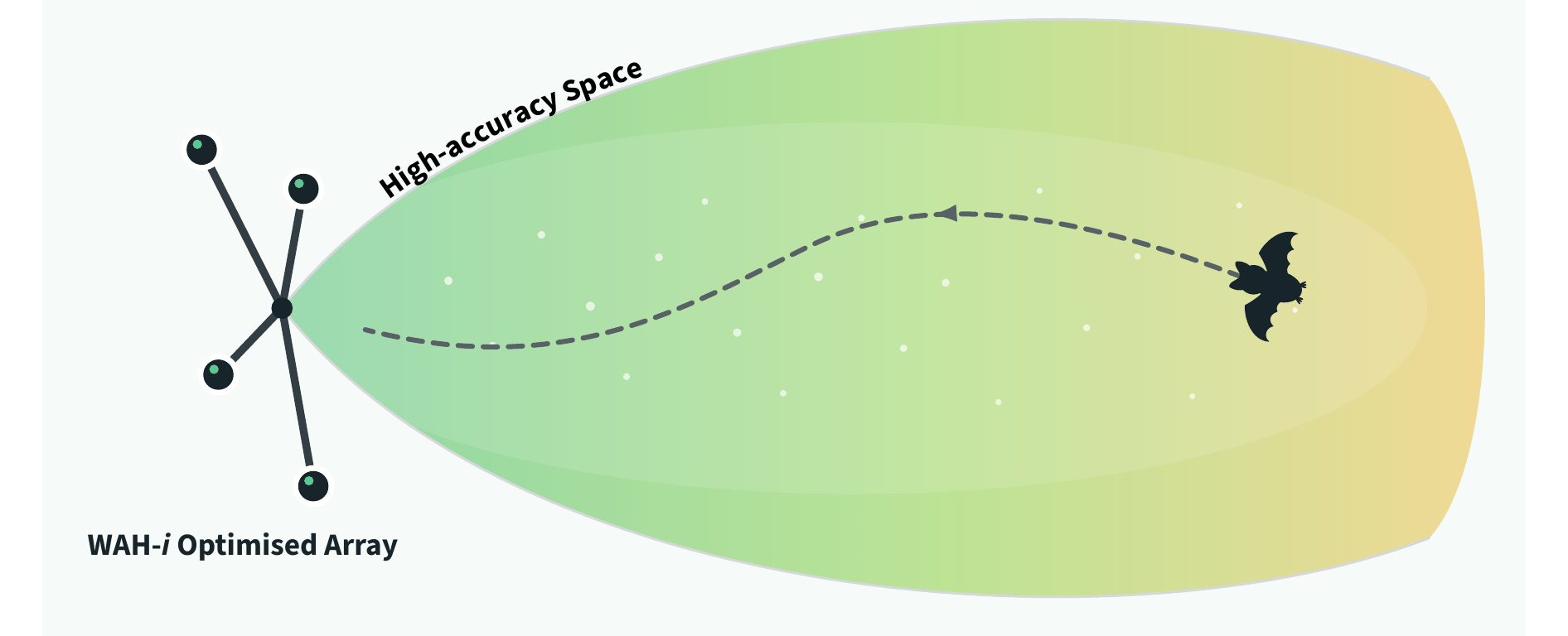
Post Provided by Ravi Umadi
On a sunny morning after heavy snowfall in the Bavarian winter, I stood by the door of an early train to Munich. Bright sunlight streamed through the glass and lit me up. I thought to myself: it was a good day.
Moments later, the train screeched to a halt. The driver announced an unscheduled stop and possible disruptions due to snow. He sounded surprised by the snow-related technical problems and half-sincerely apologised for the unusual delay.
At least there is sunlight! I told myself, still unfazed by the stoppage.
I have a recognisable tendency to get lost in thought when I am on the move, even more so when I am on my feet. That week I had set myself a problem and become stuck on it. The gears were turning, but nothing useful was emerging. I was stuck, just like the train, right on the track to something important.
1. From measuring accuracy to designing for it
In the autumn of 2025, I published the original work on the Widefield Acoustics Heuristic, an open-source simulation framework for designing and evaluating microphone arrays for spatial bioacoustics. It addressed an important practical question: how accurate is my microphone array, and how does that accuracy vary across the three-dimensional space I want to study? Knowing this helps researchers interpret localised data more carefully, especially in regions where the array performs poorly.
But I cannot tell the animals to avoid those regions simply because the array cannot handle them. I needed to solve the problem backwards: if I require a certain level of accuracy across a defined spatial field, what microphone-array geometry will achieve it?
Microphone arrays have been among my favourite toys for years. My doctoral research involved a 45-channel real-time array that I built and calibrated twice. I built another field array while developing the responsivity theory of echolocation call timing. More recently, I introduced BATSY4-PRO, an open-source four-channel ultrasound recorder for field bioacoustics. It is lightweight, records synchronised audio directly to microSD, provides live-tunable heterodyne monitoring, and can run from a small power bank.
As useful as it is, BATSY4-PRO prompted a sharp criticism: What good is it if it can handle only four channels? Field studies often use arrays of eight, twelve, or more microphones. Why should anyone prefer four if accuracy is the underlying requirement?
The hardware can be extended to eight channels, or even twelve with additional engineering. But adding channels alone would not necessarily solve the accuracy problem.
While developing the Array WAH toolkit, I had learned that microphone count was only part of the story. Geometry mattered profoundly. Simply stacking up microphones and hoping that every localisation would be accurate was one option, but how those microphones were arranged mattered more. Intuitively, I knew that breaking certain symmetries could eliminate regions of poor accuracy. The challenge was to find the best configuration when both the required accuracy and the spatial field were specified. I had already written about that problem as something to work on during the long winter months.
2. The boy, the toy, and an instant click!
As I looked around the almost empty train, now increasingly annoyed by the delay, I noticed an infant on his mother’s lap trying to grab a teddy bear too large for his hands. He repeatedly failed to keep hold of it, yet continued with slightly different finger movements. His tiny fingertips reminded me of the microphones at the ends of an array’s arms. The baby’s strategy was simple: move the fingers, test whether the grip holds, and keep adjusting until it succeeds.
We do this in everyday life all the time. It becomes so deeply embedded in our behaviour that we rarely notice the corrective calculations we are making.
Then the logic fell into place: repeat the WAH protocol until the required accuracy map is reached. Make small movements in defined steps, then use even smaller changes as the target approaches. Instead of evaluating a fixed array geometry, the method could solve the inverse problem iteratively by moving the microphones and retaining changes that improved performance.
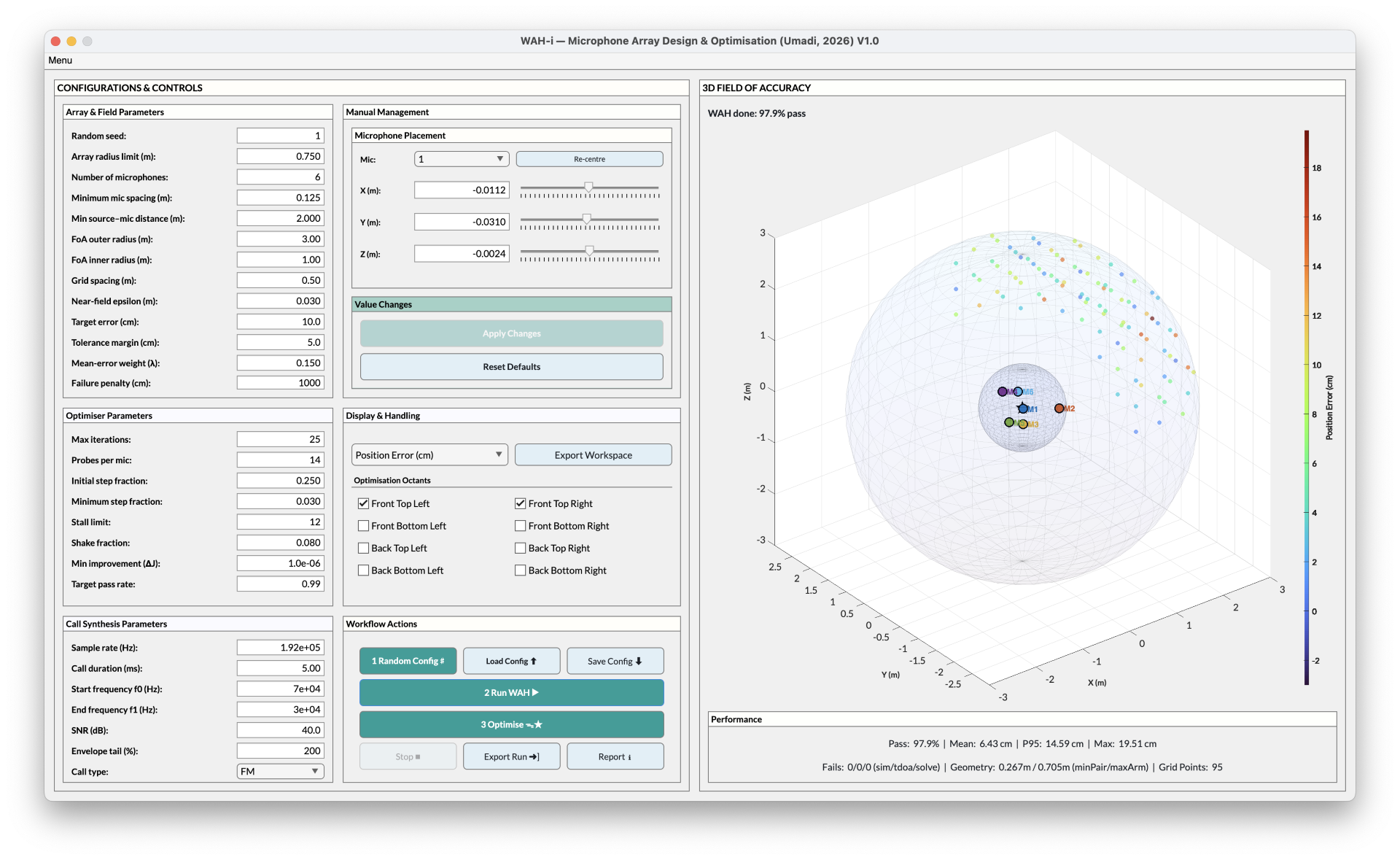
That was the beginning of the WAH-i algorithm. Over the next few weeks, the code came together, the tests became encouraging, and the experiments confirmed the central hypothesis: under practical constraints, a carefully optimised four-microphone array can match or outperform a larger array with a poorly suited geometry.
3. Why four microphones can be enough
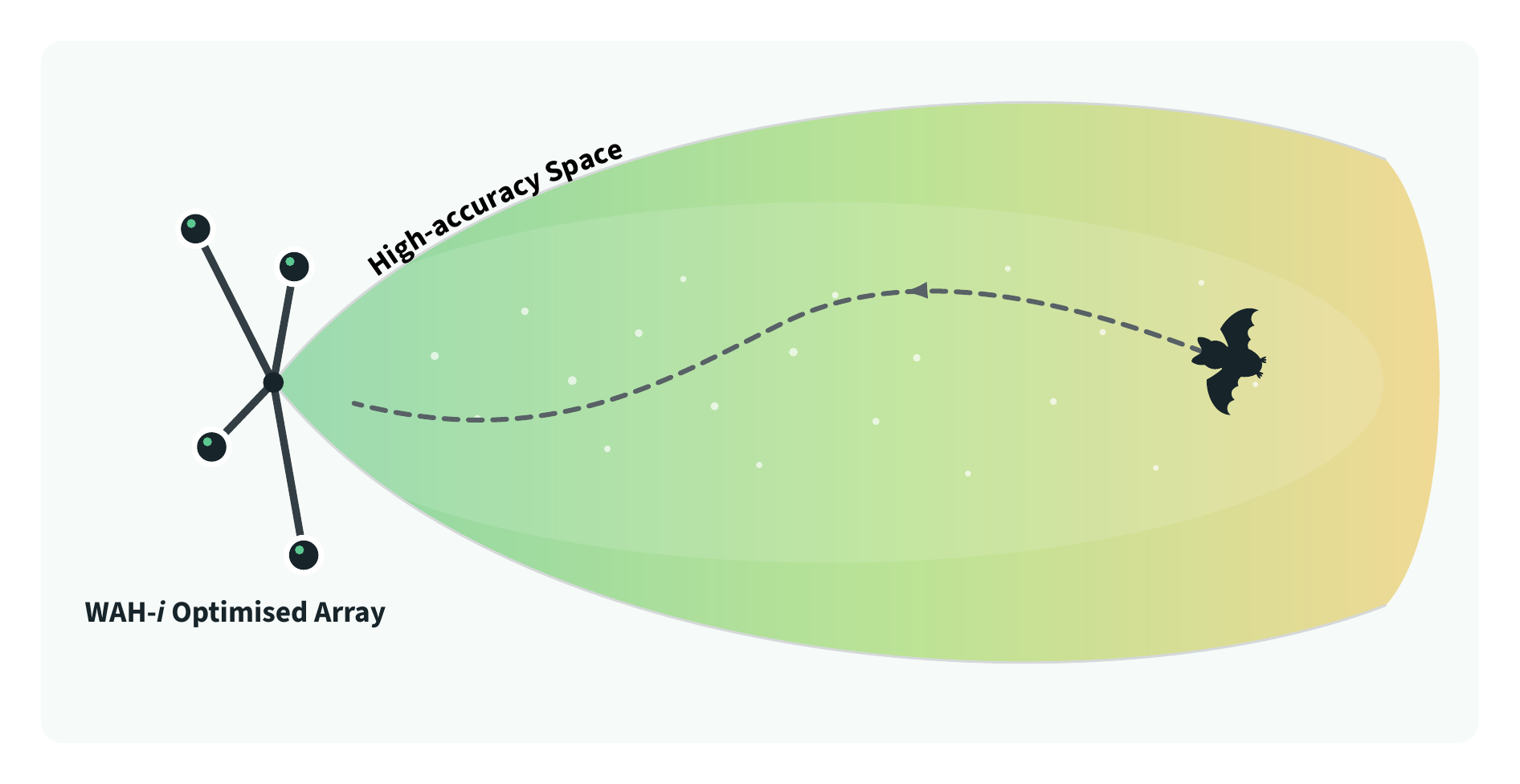
This finding can ease a persistent burden in field experiments. More microphones increase cost, synchronisation complexity, power consumption, data throughput, and the mechanical difficulty of deployment. WAH-i instead treats geometry as a design variable. It asks what arrangement best satisfies a defined localisation threshold across the volume that matters for the biological question.
The latest BATSY4-PRO work goes a step further by showing how the recorder can be combined with a reconfigurable array designed using WAH-i. The optimised microphone positions produced by WAH-i can be converted into practical instructions for changing the length and direction of each arm. The paper illustrates this for a four-arm mount, providing a bridge between the computer-designed arrangement and a portable array that can be built, adjusted, and tested in the field.
The combination of affordable research tools and methods for safeguarding data quality opens exciting opportunities for echolocation research. More than 1,200 bat species are known, most of them echolocating, yet detailed experimental knowledge remains concentrated in a small number of species. There is a treasure of knowledge to be discovered, with potential relevance far beyond bat research. Looking ahead, WAH-i and BATSY4-PRO can provide the fine-scale reconstructions of flight and call sequences needed to test the responsivity framework’s predictions about call timing, target selection, terminal buzzes, and call grouping.
Borrowing a well-known metaphor from Donald Griffin, bat echolocation is a magic well with no bottom, and I believe everyone should have the chance to explore it.
Read the full article here.
RELATED RESOURCES BY THE AUTHOR
Explore the optimisation method and supporting resources on the WAH-i website.
Download Chirps: an iOS app for live listening, visualising, and recording sound.
Esperdyne is an open-source DIY bat detector-recorder with live heterodyne monitoring and retroactive recording directly to microSD. Read the study

