Post provided by Jonathan Gallego Londoño
Most of us can recognise the voice of a friend or family member without seeing them. Sometimes, just a few words are enough to know who is speaking. But could we do something similar with birds? Research suggests we can. However, recognising the species behind a song is one challenge, while identifying the particular bird that produced it is another.
This distinction matters because many ecological questions begin at the individual level. Recognising the same animal across recordings could help us ask how many individuals are using an area, where they move, how often they return and how they interact. Traditionally, answering these questions involves capturing, marking or directly observing animals. Yet anatomical, physiological and behavioural differences can leave a distinctive signature in a vocalisation, much like an acoustic fingerprint. If that fingerprint is sufficiently consistent over time, passive recordings could help us follow individuals while reducing the need for more invasive monitoring.
This possibility also raises a challenge. How much of a vocalisation do we need to hear before we can recognise the individual? Some clues may be present in a short fragment, while others may be distributed across a much longer vocalisation. This question became the starting point for our study.
About us and data
We are a group of Colombian researchers with a shared interest in computational bioacoustics. I am Jonathan, an associate professor at the University of Antioquia and PhD researcher exploring how recorded animal vocalisations can reveal both identity and location.
For this study, we built on the generous work of researchers who had made their data openly available. We assembled four publicly available datasets, each linking vocalisations to known individuals, into an analysis-ready Zenodo archive. Together, they contain 87,865 vocalisations from 352 individuals across seven bird species. These data allowed us to explore whether combining several parts of a vocalisation could identify individual birds more reliably than using a single short excerpt.
From species to individuals
Many bioacoustic models identify bird SPECIES by learning patterns from thousands of recordings. Rather than training a system to identify individuals from scratch, we wondered whether we could reuse what these species-recognition models had already learned. This transfer-learning approach allowed us to turn each short audio segment into a compact numerical summary of sound, called an embedding.
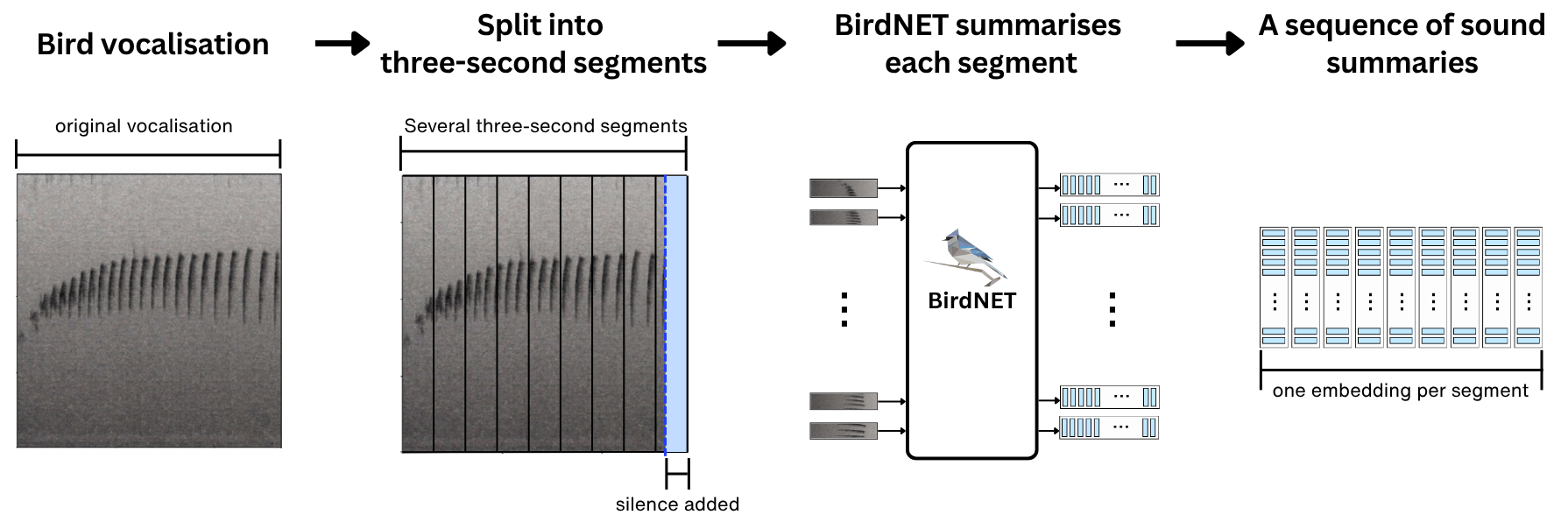
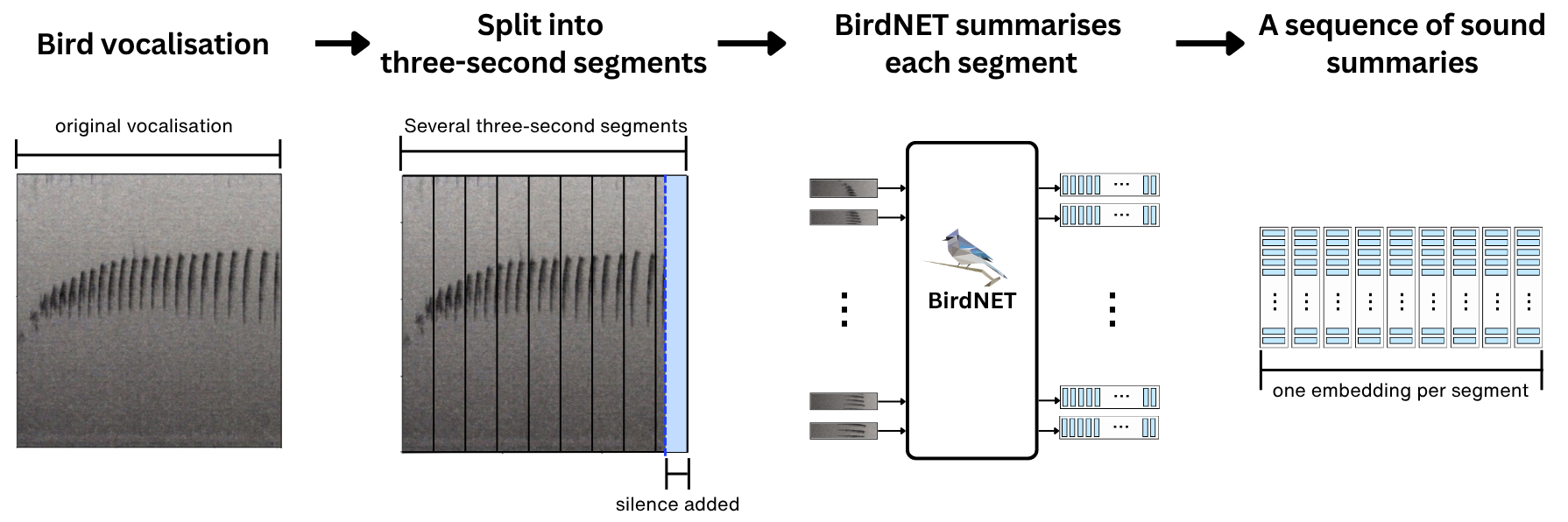
We used BirdNET version 2.4, which turns each three-second audio segment into an embedding. This works well for vocalisations that fit within one segment, but the vocalisations in our datasets ranged from less than one second to almost 28 seconds. Longer vocalisations therefore produced several embeddings, creating a sequence for each vocalisation.
A model that remembers
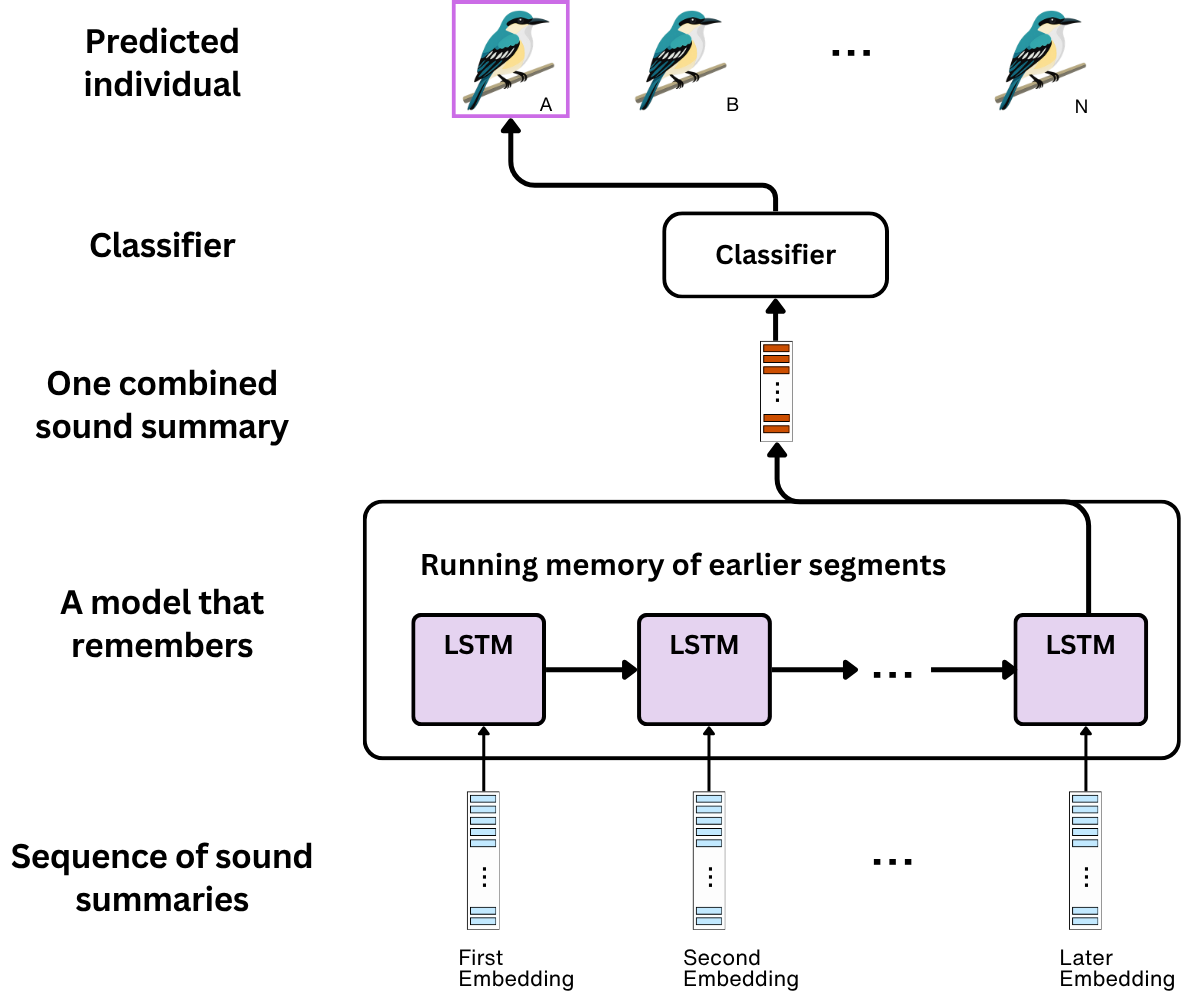
We chose a long short-term memory (LSTM) network to combine information across sequences. This is a neural network designed to work with sequences. It processes one embedding at a time, retaining a flexible memory of earlier segments while incorporating new ones.
Each vocalisation entered the LSTM as a sequence of BirdNET embeddings, and a classifier then assigned it to one of the known individuals. Rather than relying solely on the first segment or an average across all segments, the model could combine information from the whole vocalisation. We compared it with these simpler approaches and with an LSTM that received the embeddings in a shuffled order within each vocalisation. This allowed us to test whether the order of the segments itself added useful information.
What we learned
Across seven species, our approach identified individuals with accuracies ranging from 93.9% to 98.3%. The LSTM significantly outperformed the strongest static alternative for great tits and great spotted kiwis. The kiwi provided the clearest example of why this might help. Its vocalisations often lasted for many seconds, giving the model several audio segments to consider rather than only one short excerpt.
The benefit was not the same across all datasets. Great tit vocalisations were shorter on average, but many still spanned more than one segment, showing that duration was not the whole story. For shorter vocalisations, simpler approaches were often sufficient. The benefit of the LSTM seemed to depend on whether different parts of a vocalisation contained complementary clues about identity. This was not the case for every species, so longer vocalisations alone did not guarantee an improvement.
We also tested whether the chronological order of the segments mattered by shuffling them within each vocalisation. In most cases, this made little difference, although one chiffchaff dataset performed better when the original order was retained.
Our main conclusion is therefore not that every bird’s identity is encoded in a fixed temporal pattern, but that combining information flexibly across a vocalisation can be valuable when one short excerpt is not enough.
The next challenges
Our model currently chooses among individuals it has already encountered during training. An important next step is to recognise when a recording comes from a new individual, and to test whether a model trained in one population, place or year remains useful in another.
The workflow also starts with a focal vocalisation that has already been isolated from the surrounding soundscape. Applying it to everyday acoustic monitoring will require reliable methods for detecting and segmenting vocalisations in noisy recordings, as well as a better understanding of the acoustic cues underlying each prediction. These challenges are exactly why we see this work not as a finished solution, but as one step towards listening to animal populations in more detail.
Try it yourself
The datasets, metadata and precomputed embeddings are available in our Zenodo archive. The full workflow can be explored in our embedding-extraction and individual-identification repositories.
Read the full paper here.

