Post provided by Alexa Fredston
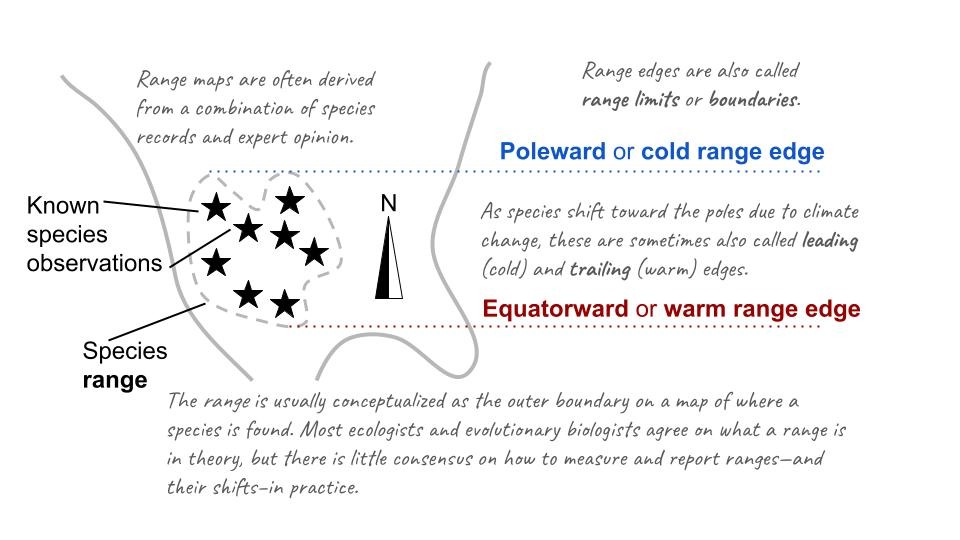
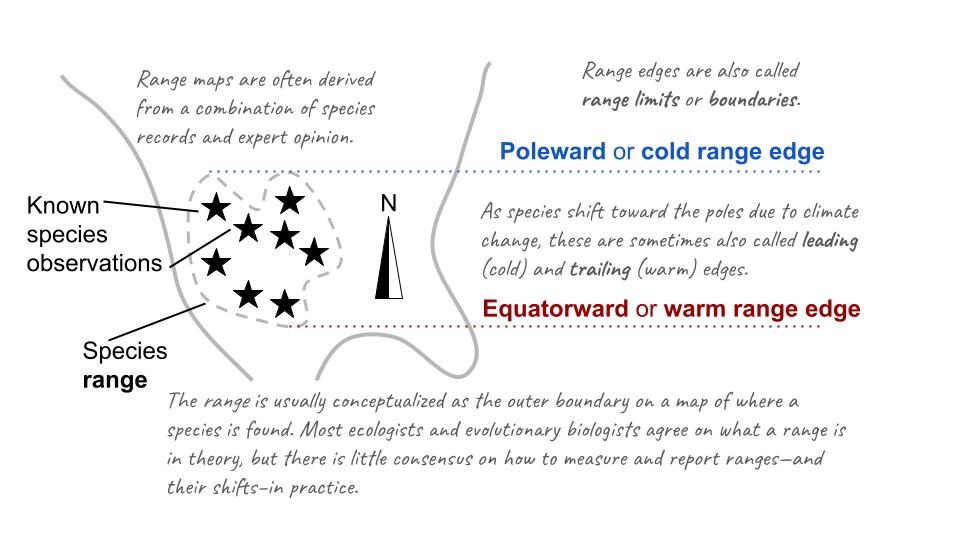
What is a range edge? Every ecologist and evolutionary biologist knows what the edges of species’ geographic ranges (also called distributions) mean, in theory. But I’ve learned that we have virtually no agreement on what they are in practice. Give ten researchers a dataset of a species’ occurrences and abundances over space and time to calculate where the range edges fall, and you will likely get ten different answers.
I became fascinated by species’ range edges after beginning my PhD in 2014. At the time, a landslide of new studies had accumulated showing that species were “on the move”: shifting deeper into the oceans, upwards in elevation, and generally towards the poles as the planet warmed. The poleward range edges of North American birds shifted northwards between 1975 and 2004. We reported that over decades, range edges of North American marine fishes occurred in different locations but at consistent temperatures, suggesting that they were tracking a thermal niche through the sea. But across these and many other studies, individual species’ responses to environmental warming were highly idiosyncratic.
A turning point in my outlook came when I explored whether poleward edges of marine fishes were more closely tracking temperature change than equatorward edges, as some biogeographical theories hypothesized. When we tested this using the presence of fish, we found that poleward range edges did indeed track temperature more closely than did equatorward edges. But when we later revisited the question with more sophisticated species distribution models based on the abundance of fish, that result did not hold, even though the two studies used the same raw data.
Since then, I have wondered: How much of our understanding of Anthropocene range edge positions and shifts is driven by actual ecological processes versus researchers’ methodological decisions? The more I searched for standardized definitions and best practices, the more concerned I became that our field’s inconsistent approach could have ripple effects far beyond single species and systems. At the same time, meta-analyses on climate-related range shifts hinted that methodological variation among published studies has influenced global metrics of biodiversity responses to climate change. I set out to quantify the extent of this problem by answering three questions:
- Do different methods for quantifying range edge positions and shifts give different answers when applied to the same data?
- For species that are in fact shifting, how long of a time-series do we need to reliably detect that a shift is happening?
- For species that are in fact shifting, can a “resurvey” (a study comparing two time points, often many years apart) reliably detect that a shift is happening?
To answer #1, I used two canonical datasets in global change biology: the Audubon Society Christmas Bird Count, and the National Oceanic and Atmospheric Administration bottom trawl survey in the Northeast U.S. I chose a fish with an equatorward edge in the U.S. (the white hake) and a bird with a poleward edge in the U.S. (the Black Vulture), and applied published methods for detecting range edge positions to each one.
These methods identified very different range edge latitudinal positions—often several degrees of latitude (hundreds of kilometers) apart!—and they also estimated different interannual variability. For the Black Vulture, every metric we tested revealed a significant northward shift over time, but the abundance-weighted methods led to slower estimates of shift rates than the presence-based methods. For the white hake, not all methods led to a significant shift. These results confirmed that the methods researchers choose influence where they report range edges occur; whether those edges shifted at all; and if so, how fast.
To address questions two and three, I simulated a 100-year time-series of range edge positions, with a range of shift rates drawn from published studies. I then subsampled this 100-year time-series into windows of different lengths to explore the relationship between standard deviation, shift rate, time-series length, and statistical power. In general, the statistical power to detect a significant range edge shift increases with time-series length, with “true” shift rate, and with lower standard deviation. For most realistic parameter values, decades of continuous annual data are likely needed to distinguish the signal from the noise. You can explore the statistical power I calculated for all parameter combinations, including some that might be analogous to your study system and use case, here: https://afredston.shinyapps.io/range-edge-methods/
I expected one of my main results would be that resurveys—studies that compare a historical dataset to a modern-day one—would have little power to detect range edge shifts. Resurveys may be poor indicators of global change trends. But on the contrary, I found that resurveys with time points more than a few decades apart are very likely to detect significant range edge shifts if they occurred.
These results reflect the fact that I focused on the power to detect a range edge shift if it occurred, not the power to accurately estimate the shift rate. The latter is a much higher bar, and likely requires much more data. While there is no current consensus on exactly how to quantify the rate of range change, multidecadal studies reporting the direction of range change (e.g., polewards) are likely correct. I’ll be doing more research into this soon, and into better metrics to measure range edges.
Our field has taken an ad hoc approach to defining range edges thus far. Several straightforward steps, taken by scientists like you, could substantially reduce the bias introduced into scientific results by our methodological decisions. These include: (1) power analyses to quantify whether studies have sufficient data to reliably detect change, (2) using an ensemble of edge metrics to reveal the robustness of results, and (3) sharing raw data so they can be re-analyzed later with new approaches are all key parts of the path forward.
Range edges matter. As the frontier dividing where populations can and cannot persist, they tell us something profound about a species’ ecology and evolution. As the outlines of where species are found on a map, they are a critical input for the conservation and management of nature. Yet in theoretical and quantitative ecology they are rarely a focus, languishing instead in the category of “I know it when I see it” phenomena. I would be delighted if this article inspires a new direction of research to formally study range edges with the rigor they deserve.
Read the full article here.

