Speed Review at the BES Annual Meeting: Get a Senior Editor’s Opinion on YOUR Manuscript

Coming to the BES Annual Meeting? Planning to submit a paper to a BES journal? Then you should sign up for the Speed Review Session on Thursday 12 December! (sign-up sheets will be on the BES Stand in the Exhibition Hall.) Find out more about this session below.

What is a Speed Review Session?

©schlagzahluhren.de

Essentially, Speed Review is a chance for you to get a Senior Editor’s opinion on your manuscript. All you need to do is sign-up and bring along a figure or a key finding from your research to centre the discussion on. Each session will be limited to five minutes, so try to have a succinct summary of your manuscript ready as well. The Editor you speak to will let you know what they think of your paper and try to give you some advice about any areas to highlight or any potential concerns that they might have about it.  Continue reading “Speed Review at the BES Annual Meeting: Get a Senior Editor’s Opinion on YOUR Manuscript”

Issue 10.12: Statistical Ecology, UAVs, Invasive Species and More

The December issue of Methods is now online!

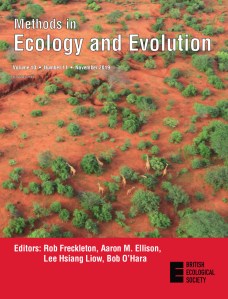
The final 2019 issue of Methods in Ecology and Evolution is online now.

To close out another brilliant year, we’ve got papers on invasive species, convolutional neural networks, rapid spatial risk modelling, species distribution models and much more.

You can find out more about our Featured Articles (selected by the Senior Editor) below. We also discuss this month’s Open Access and freely available papers we’ve published in our latest issue (Practical Tools and Applications articles are always free to access, whether you have a subscription or not) .

Continue reading “Issue 10.12: Statistical Ecology, UAVs, Invasive Species and More”

New Associate Editor: Saras Windecker

Today, we are pleased to announce the latest new member of the Methods in Ecology and Evolution Associate Editor Board. Saras Windecker joins us from the University of Melbourne, Australia as an Applications Editor. You can find out a little more about her below.

Saras Windecker

“I’m a quantitative ecologist who started out as a wetland ecologist. I’m interested in developing and applying models for a range of applied and theoretical questions, spanning decomposition, species distributions, and more recently, public health forecasting. I’m interested in software development for scientists and thinking about how we develop literate programming skills and promote open science in ecology.” Continue reading “New Associate Editor: Saras Windecker”

Gwneud Tagiau’n Fwy Cyfleus:Optimeiddio Dyfeisiau Biogofnodi gyda Dynameg Hylifau Gyfrifiadurol

Post wedi’i ddarparu gan William Kay

This blog post is also available in English

Dyfeisiau llusgo a biogofnodi

A harbour seal tagged with a biologging device. ©Dr Abbo van Neer
Morlo harbwr gyda dyfais fiogofnodi wedi’i hatodi iddo. ©Dr Abbo van Neer

Michael Phelps yw un o’r athletwyr Olympaidd mwyaf clodfawr erioed, ynghyd â’r nofiwr cyflymaf yn y byd. Ac eto, gallai nofio’n gyflymach. Gan wisgo siwt arbennig LZR Racer Speedo, gallai Michael Phelps leihau’i lusgiad hydrodynamig, neu’i wrthiant dŵr, 40% neu fwy. O ganlyniad gallai ei gyflymdra nofio gynyddu dros 4%! Mewn cystadleuaeth, dyna’r gwahaniaeth rhwng gwobrau arian ac aur. Ond, petai Phelps yn anghofio tynnu’i “hosanau llusgo” –  sef hosanau rhwystrus a ddyluniwyd i gynyddu gwrthiant dŵr er mwyn cynyddu cryfder y nofiwr – caiff ei gyflymder ei leihau’n sylweddol. Byddai’n ffodus i ennill gwobr efydd!

Mae nofwyr proffesiynol yn gyfarwydd â defnyddio technolegau i wella eu perfformiad drwy leihau eu llusgiad ond ni all hynny gymharu â’r addasiadau a wnaed gan anifeiliaid gwyllt. Mae creaduriaid yn y môr wedi esblygu addasiadau anghredadwy i leihau llusgiad, megis lliflinio eithafol mewn mamaliaid ac adar y môr. Mae hyn yn eu galluogi i symud dan y dŵr mor gyflym ac effeithlon â phosib. Mae morloi, er enghraifft, yn eithaf afrosgo ar y tir ond maent yn osgeiddig ac yn gyflym o dan y dŵr. Mae siâp eu cyrff wedi’i ddylunio er mwyn iddynt symud yn gyflymaf pan fyddant yn nofio.

Pan fyddwn yn astudio mamaliaid y môr, rydym yn aml yn defnyddio dyfeisiau olrhain y gellir eu hatodi gan ddefnyddio harneisiau, glud neu sugnolion. Mae’r “dyfeisiau biogofnodi” hyn, a elwir hefyd yn dagiau, yn debyg i Fitbits. Mae atodi’r rhain i anifeiliaid yn ein galluogi i gofnodi symudiadau ac ymddygiad yr anifail, ynghyd â phethau eraill. Mae’r wybodaeth hon yn hanfodol o ran deall eu hecoleg a gwella’r ffordd y rheolir eu cadwraeth. Continue reading “Gwneud Tagiau’n Fwy Cyfleus:Optimeiddio Dyfeisiau Biogofnodi gyda Dynameg Hylifau Gyfrifiadurol”

Understanding Deep Learning

Post provided by Sylvain Christin

We have now entered the era of artificial intelligence. In just a few years, the number of applications using AI has grown tremendously, from self-driving cars to recommendations from your favourite streaming provider. Almost every major research field is now using AI. Behind all this, there is one constant: the reliance, in one way or another, on deep learning. Thanks to its power and flexibility, this new subset of AI approach is now everywhere, even in ecology we show in ‘Applications for deep learning in ecology’.

But what is deep learning exactly? What makes it so special?

Deep Learning: The Basics

Deep learning is a set of methods based on representation learning: a way for machines to automatically detect how to classify data from raw examples. This means they can detect features in data by themselves, without any prior knowledge of the system. While some models can learn without any supervision (i.e. they can learn to detect and classify objects without knowing anything about them) so far these models are outperformed by supervised models. Supervised models require labelled data to train. So, if we want the model to detect cars in pictures, it will need examples with cars in them to learn to recognise them.

Continue reading “Understanding Deep Learning”

Transparent Peer Review at Methods in Ecology and Evolution

©Matt Clark

We’re starting a new initiative to make our peer review process more open and visible. If you submit a manuscript to Methods in Ecology and Evolution from today onwards, you’ll be able to choose to make the review process transparent.

But what does that actually mean? How will the process work? And why are we doing it?

Keep reading to find out!

How Does Transparent Peer Review Work?

When you submit a manuscript to Methods in Ecology and Evolution, you’ll be asked if you’d like to be part of our transparent peer review model (every manuscript will be included by default, but you can opt out). If you choose to stay with the transparent peer review model and your manuscript is published, the peer reviewers’ reports, your responses, and the editors’ decisions will be published alongside your final article. You can see an example of how this might look here. Continue reading “Transparent Peer Review at Methods in Ecology and Evolution”

‘Tis the Season for Modelling Mortalities

Post provided by ELIE GURARIE

A warning: Halloween is nigh, and the following post contains graphic real-life imagery of maggot-eaten eye-sockets and deadly pianos. Read on… if you dare!

A Death in the Woods 

In the vast and often frozen boreal forest of northern Canada there is a slow-burning forensic investigation into a death. The victim: a woodland caribou, an iconic species that is threatened or endangered throughout its range.

Kyle Joly

The scene is very much made for TV neo-Scandinavian neo-noir. From a not-too-luxurious regional office in the town of Fort Smith, just north of the Alberta border, over a steaming cup of coffee, world-weary biologist Allicia Kelly – who’s seen it all and then some – is monitoring the movements of collared animals on her computer screen. It’s the middle of May. The females, nearly all pregnant, are scattering to higher ground to find suitably cozy and secluded sites to calve. All is as peaceful and idyllic as a bunch of blips on a computer screen can be.

But then (cue slightly unsettling dissonance in the soundtrack) one of the little blips seems to have stopped moving. Kelly raises her eyebrow, tells herself to keep an eye out. A moment later she makes the call: “Team, we’ve got another ringer … let’s roll!Continue reading “‘Tis the Season for Modelling Mortalities”

A Move Towards Trait-Data Democracy: Creating the Ecological Trait-Data Standard Vocabulary

Post provided by FLORIAN D. SCHNEIDER

The past ten years brought a major game changer to ecological community and ecosystems research: functional trait data. This has shifted the focus from assessing and analysing ecosystems by not just the quantities of species but also those species’ qualities. Functional trait data can give us major insights into how communities are composed and how species assemblages evolve under certain environmental pressures. They also link community composition to ecosystem functioning and provide a framework for the assessment of communities across trophic levels and functional groups. Continue reading “A Move Towards Trait-Data Democracy: Creating the Ecological Trait-Data Standard Vocabulary”

aKIDemic Life: Empowering You to Navigate Life and Work

Post provided by Kirsty Nash

Most researchers I know are passionately invested in their research. Work consumes a significant amount of their focus, energy and time. But, researchers are so much more than that! Most of us have a life outside work that involves family, friends, even the odd hobby (if this isn’t the case and your life is purely about work, then read this).

Balancing or, more precisely, juggling the different parts of life can be taxing. Often academics and researchers face the competing demands of caring responsibilities, and the need to attend conferences, go on field trips or relocate for the next fixed-term contract. There are lots of resources out there to help researchers balance their home and work life, but, let’s be honest, who has the time to search for those resources?

This is where aKIDemic Life comes in. aKIDemic Life is a website built by academics for academics to empower parents and carers to navigate life and work. We curate free advice, tools and training, using the experience of researchers who have been through it. We want you to know that you’re not alone and to be able to quickly find the help you need, whatever your story. Continue reading “aKIDemic Life: Empowering You to Navigate Life and Work”