Microbial Methods Virtual Issue

The BES Microbial Ecology Special Interest Group is running a workshop today (Thursday 2 November) on Novel Tools for Microbial Ecology. To compliment this workshop, Xavier Harrison has edited a Virtual Issue of the best Methods in Ecology and Evolution articles on advances in methods of studying microbial evolution and ecology from the past few years.
Advances in Next-Generation Sequencing (NGS) technology now allow us to study associations between hosts and their microbial communities in unprecedented detail. However, studies investigating host-microbe interactions in the field of ecology and evolution are dominated by 16S and ITS amplicon sequencing. While amplicon sequencing is a useful tool for describing microbial community composition, it is limited in its ability to quantify the function(s) performed by members of those communities. Characterising function is vital to understanding how microbes and their hosts interact, and consequently whether those interactions are adaptive for, or detrimental to, the host. The articles in this Virtual Issue cover a broad suite of approaches that allow us to study host-microbe and microbe-microbe interactions in novel ways.

All of the articles in the Microbial Methods Virtual Issue will be freely available for the next two months. You can find out a little more about each one below. Continue reading “Microbial Methods Virtual Issue”

New Associate Editors

Today we are welcoming seven new people to the Methods in Ecology and Evolution Associate Editor Board. All of these new Associate Editors were invited to join the Board following our open call for applications a couple of months ago. You can find out more about them below.

Karen Bacon

Karen Bacon
Karen Bacon

“I am a plant ecologist and palaeoecologist with interests that span the present day to the Mesozoic. My particular interests include plant–atmosphere interactions, fossil plant taphonomy, mass extinctions, stable isotope ecology, and Anthropocene ecology. My current work focuses on the development of plant-based proxies to improve interpretations of plant responses to past environmental change and investigating plant functional traits that lead to success across environmental upheaval events in both the fossil record and present day.”

Torbjørn Ergon

Torbjørn Ergon

“I am a population/evolutionary ecologist with wide interests. My research has mostly been focused on variation in life-history traits and demographic rates within populations, and I have a strong interest in statistical modelling in this field. As an associate editor of Methods in Ecology and Evolution, I hope to promote novel papers that pay close attention to ecological/evolutionary theory in addition to study design and statistical modelling.” Continue reading “New Associate Editors”

Midwater Ocean Communities: Sounds Like Siphonophore Soup

Post provided by Roland Proud

How do we know how many fish there are in the ocean? 1000, 1 billion, 1000 billion? We can’t catch them all and count – that’s not practical. Nor can we make observations from Earth-orbiting satellites – light does not penetrate far into the ocean. What we can use is sound.

Sound travels well in water (faster and further than it does in air), so we can use scientific SONAR (echosounders) to produce sound waves and record backscatter from organisms and communities. This provides information concerning their biomass, distribution and behaviour. A recent study used echoes from the mesopelagic zone (200 – 1,000m) to predict global mesopelagic fish biomass to be between 11 and 15 billion tonnes (that’s a lot), suggesting that mesopelagic fish communities could potentially provide global food security.

Mesopelagic Biogeography

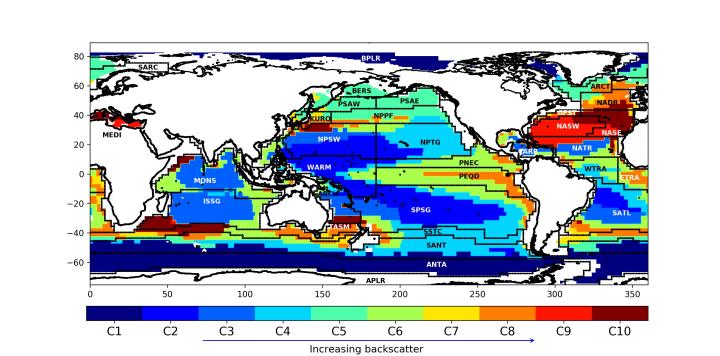
In a recent paper, we (the Pelagic Ecology Research Group, PERG at the University of St Andrews) divided the global ocean up into regions based on the properties of echoes from the mesopelagic zone (see below).

10 mesopelagic classes are shown for the open-ocean, echo intensity (a proxy for biomass) increases from blue to red. Coastal zones excluded. Longhurst provinces overlaid. Shapefile here. Proud et al. (2017)

Continue reading “Midwater Ocean Communities: Sounds Like Siphonophore Soup”

Phylogenies, Trait Evolution and Fancy Glasses

Post provided by Daniel S. Caetano

Phylogenetic trees represent the evolutionary relationships among different lineages. These trees give us two crucial pieces of information:

  1. the relationships between lineages (which we can tell from the pattern of the branches (i.e., topology))
  2. the point when lineages separated from a common ancestor (which we can tell from the length of the branches, when estimated from genetic sequences and fossils).
Phylogeny of insects inferred from genetic sequences showing the time of divergence between ants and bees.

As systematic biologists, we are interested in the evolutionary history of life. We use phylogenetic trees to uncover the past, understand the present, and predict the future of biodiversity on the planet. Among the tools for this thrilling job are the comparative methods, a broad set of statistical tools built to help us understand and interpret the tree of life.

Here’s a Tree, Now Tell Me Something

The comparative methods we use to study the evolution of traits are mainly based on the idea that since species share a common evolutionary history, the traits observed on these lineages will share this same history. In the light of phylogenetics, we can always make a good bet about how a species will look if we know how closely related it is to another species or group. Comparative models aim to quantify the likelihood of our bet being right and use the same principle to estimate how fast evolutionary changes accumulate over time. Continue reading “Phylogenies, Trait Evolution and Fancy Glasses”

Issue 8.8

Issue 8.10 is now online!

The October issue of Methods is now online!

This double-sized issue contains three Applications articles and two Open Access articles. These five papers are freely available to everyone, no subscription required.

 Phylogenetic TreesThe fields of phylogenetic tree and network inference have advanced independently, with only a few attempts to bridge them. Schliep et al. provide a framework, implemented in R, to transfer information between trees and networks.

 Emon: Studies, surveys and monitoring are often costly, so small investments in preliminary data collection and systematic planning of these activities can help to make best use of resources. To meet recognised needs for accessible tools to plan some aspects of studies, surveys and monitoring, Barry et al. developed the R package emon, which includes routines for study design through power analysis and feature detection.

 Haplostrips: A tool to visualise polymorphisms of a given region of the genome in the form of independently clustered and sorted haplotypes. Haplostrips is a command-line tool written in Python and R, that uses variant call format files as input and generates a heatmap view.

Continue reading “Issue 8.8”

Imperfect Pathogen Detection: What to Do When Sampling and Diagnostic Tests Produce Inaccurate Results

Post Provided by Graziella DiRenzo

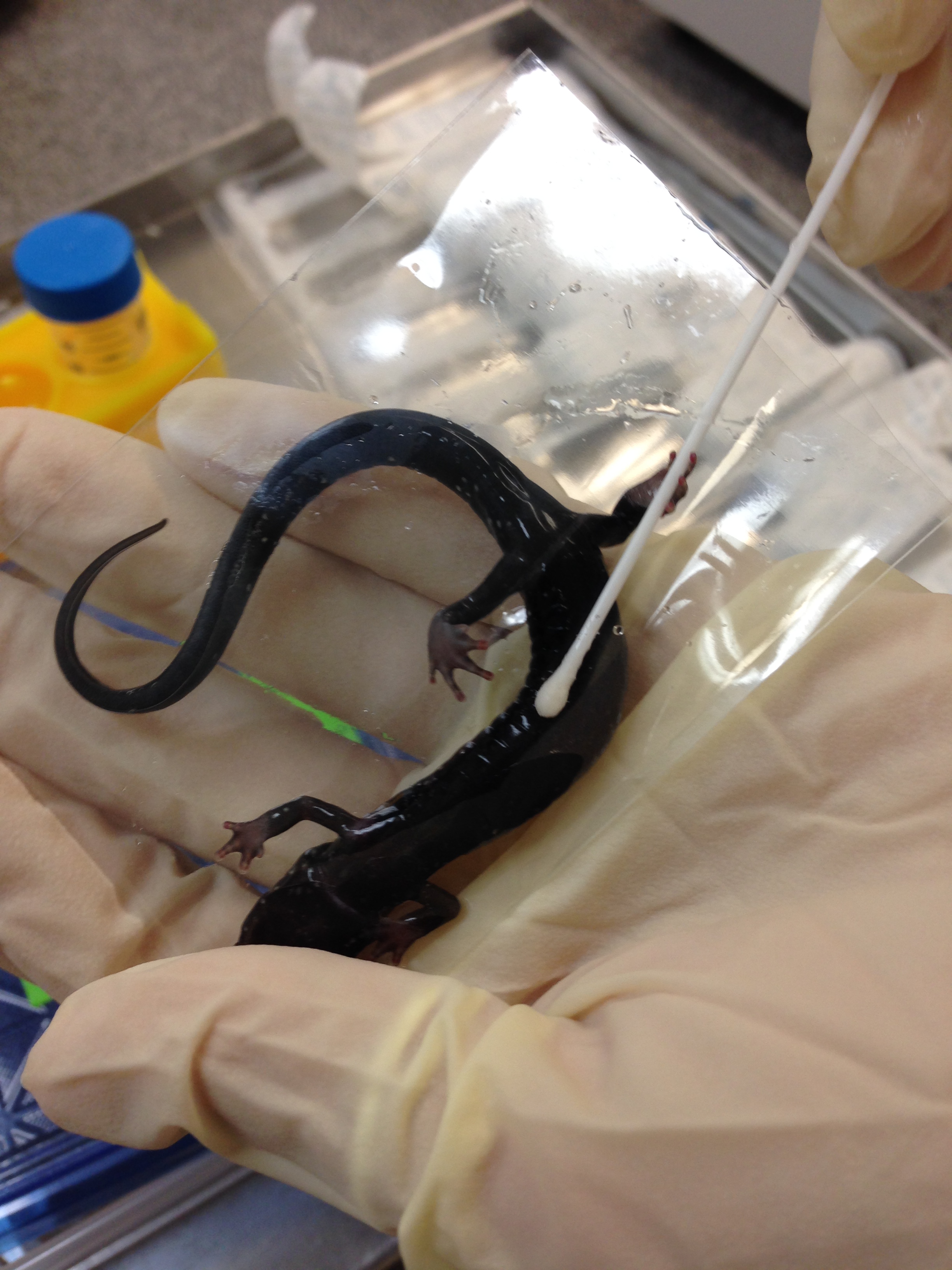
A salamander having its skin swabbed to test for Bsal infection.

Imagine you’re at the doctor’s office. You’re waiting to hear back on a critical test result. With recent emerging infectious diseases in human populations, you are worried you may be infected after a sampling trip to a remote field site. The doctor walks in. You sit nervously, sensing a slight tremble in your left leg. The doctor confidently declares, “Well, your tests results came back negative.” In that moment, you let out a sigh of relief, the kind you feel throughout your body. Then, thoughts start flooding your mind. You wonder– what are the rates of false negatives associated with the test? How sensitive is the diagnostic test to low levels of infection? The doctor didn’t sample all of your blood, so how can they be sure I’m not infected? Is the doctor’s conclusion right?

 Now, let’s say I’m the doctor and my patient is an amphibian. I don’t have an office where the amphibian can come in and listen to me explain the diagnosis or the progression of disease − BUT I do regularly test amphibians in the wild for a fatal fungal pathogen, known as Batrachochytrium dendrobatidis (commonly known as Bd). Diseases like Bd are among the leading causes of the approximately one-third of amphibian species that are threatened, near threatened, or vulnerable to extinction. To test for Bd, and the recently emerged sister taxon Batrachochytrium salamandrivorans (hereafter referred to as: Bsal), disease ecologists rely on non-invasive skin swabs. Continue reading “Imperfect Pathogen Detection: What to Do When Sampling and Diagnostic Tests Produce Inaccurate Results”

Monitoring the Distribution and Abundance of Sea Otters

Post provided by Perry Williams

Sea otters (Enhydra lutris) are an apex predator of the nearshore marine ecosystem – the narrow band between terrestrial and oceanic habitat. During the commercial maritime fur trade in the 18th and 19th centuries, sea otters were nearly hunted to extinction across their range in the North Pacific Ocean. By 1911, only a handful of small isolated populations remained.

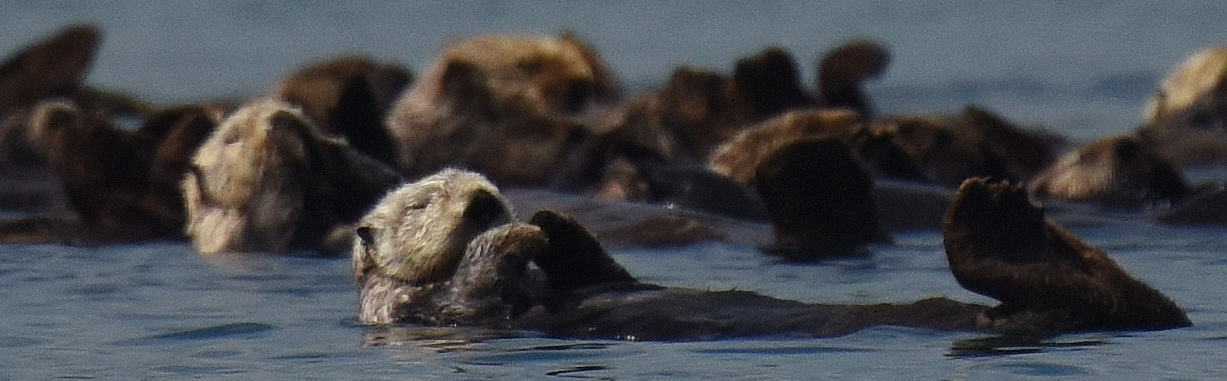
Sea otters resting in Glacier Bay National Park. © Jamie Womble, NPS. USFWS Permit #14762C-0, NPS Permit #GLBA-2016- SCI-0022.

But sea otter populations have recovered in many areas due to a few changes. The International Fur Seal Treaty in 1911 and the Marine Mammal Protection Act (1972) protected sea otters from most human harvest. Wildlife agencies helped sea otter colonisation by transferring them to unoccupied areas. Eventually, sea otters began to increase in abundance and distribution, and they made their way to Glacier Bay, a tidewater glacier fjord and National Park in southeastern Alaska. Continue reading “Monitoring the Distribution and Abundance of Sea Otters”

A New Way to Study Bee Cognition in the Wild

Understanding how animals perceive, learn and remember stimuli is critical for understanding both how cognition is shaped by natural selection, and how ecological factors impact behaviour.Unfortunately, the limited number of protocols currently available for studying insect cognition has restricted research to a few commercially available bee species, in almost exclusively laboratory settings. In a new video Felicity Muth describes a simple method she developed with Trenton Cooper, Rene … Continue reading A New Way to Study Bee Cognition in the Wild

Tracing New and Old Resources in Estuarine Ecosystems

Post provided by Thomas Larsen, Kim Vane & Ricardo Fernandes

This week, more than 150 events along the US shores will celebrate estuaries and educate the public and policy makers of the many benefits we get from healthy and thriving ecosystems. But why do we need to pay more attention to estuaries?

A woman collecting snails in the Yellow River estuary, China. Estuaries are important habitats for marine gastropods and nurturing grounds for marine fishes. ©Thomas Larsen
Estuaries are important habitats for marine gastropods and nurturing grounds for marine fishes. ©Thomas Larsen

Estuaries are biological hotspots and by far the most productive ecosystems on our planet. The shallow waters where streams and rivers meet the sea often harbour a rich terrestrial and aquatic flora and are home to many animals. They’re important feeding and reproduction areas for a diverse array of wildlife such as birds and fish, which can include both freshwater and marine species. A large portion of the world’s marine fisheries today depend on the ecosystem services of estuaries; it has been estimated that well over half of all marine fishes develop in the protective environment of an estuary. Historically, humans have been attracted to these large expanses of shallow water that could sustain their basic needs. Nowadays, these estuaries also have economic value as recreational and touristic destinations as for example fishing, boating and swimming spots.

However, our understanding of how estuaries function and sustain this amount of biodiversity is limited. As is the case for most ecosystems on our planet, estuaries are under increasing pressure from human activities. Estuaries are subjected to intensive land reclamation and developments like harbours and aquacultural farms. They also receive excessive amounts of of nutrients, soil and organic matter from intensive farms and urban landscapes via small streams and large rivers. These stressors are accentuated by environmental changes such as sea level rise, increasing water temperatures and extreme weather conditions causing droughts and flooding. Continue reading “Tracing New and Old Resources in Estuarine Ecosystems”