What Makes a Good Peer Review: Peer Review Week

For many academics, especially Early Career Researchers, writing a review can seem like quite a daunting task. Direct training is often hard to come by and not all senior academics have the time to act as mentors. As this week is Peer Review Week, we wanted to provide some advice on what makes a good review and what makes a bad review. This advice has been kindly provided by the Methods in Ecology and Evolution Associate Editors – all of whom are authors and reviewers as well.
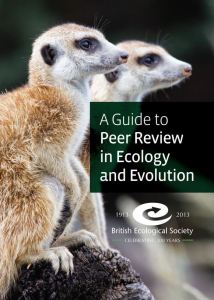
The BES Guide to Peer Review in Ecology and Evolution

Before we dive into the tips from our Editors though, we want to highlight one of the best resources for anyone looking for peer review guidance – the BES Guide to Peer Review in Ecology and Evolution. This booklet is intended as a guide for Early Career Researchers, who have little or no experience of reviewing journal articles but are interested in learning more about what is involved. It provides a succinct overview of the many aspects of reviewing, from hands-on practical advice about the actual review process to explaining less tangible aspects, such as reviewer ethics. You can get the PDF version of the guide (and the other BES guides) for free on the BES website. Continue reading “What Makes a Good Peer Review: Peer Review Week”

Peer review week: Encouraging collaborative peer review

Post from Managing Editor Emilie Aimé. Check out the methods.blog later in the week for some of the Methods in Ecology and Evolution Associate Editors’ perspective on collaborative peer review. It’s Peer Review Week 2016 and the BES journals are celebrating with a series of blog posts on how much we value our reviewers. Here at the BES we love Early Career Researchers. We give out grants… Continue reading Peer review week: Encouraging collaborative peer review

Thank You to All of Our Reviewers: Peer Review Week 2016

As many of you will already know, this week is Peer Review Week (19-25 September). Peer Review Week is a global event celebrating the vital work that is done by reviewers in all disciplines. To mark the week, we will be having a series of blog posts about peer review. The theme for this year’s Peer Review Week is recognition for review and we’re starting … Continue reading Thank You to All of Our Reviewers: Peer Review Week 2016

Issue 7.9

Issue 7.9 is now online!

The September issue of Methods is now online!

This month’s issue contains two Applications articles and three Open Access articles, all of which are freely available.

– Arborist Throw-Line Launcher: A cost-effective and simple alternative for collecting leaves and seeds from tall trees. The authors have also provided some tutorial videos on YouTube.

– ctmm: An R package which implements all of the continuous-time stochastic processes currently in use in the ecological literature and couples them with powerful statistical methods for autocorrelated data adapted from geostatistics and signal processing.

Continue reading “Issue 7.9”

New Associate Editor: Marie Auger-Méthé

Today, we are pleased to be welcoming a new member of the Methods in Ecology and Evolution Associate Editor Board. Marie Auger-Méthé joins us from Dalhousie University in Canada and you can find out a little more about her below.

Marie Auger-Méthé

Marie Auger-Méthé

“I am broadly interested in developing and applying statistical tools to infer behavioural and population processes from empirical data. My work tends to focus on marine and polar mammals, but the methods I develop are often applicable to a wide range of species and ecosystems. My recent work has centred on modelling animal behaviour using movement data and I generally analyse data with spatial and/or temporal structure.”

Marie has been reviewing for Methods in Ecology and Evolution for a few years and has contributed articles to some of the other journals of the British Ecological Society too. Earlier this month, her article titled ‘Evaluating random search strategies in three mammals from distinct feeding guilds‘ was published in the Journal of Animal Ecology. Continue reading “New Associate Editor: Marie Auger-Méthé”

New Associate Editors

Today we are welcoming two new Associate Editors to Methods in Ecology and Evolution: Samantha Price (University of California, Davis, USA) and Andrés Baselga (University of Santiago de Compostela, Spain). Samantha Price “My research seeks to answer the question ‘What regulates biodiversity?’. I use phylogenetic and comparative methods to investigate the abiotic and biotic drivers of global patterns of ecomorphological and lineage diversity over long periods of time and across … Continue reading New Associate Editors

moveHMM: An Interview with Théo Michelot

David Warton (University of New South Wales) interviews Théo Michelot (University of Sheffield) about an article on his recent R package moveHMM in Methods in Ecology and Evolution. David and Théo also discuss the case study in the paper – on the understudied wild haggis – and what advances could be made to the package in future.

Continue reading “moveHMM: An Interview with Théo Michelot”

Exploring Microbial Diversity: From the Sequence to the Cell

Post provided by Ruben Props, Michelle Berry, Marian Schmidt, Frederiek-Maarten Kerckhof, Vincent Denef and Nico Boon

Searching Lake Michigan (USA) for uncharacterized microbial diversity. © Michelle Berry

Exploring microbial diversity and relating it to ecosystem functions is one of the primary occupations of microbiologists and microbial ecologists worldwide. Unfortunately, recent studies have shown that the microbial census is far from complete and that it is heavily biased towards certain (host-associated) environments. With the Earth’s microbial diversity estimated at an impressive one trillion (1012) taxa, the search continues for new technologies and methodologies that may help us better describe, monitor and preserve the microbial diversity of our planet’s natural and engineered ecosystems.

Continue reading “Exploring Microbial Diversity: From the Sequence to the Cell”

New Associate Editor: Michael Morrissey

Today, we are pleased to be welcoming a new member of the Methods in Ecology and Evolution Associate Editor Board. Michael Morrissey joins us from the University of St Andrews in Scotland and you can find out a little more about him below.

Michael Morrissey

“I am an evolutionary quantitative geneticist. I am interested in the selection, genetics, and evolutionary trajectories of traits in natural populations. I typically work at the interface of statistics, evolutionary theory, and empirical problems.”

Michael has been an active reviewer for Methods for the past few years and has provided excellent comments and recommendations on a number of papers. He also had an article – ‘In search of the best methods for multivariate selection analysis‘ – published in the journal in 2014 (which will become freely available in October this year).
Continue reading “New Associate Editor: Michael Morrissey”

Creating Bigger, Better and More Joined-up Habitat Networks

Below is a press release about the Methods paper ‘How to manipulate landscapes to improve the potential for range expansion‘ taken from the University of Liverpool.

©Bidgee
©Bidgee

Scientists at the University of Liverpool have developed a new ‘route planner’ tool that could help conservationists aid the movement of species as they adapt to a changing climate.

The environmental ranges of many animal and plant species are starting to alter with climate change, as temperatures change and force species to migrate to more suitable climes.

To be able to do this successfully, they will need sufficient habitat in their existing range, their future range, and any intermediate areas to enable populations to survive and thrive. Many conservation initiatives to restore habitats and increase connectivity are trying to address this issue. However, existing modelling tools mainly treat the landscape as static, and it is difficult to use these to plan restoration. Continue reading “Creating Bigger, Better and More Joined-up Habitat Networks”