David Warton (University of New South Wales) interviews Marie-Josee Fortin (University of Toronto) about a recent article on state-and-transition models from her group in Methods in Ecology and Evolution. David and Marie-Josee also discuss what motivated her career to date in spatial ecology, and what she sees as the main advances in this area and current challenges in the field.
This month’s issue contains two Applications articles and two Open Access articles, all of which are freely available.
– MO-Phylogenetics: A software tool to infer phylogenetic trees optimising two reconstruction criteria simultaneously and integrating a framework for multi-objective optimisation with two phylogenetic software packages.
– PHYLOMETRICS: An efficient algorithm to construct the null distributions (by generating phylogenies under a trait state-dependent speciation and extinction model) and a pipeline for estimating the false-positive rate and the statistical power of tests on phylogenetic metrics..
A model that predicts outbreaks of zoonotic diseases – those originating in livestock or wildlife such as Ebola and Zika – based on changes in climate, population growth and land use has been developed by a UCL-led team of researchers.
We wanted to test whether arboreal mammals were using natural canopy bridges – connections between tree branches over a clearing – to travel over a natural gas pipeline in the Peruvian Amazon. The challenge was figuring out how to monitor branches 100 feet up in the tree tops. In this case, the clearing was a 30-foot-wide pipeline path, and we expected arboreal mammals – like monkeys, squirrels and porcupines – to prefer crossing on the branches rather than on the ground. The ground is an unfamiliar and often dangerous place for an animal that’s spent its life way up in the canopy.
The yellow arrow shows the path captured by the camera trap.
In fact, we wondered if without branches, would arboreal mammals cross at all? How could we find out if animals were using the branches? There were 13 canopy bridges and finding a person to sit and wait all day (and night) under each of them for animals to cross wasn’t an option. With our goal of a year’s worth of monitoring, we had a conundrum. We needed a more efficient way to gather the data and concluded that camera traps – motion sensitive cameras – could be an excellent way to monitor the bridges continuously and remotely.
But, we discovered that no one had ever really used camera traps in the high canopy before. How were we going to get them all the way up there? If we were able to get up to the canopy, how could we make sure they were taking photos of the correct points where animals would potentially cross? Continue reading “Canopy Camera Trapping: Heightening Our Knowledge of Arboreal Mammals”
At the last ISEC, in Montpellier in 2014, an informal survey suggested that Methods in Ecology and Evolution was the most cited journal in talks. This reflects the importance of statistical methods in ecology and it is one reason for the success of the journal. For this year’s International Statistcal Ecology Conference in Seattle we have produced a virtual issue that presents some of our best recent papers which cross the divide between statistics and ecology. They range over most of the topics covered at ISEC, from statistical theory to abundance estimation and distance sampling.
We hope that Methods in Ecology and Evolution will be equally well represented in talks in Seattle, and also – just as in Montpellier – some of the work presented will find its way into the pages of the journal in the future.
Our 5th Anniversary Special Feature is a collection of six articles (plus an Editorial from Executive Editor Rob Freckleton) that highlights the breadth and depth of topics covered by the journal so far. It grew out of our 5th Anniversary Symposium – a joint event held in London, UK and Calgary, Canada and live-streamed around the world in April 2015 – and contains papers by Associate Editors, a former Robert May prize winner and regular contributors to the journal.
The six articles are based on talks given at last May’s Symposium. They focus on:
In his Editorial for the Special Feature, Rob Freckleton looks to the future. In his words: “we hope to continue to publish a wide range of papers on as diverse a range of topics as possible, exemplified by the diversity of the papers in this feature”.
As a consequence of human activities the global climate is changing at a rate that is unprecedented in at least the past few centuries, leading to the suggestion that this era should be referred to as the “Anthropocene”. While climate hind-casting and pollen histories in sediments are advancing our understanding of how past ecological ecosystems responded to previous climate changes, forecasting power really depends on how accurately we can predict ecosystem functions that are likely to change in the future.
Despite substantial recent advances in our ability to predict climate change, considerable uncertainty remains – especially in our understanding of how ecosystem functioning could be influenced by climate change and how this may feed back to affect greenhouse-gas fluxes. The decomposition of organic matter in leaf litter and soils accounts for a global flux that is approximately 7 times as large as global anthropogenic emissions. Understanding how climate change will affect carbon held in dead organic matter pools – including leaf litter, woody debris and soil organic carbon – is essential.
Decomposition and Why it Matters
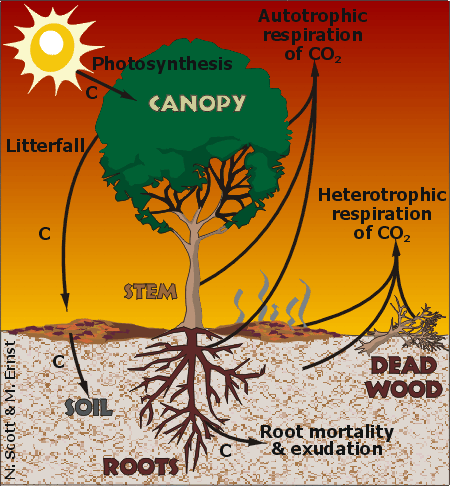
Carbon cycle summary. Note this focuses only in forested or terrestrial ecosystem.
Decomposition is defined as the “physical, chemical and biological mechanisms that transform organic matter into increasingly stable forms” in plant detritus. However, only small part of carbon goes through this process. Most of dead organic matter becomes CO2. Decomposition of organic matter is important because of its link to the global carbon cycle. Simply stated, the carbon cycle consists of carbon inputs via photosynthesis and outputs via respiration. However, while photosynthesis is relatively well studied and understood, respiration – including that of living organisms (autotrophy) and of dead ones (heterotrophy) – is understudied. As a consequence, our understanding of decomposition is much less sophisticated. A substantial amount of greenhouse-gas (CO2, CH4, N2O) production occurs either directly or indirectly from organic matter decomposition, including woody debris. Similar amounts of CO2 efflux exist between fluxes from woody debris decomposition (8.6 Pg yr-1) and fossil fuel burning (9.6 Pg yr-1). So we desperately need a reliable technique to quantify CO2 from decomposition. Continue reading “CO2 Efflux Rates from Dead Organic Matter: Get It Right”
Friday was Endangered Species Day – so this is a good time to reflect on what science and scientists can do to support conservation efforts and to reduce the rate of species extinctions. One obvious answer is that we need to study endangered species to understand their habitat requirements as well as their potential for acclimatization and adaptation to changing environmental conditions. This information is crucial to for the design of informed conservation planning. However, for most endangered species the relevant phenotypes are not known a priori, which leaves the well-intentioned scientist asking “which traits should I measure?”. Transcriptome analysis is often a good way to answer to this question.
Our understanding of how biological diversity works has been advanced by a long history of observing species and linking patterns to ecological processes. However, we generally don’t focus as much on those species that aren’t observed, or in other words ‘absent species’. But, can absent species provide valuable information?
To begin learning about dark diversity, there are two important terms that we need to define: ‘species pool’ and ‘focal community’. A ‘species pool’ is a set of species present in a particular region or landscape that can potentially inhabit a particular observed community because of suitable local ecological conditions.
A ‘focal community’ is the set of species that have been observed in a particular region or landscape (this is the ‘observed community’ and can also be referred to as alpha diversity). For a given focal community to become established, the species within it must have overcome dispersal pressures as well as environmental and biotic filters.





 Methods Blog