Fish and invertebrates predominantly or exclusively detect particle motion.
A growing number of studies on the behaviour of aquatic animals are revealing the importance of underwater sound, yet these studies typically overlook the component of sound sensed by most species: particle motion. In response, researchers from the Universities of Bristol, Exeter and Leiden and CEFAS have developed a user-friendly introduction to particle motion, explaining how and when it ought to be measured, and provide open-access analytical tools to maximise its uptake. Continue reading “The Overlooked Commotion of Particle Motion in the Ocean”
Today we are welcoming three new Associate Editors to Methods in Ecology and Evolution: Nick Golding (University of Melbourne, Australia), Rachel McCrea (University of Kent, UK) and Francesca Parrini (University of the Witwatersrand, South Africa). They have all joined on a three-year term and you can find out more about them below. Nick Golding “I develop statistical models and software for mapping the distributions of species and diseases. I’m particularly interested in … Continue reading New Associate Editors
The February issue of Methods is now online! As you may have seen already, it includes the BES cross-journal Special Feature: “Demography Beyond the Population“. There are also eight other wonderful articles to read.
In demography, a set of processes (survival, growth, fecundity, etc.) interacts to produce observable patterns (population size, structure, growth rate, etc.) that change over time. With traditional approaches you follow the individuals of a population over some timespan and track all of these processes.
Demographic patterns and processes (Click to expand)
However, depending on the organism, some processes may be very hard to quantify (e.g. mortality or recruitment in animals or plants with long lifespans). You may have observed the patterns for the organism that you’re studying and, even better, measured some, but not all, of the processes. The question is: can we use this limited information to estimate the processes we couldn’t measure?Continue reading “Inverse Modelling and IPMs: Estimating Processes from Incomplete Information”
Back in 1997 MR was awarded a travel grant from CSIRO to visit Andy Sheppard in Canberra. CSIRO had been collecting detailed long-term demographic data on several plant species and Andy was keen to develop data-driven models for management.
Andy decided Illyrian thistle (Onopordum Illyricum) would be a good place to start, as this was the most complicated in terms of its demography. The field study provided information on size, age and seed production. The initial goal was to quantify the impact of seed feeders on plant abundance, but after a few weeks of data analysis it became apparent that the annual seed production per quadrat was huge (in the 1000s) but there were always ~20 or so recruits. This meant that effects of seed feeders (if any) occurred outside the range of the data, which wasn’t ideal for quantitative prediction.
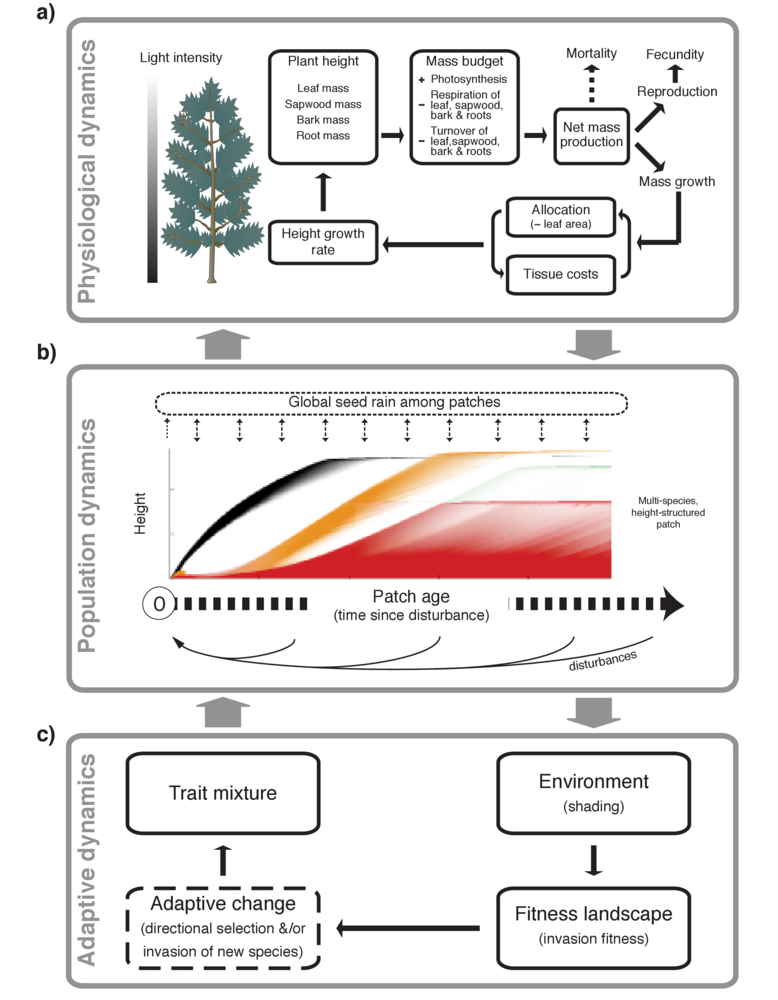
Our paper in Methods in Ecology and Evolution describes a new software package, plant. plant is an individual-based simulation model that simulates the growth of individual trees, stands of competing plants, or entire metacommunities under a disturbance regime, using common physiological rules and trait-based functional trade-offs to capture differences among species.
Non-Linear Processes and Thousands of Plants
Since the development of gap models in the 1970s (e.g. Botkin 1972), researchers have been using computer simulations to investigate how elements of plant biology interact with competition and disturbance regimes to influence vegetation demography, structure and diversity. Simulating the competitive interactions among many thousands of plants, however, is no easy task.
Despite widespread recognition of the importance of key non-linear processes — such as size-structured competition, disturbance, and trait-based trade-offs — for vegetation dynamics, relatively few researchers have been brave (or daft) enough to try and incorporate such processes into their models. The situation is most extreme in theoretical ecology, where much contemporary theory (e.g. coexistence theory, neutral theory) is still built around completely unstructured populations.
Features of plant
Key processes modelled within the plant package.
The plant package attempts to change that by providing an extensible, open source framework for studying trait-, size- and patch-structured dynamics. One thing that makes the plant model significant is the focus on traits. plant is one of several attempts seeking to integrate current understanding about trait based trade-offs into a model of individual plant function (see also Moorcroft et al 2001, Sakschewski et al 2015).
A second feature that makes the plant software significant, is it that is perhaps the first example where a computationally intensive model has been packaged up in a way that enables widespread usage, makes the model more usable and doesn’t sacrifice speed.
“Demography Beyond the Population” is a unique Special Feature being published across the journals of the British Ecological Society. The effort evolved from a symposium of the same name hosted in Sheffield, UK last March. Both the meeting and the Special Feature were designed to challenge ecologists from a range of fields whose research focuses on populations.
The participants were charged with sharing how they are pushing the work they do beyond the stage where the population is the focus into research where the population is just the beginning and the focus spans scales, systems and tools. This encompasses a broad suite of biological research, including range modelling, disease impacts on communities, biogeochemistry, evolutionary theory, and conservation biology. The meeting was a great success, and this Special Feature should be equally valuable to the broad readership of the BES journals.
Methods in Ecology and Evolution has a special place in the Special Feature, hosting four papers. These papers not only introduce new efforts in population biology, they provide the methods that other scientists can use to implement them. With the tools provided by these four papers, researchers will be able to advance forest modelling, evolutionary theory, climate change biology and statistical inference of hidden population parameters. Seriously good stuff! Continue reading “Methods Beyond the Population”
iMarCo is a new initiative aimed at creating an international network for promoting collaborative projects among European scientists interested in the study of marine connectivity. The network covers a broad spectrum of marine science disciplines including physical oceanography, microchemistry, genetics and evolutionary ecology, behaviour, tagging, fisheries and aquaculture.
Register for FREE for the first ever BES Publishing webinar based on our forthcoming Demography Beyond the Population Special Feature.
This hour long webinar will begin at 1pm (GMT) on Tuesday 1 March. It highlights some of the excellent articles soon to be published in the British Ecological Society journals Special Feature entitled “Demography Beyond the Population”. The Special Feature is a collaborative effort including articles in all six BES journals. This is the first time such a large ecological collaboration has been attempted worldwide. Using a cross-journal approach has allowed us to highlight the strongly interdisciplinary nature of the field of demography to its fullest potential as well as to lay down the foundations for future directions at the interface of ecology, evolution, conservation biology and human welfare. The webinar has several international speakers and will discuss the articles in the Special Feature and the implications for demography research going forward. Continue reading “Demography Beyond the Population Webinar: Register for Free Now”






 Methods Blog