By Methods in Ecology and Evolution Executive Editor Aaron M. Ellison A recent Practical Tools article published in Methods in Ecology & Evolution described a foot snare used to capture jaguars and cougars in Brazil (Ribeiro de Araujo et al. 2021a). Within hours of the posting of the proofed version of the article on the Early View section of the journal’s website, comments on Twitter … Continue reading On foot snares and felids
Species identification is an essential tool for recording biodiversity, especially in an era of habitat loss and climate change. Developing skills to correctly identify plants to a species or even a genus level can take many years of training, but a new app called Flora Incognita aims to empower citizens with botanical expertise while also collecting data for scientific analysis.
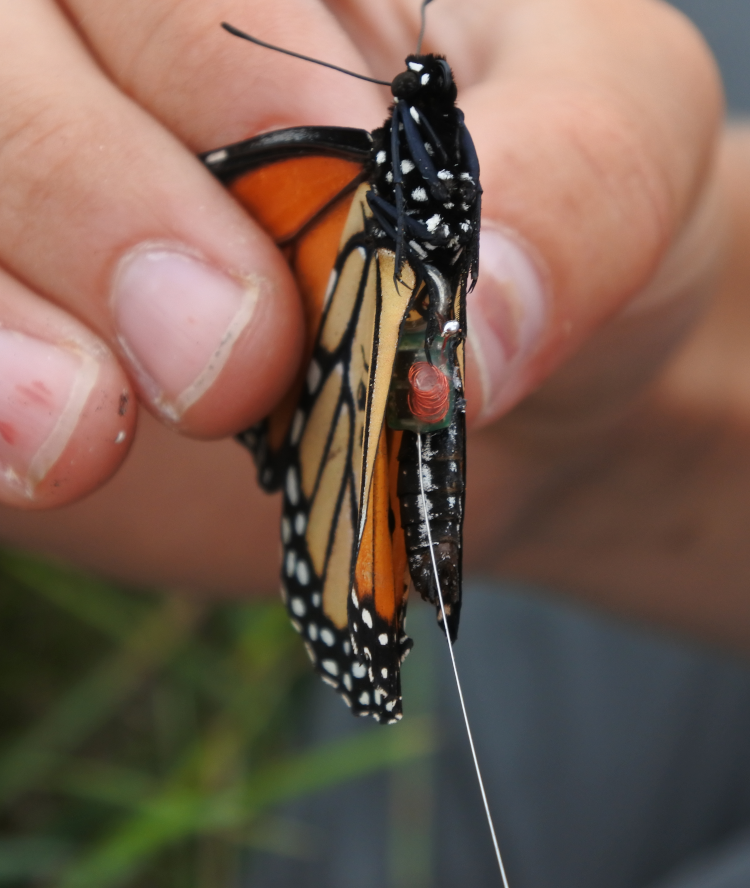
LB-2X transmitter attached to a monarch butterfly.
Understanding animal movement across varying spatial and temporal scales is an active area of fundamental ecological research, with practical applications in the fields of conservation biology and natural resource management. Advancements in tracking technologies, such as GPS and satellite systems, allow researchers to obtain more location information for a variety of species than ever before. It’s an exciting time for movement ecologists! However, entomologists studying insect movement are still limited because of the large size of tracking devices relative to the small size of insects.
In this post Thomas White and Laura Graham, two of our Associate Editors with expertise in Application articles, highlight their favourite of our papers about R packages.
In this post, three of our Associate Editors with expertise in acoustic monitoring, Sarab Sethi, Camille Desjonquèresand Lian Pin Koh, select their favourite MEE papers in this field.