boral: R package for multivariate data analysis in Ecology

In this video Francis Hui introduces boral, a new R package he developed for Bayesian analysis of multivariate data in ecology. It uses Bayesian MCMC estimation to fit latent variable models for unconstrained ordination (read the MEE paper, Model-based approaches to unconstrained ordination, for details), and for multi-species inference while accounting for inter-species correlation: Download boral from CRAN Read the MEE paper Model-based approaches to … Continue reading boral: R package for multivariate data analysis in Ecology

Open Access Week 2014

Once more Open Access Week has rolled around. At MEE we operate a hybrid model: although we are a subscription journal, authors can choose to make their papers open access (for a price – sorry). Over the past year, 21 papers have been published as open access (listed here). They span the range of topics we cover, including citizen science, using cell phones, and asking … Continue reading Open Access Week 2014

Graybill/ENVR 2014 – highlights, current trends and what’s next

In this video David Warton interviews the organisers of the “Modern Statistical Methods for Ecology” Graybill/ENVR Conference (Sept 7-10 2014, Fort Collins) – Alix Gitelman, Geof Givens, and Janine Illian.  They discuss highlights of the conference, current trends in statistical ecology, and where the Graybill conference series (organised at Colorado State every year) is going next. Continue reading Graybill/ENVR 2014 – highlights, current trends and what’s next

Are your analyses too fancy?

In this video David Warton interviews Ben Bolker, Professor in Theoretical and Statistical Ecology at McMaster University and maintainer of the lmer package, and Mark Brewer, Principal Consultant for Ecology and Environmental Science at BioSS, Scotland. They discuss the tendency to develop and use big fancy analyses that are in some applications unnecessarily complex, why it happens, and what can be done about it. Look … Continue reading Are your analyses too fancy?

Ecology in China

At MEE we are looking to publish the best methodological papers. It is no surprise, then, that we are able to contribute several papers to this ‘Ecology in China’ Virtual Issue. The topics covered range from an elegant new way of using very old technology (Zhao et al.) to methods based on next generation sequencing to investigate biodiversity (for example Liu et al.). It is … Continue reading Ecology in China

Kinect connects for mangroves research

Here is a video and press release about the recent Methods paper, ‘Investigating three-dimensional meso-scale habitat complexity and its ecological implications using low-cost RGB-D sensor technology‘, taken from Griffith University:


Motion sensing technology, best known in computer games, is vastly improving Queensland scientists’ ability to quantify habitat complexity in mangroves.

The Kinect line of devices developed by Microsoft for Xbox consoles and Windows PCs is marrying gaming technology with ecological research to deliver precise three-dimensional data in greater efficiency and at a fraction of the cost of current imaging techniques.

At Griffith University’s Australian Rivers Institute (ARI) on the Gold Coast, Professor Joe Lee, Dr Jan Warnken and Higher Degree Research student Ms Shafagh Kamal have been Continue reading “Kinect connects for mangroves research”

Ecological statistics are methods too!

Methods in Ecology and Evolution has been publishing papers on statistical ecology since its inception in 2010. Since the last ISEC meeting, we have published many more papers, of an increasing quality and influence. We have put together a Virtual Issue to showcase some of those papers (but it also misses out many more that will be just as interesting)!. The papers chosen show the … Continue reading Ecological statistics are methods too!

Enhanced articles (HTML)

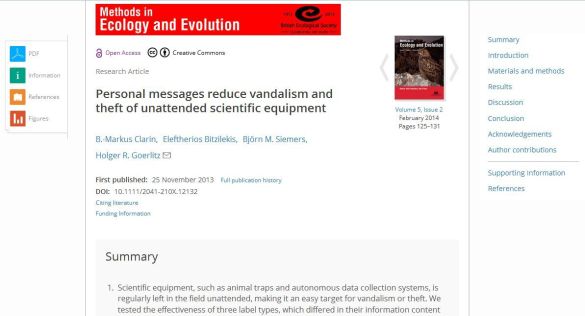
Wiley have just launched the Anywhere Article, which is an enhanced version of the HTML article. It allows readers to view an article on any device – whether at a desktop, or on the move with a tablet or smart phone, and it includes a host of useful new features.

Anywhere article example

Here are a few of the features that an Anywhere Article offers:
o Superfluous information is kept tucked away under a hyperlink, which you can click on for further information if you choose e.g. an author’s contact information and links to any of their previous publications stored on Wiley Online Library.
o There’s a panel on the left-hand side of the screen where you can view the article information, the reference list, download a PDF, and open the interactive figure viewer.
o There’s a menu on the right-hand side of the screen that lets you skip between sections.
o If you click on a reference within the article, the full details will pop-up in the left-hand panel, along with links to the abstract online, and details of it’s previous citations.
o You can open figures in the figure viewer, which allows you to zoom in, download as a Continue reading “Enhanced articles (HTML)”